Cells and Immunity
Week 3
Phil Dash
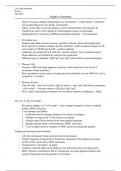
Adaptive Immunity
- Innate recognises antigen and phasgocytose [immediate = within hours] = ineffienct/
not enough phagocytes for speedy containment.
- Innate system able to activate adaptive system; Natural killer cells [innate]/ B
lymphocytes and T cells [Adaptive]. Heterogenous [stages of maturation
distinguished by expression of different membrane proteins – CD molecules]
1. B lymphocytes;
- Produce and mature in bone marrow/ circulate in blood/ spleen and lymph nodes
- Role; specific as produce antigen-specific antibodies which recognise antigens via B
cell receptors [150,000 per B cell] = surface antibody.
- Antibodies are produced by B cells for 1 specific epitope. They neutralise toxins/
block adhesion/ cell ineffictivity and prevents replication
- Different types of antibody; IgM/ IgG/ IgA/ IgE [which bind to exposed epitopes]
2. Plasma Cells;
- Extensive RER and Golgi appartus [secretory cells] which have low levels of
membrane bound antibodies.
- Role; production and secretion of antign-specific antibodies [secrete 2000 Ab a cell a
second for 1-2 weeks]
3. Memory B cells;
- Niave B cells – don’t have IgM or IgD on surface = only cells which have undergone
“class switch” = become memory cells [IgA/ IgG/ IgE]
- Role; confer immunological memory for secondary response of pathogen = rapid.
How are T cells Activated?
- Recognise antigen via T cell recepto – only recognise antigens in form of peptide
bond to MHC molecules.
- T cell epitopes are hidden:
1. Antibodies bind to epitopes displayed on surface of antigens
2. Epitopes recongined by T cell recpeors are buried
3. Antigen must first be broken down into peptide fragments
4. Epitope peptide binds to self-molecules [MHC molecule]
5. T cell receptor binds to complex of MHC molecule and epitope peptide.
Antigen processing and presentation;
- All cells continously break down proetins in proteasome
- Peptide fragments transported by transporter associated with antigen processing
[TAP] in ER which bind to MHC molecules
- Transported to cell surface via golgi
- Antigenic material taken up bia phagocytosis and broken down in phagosomes
- MHC molcules assembled in ER are transported via Golgi appartus [loaded with
antigen fragments] and transported to cell surface.
Week 3
Phil Dash
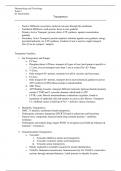
Adaptive Immunity
- Innate recognises antigen and phasgocytose [immediate = within hours] = ineffienct/
not enough phagocytes for speedy containment.
- Innate system able to activate adaptive system; Natural killer cells [innate]/ B
lymphocytes and T cells [Adaptive]. Heterogenous [stages of maturation
distinguished by expression of different membrane proteins – CD molecules]
1. B lymphocytes;
- Produce and mature in bone marrow/ circulate in blood/ spleen and lymph nodes
- Role; specific as produce antigen-specific antibodies which recognise antigens via B
cell receptors [150,000 per B cell] = surface antibody.
- Antibodies are produced by B cells for 1 specific epitope. They neutralise toxins/
block adhesion/ cell ineffictivity and prevents replication
- Different types of antibody; IgM/ IgG/ IgA/ IgE [which bind to exposed epitopes]
2. Plasma Cells;
- Extensive RER and Golgi appartus [secretory cells] which have low levels of
membrane bound antibodies.
- Role; production and secretion of antign-specific antibodies [secrete 2000 Ab a cell a
second for 1-2 weeks]
3. Memory B cells;
- Niave B cells – don’t have IgM or IgD on surface = only cells which have undergone
“class switch” = become memory cells [IgA/ IgG/ IgE]
- Role; confer immunological memory for secondary response of pathogen = rapid.
How are T cells Activated?
- Recognise antigen via T cell recepto – only recognise antigens in form of peptide
bond to MHC molecules.
- T cell epitopes are hidden:
1. Antibodies bind to epitopes displayed on surface of antigens
2. Epitopes recongined by T cell recpeors are buried
3. Antigen must first be broken down into peptide fragments
4. Epitope peptide binds to self-molecules [MHC molecule]
5. T cell receptor binds to complex of MHC molecule and epitope peptide.
Antigen processing and presentation;
- All cells continously break down proetins in proteasome
- Peptide fragments transported by transporter associated with antigen processing
[TAP] in ER which bind to MHC molecules
- Transported to cell surface via golgi
- Antigenic material taken up bia phagocytosis and broken down in phagosomes
- MHC molcules assembled in ER are transported via Golgi appartus [loaded with
antigen fragments] and transported to cell surface.