Birds
Week 5
Chris Foster
Bird Senses
Bird Brains;
- Large compared to skill size
- Main features similar to mammalian brains; medulla oblongata [brain stem] / optic
lobes [large] / cerebellum [large = muscular coordination/ posture/flight] / cerebral
hemispheres [coordinate complex behavior/ largest in mammals] / olfactory lobes
[small]
Vision;
- Most important sense / wide
colour spectrum / range of
speed and accommodation /
monocular vision with wide
field / Binocular vision in owls
and raptors = narrower field
- Accommodation; able to
continually refocus [watch prey
whilst descending]
- Penguins have myopic [evolved
for hunt/navigation underwater]
/ hornbill = long, narrow,
binocular vision.
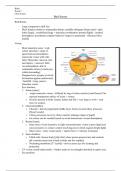
- Eye structure;
1. Sclera [outer];
o tough connective tissue / stiffened by ring of sclera ossicles [small bones] The
exposed transparent surface of sclera = cornea.
o Ossicles present in birds, lizards, turtles and fish // very large in owls = cant
move in sockets.
2. Choroid [middle];
o Choroid = heavily pigmented middle layer, forms iris and ciliary processes
[blood vessels]
o Ciliary processes move by ciliary muscles [changes shape of pupil]
o Iris colour can be variable based on social interactions/ sexual dimorphism.
3. Retina [inner];
o Inner layer of rods [sensitive to light/ monochromatic vision in poor light] and
cones [sensitive to colour/ control resolving power which requires bright light]
o More cones = more visual acuity // raptors have x 5 density to humans
4. Inner chamber;
o Filled with vitreous body [jelly-like] where pecten projects into and controls
pH/ nourish retina [only found in birds and few reptiles]
o Nictitating membrane [3rd eyelid] = moves across eye for cleaning and
protection
- UV vision; tested behaviorally // further study on wavelengths absorbed in raptor eyes
- Eye position;
, Birds
Week 5
Chris Foster
o Monocular vision; limited depth perception [behind head cocking and head
bobbing]
o Limited binocular vision. / pigeons bob heads/ 360 In woodcock.
- Visual Fields;
o Foveae regions in eye = cones tightly packed / 1 foveae = 1 eye
o Hawks have 2 foveae per eye; central [sharp binocular vision] and temporal
[for sharp monocular vision] = can focus on 3 areas at once = hunting.
Bird Hearing;
- Similar peak sensitivity to humans / discern fine temporal structure [bird song musical
If at lower speed] of complex sounds / echolocation
- Ears are behind facial disk / not visible
- Structure;
o Outer/middle/inner [similar to mammals] / columella=
single middle ear bone which transmits vibrations to
inner ear.
- Owls; asymmetric ear canals [direction on 2 planes] =
accurate prey location.
Bird Taste;
- Taste buds are few [chicken; 24/ mallard; 400 / human; 10k] / no tastebuds on tongue
= manipulating food and sounds.
Bird Olfaction;
- Large in vultures/ petrels/ snipes/ kiwis = correlates
to size of olfactory lobe
- Tubenoses [procellariforms] use smell to locate food/
navigation/ mate recognition.
- Nasal cavity structure;
o Nostrils open into nasal cavities
o Septum; perforated [better for detecting
smells] or imperforate [navigation]
o Conchae covered in mucus secreting
membrane with olfactory nerves embedded /
warms air and traps dust.
Bird Physiology
Homeostasis;
- Must regulate water/ salt/ temperature/ pH/ nutrient levels/ O2 levels
1. Water and Salt;
Week 5
Chris Foster
Bird Senses
Bird Brains;
- Large compared to skill size
- Main features similar to mammalian brains; medulla oblongata [brain stem] / optic
lobes [large] / cerebellum [large = muscular coordination/ posture/flight] / cerebral
hemispheres [coordinate complex behavior/ largest in mammals] / olfactory lobes
[small]
Vision;
- Most important sense / wide
colour spectrum / range of
speed and accommodation /
monocular vision with wide
field / Binocular vision in owls
and raptors = narrower field
- Accommodation; able to
continually refocus [watch prey
whilst descending]
- Penguins have myopic [evolved
for hunt/navigation underwater]
/ hornbill = long, narrow,
binocular vision.
- Eye structure;
1. Sclera [outer];
o tough connective tissue / stiffened by ring of sclera ossicles [small bones] The
exposed transparent surface of sclera = cornea.
o Ossicles present in birds, lizards, turtles and fish // very large in owls = cant
move in sockets.
2. Choroid [middle];
o Choroid = heavily pigmented middle layer, forms iris and ciliary processes
[blood vessels]
o Ciliary processes move by ciliary muscles [changes shape of pupil]
o Iris colour can be variable based on social interactions/ sexual dimorphism.
3. Retina [inner];
o Inner layer of rods [sensitive to light/ monochromatic vision in poor light] and
cones [sensitive to colour/ control resolving power which requires bright light]
o More cones = more visual acuity // raptors have x 5 density to humans
4. Inner chamber;
o Filled with vitreous body [jelly-like] where pecten projects into and controls
pH/ nourish retina [only found in birds and few reptiles]
o Nictitating membrane [3rd eyelid] = moves across eye for cleaning and
protection
- UV vision; tested behaviorally // further study on wavelengths absorbed in raptor eyes
- Eye position;
, Birds
Week 5
Chris Foster
o Monocular vision; limited depth perception [behind head cocking and head
bobbing]
o Limited binocular vision. / pigeons bob heads/ 360 In woodcock.
- Visual Fields;
o Foveae regions in eye = cones tightly packed / 1 foveae = 1 eye
o Hawks have 2 foveae per eye; central [sharp binocular vision] and temporal
[for sharp monocular vision] = can focus on 3 areas at once = hunting.
Bird Hearing;
- Similar peak sensitivity to humans / discern fine temporal structure [bird song musical
If at lower speed] of complex sounds / echolocation
- Ears are behind facial disk / not visible
- Structure;
o Outer/middle/inner [similar to mammals] / columella=
single middle ear bone which transmits vibrations to
inner ear.
- Owls; asymmetric ear canals [direction on 2 planes] =
accurate prey location.
Bird Taste;
- Taste buds are few [chicken; 24/ mallard; 400 / human; 10k] / no tastebuds on tongue
= manipulating food and sounds.
Bird Olfaction;
- Large in vultures/ petrels/ snipes/ kiwis = correlates
to size of olfactory lobe
- Tubenoses [procellariforms] use smell to locate food/
navigation/ mate recognition.
- Nasal cavity structure;
o Nostrils open into nasal cavities
o Septum; perforated [better for detecting
smells] or imperforate [navigation]
o Conchae covered in mucus secreting
membrane with olfactory nerves embedded /
warms air and traps dust.
Bird Physiology
Homeostasis;
- Must regulate water/ salt/ temperature/ pH/ nutrient levels/ O2 levels
1. Water and Salt;