BTEC Level 3 National Extended Business Studies | Unit 1: Exploring Businesses
A.P1 – Describe the Features of Two Contrasting Businesses
The Features of a Business
In this task I will be exploring the features of a PLC: Public Limited Company and a
Non-For-Profit Organisation. I will be exploring the History, Ownership, Liability,
Purpose and Industrial Sector of the two contrasting organisations.
Tesco PLC
Introduction
As a leading UK retailer Tesco’s boast over 6,300
stores worldwide. As such a big retailer Tesco’s
have promised to be committed in order to
deliver goods that have a sustainable value for
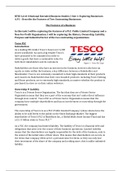
both their stakeholders and its customers. Figure 1 – Tesco PLC Logo
Stakeholders are those who have an interest in the business, however also have an
equity or stake within the business, a key difference between a Stakeholder and
Shareholder. Tesco’s are extremely committed to their high standards of their products
and ensures its Stakeholders that their own-branded products: including Food, Clothing
and Home products, are to extremely high standards, no matter whether the product is
purchased in-store or on their online webstore.
Ownership & Liability
Tesco’s is a Private Sector Organisation. The fact that they are a Private Sector
Organisation mean that they are a part of the economy that isn’t under direct influence
through state control. Tesco PLC as a Private Sector Organisation means that the
company have multiple shareholders and has no involvement or ownership through the
government.
The ownership of Tesco’s is as a PLC (Public Limited Company) whose shares have the
ability to be sold freely to the public on the Stock Exchange Market. The biggest
shareholder of Tesco’s PLC is BlackRock Inc., a Global Multi-Asset Income Fund and has
a £1.13 billion stake in Tesco PLC.(a)
As a PLC, the company has limited liability. The liability of Tesco’s is financial debt and
obligations that arise over the course of their business operations. Limited Liability
means that the shareholders are legally responsible for the debt of the business, only to
the extent of the initial value of their share. This means that shareholders are secure, in
the terms that company debts aren’t a personal issue for them, so they can only lose
their investment of the share of the company and nothing more, this is unlike unlimited
liability.
A.P1 – Describe the Features of Two Contrasting Businesses
The Features of a Business
In this task I will be exploring the features of a PLC: Public Limited Company and a
Non-For-Profit Organisation. I will be exploring the History, Ownership, Liability,
Purpose and Industrial Sector of the two contrasting organisations.
Tesco PLC
Introduction
As a leading UK retailer Tesco’s boast over 6,300
stores worldwide. As such a big retailer Tesco’s
have promised to be committed in order to
deliver goods that have a sustainable value for
both their stakeholders and its customers. Figure 1 – Tesco PLC Logo
Stakeholders are those who have an interest in the business, however also have an
equity or stake within the business, a key difference between a Stakeholder and
Shareholder. Tesco’s are extremely committed to their high standards of their products
and ensures its Stakeholders that their own-branded products: including Food, Clothing
and Home products, are to extremely high standards, no matter whether the product is
purchased in-store or on their online webstore.
Ownership & Liability
Tesco’s is a Private Sector Organisation. The fact that they are a Private Sector
Organisation mean that they are a part of the economy that isn’t under direct influence
through state control. Tesco PLC as a Private Sector Organisation means that the
company have multiple shareholders and has no involvement or ownership through the
government.
The ownership of Tesco’s is as a PLC (Public Limited Company) whose shares have the
ability to be sold freely to the public on the Stock Exchange Market. The biggest
shareholder of Tesco’s PLC is BlackRock Inc., a Global Multi-Asset Income Fund and has
a £1.13 billion stake in Tesco PLC.(a)
As a PLC, the company has limited liability. The liability of Tesco’s is financial debt and
obligations that arise over the course of their business operations. Limited Liability
means that the shareholders are legally responsible for the debt of the business, only to
the extent of the initial value of their share. This means that shareholders are secure, in
the terms that company debts aren’t a personal issue for them, so they can only lose
their investment of the share of the company and nothing more, this is unlike unlimited
liability.