NGN ATI RN MENTAL HEALTH COMPLETE QUESTIONS AND ANSWERS
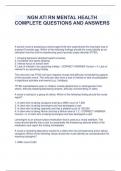
NGN ATI RN MENTAL HEALTH COMPLETE QUESTIONS AND ANSWERS A school nurse is assessing a school aged child who experienced the traumatic loss of a parent 8 months ago. Which of the following findings should the nurse identify as an indication that the child is experiencing post traumatic stress disorder (PTSD) 1. Clinging behaviors directed toward a teacher 2. Increased time spent sleeping 3. Intense focus on school work 4. Lack of interest in an upcoming holiday - CORRECT ANSWER-Correct = 4. Lack of interest in an upcoming holiday The child who has PTSD will have negative moods and difficulty remembering aspects of the traumatic event. The child can also have a loss of interest or lack of participation in significant activities and events (e.g., Holidays) *PTSD manifestations seen in children include detachment or estrangement from others, difficulty sleeping/distressing dreams, difficulty concentrating on tasks A nurse is caring for a group of clients. Which of the following finding should the nurse report? 1. A client who is taking clozapine and has a WBC count of 7,500 2. A client who is taking lamotrigine and has developed a rash 3. A client who is taking valproate and has a platelet count of 150,000 4. A client who is taking lithium and has a lithium level of 1.2 - CORRECT ANSWERCorrect = 2. A client who is taking lamotrigine and has developed a rash Lamotrigine is an anticonvulsant medication that is used as a mood stabilizer. The nurse should identify that a rash is a potentially life threatening adverse effect of the medication and report the finding immediately A nurse is reviewing laboratory results for a client who has schizophrenia and is taking clozapine. Which of the following values should the nurse identify as contraindication for receiving clozapine? 1. WBC count 2,500 2. Hgb 11.5 3. Platelets 150,000 4. RBC count 3.5 - CORRECT ANSWER-Correct - 1. WBC count 2,500 Clozapine can cause agranulocytosis, which can be fatal due to overwhelming infection. The nurse should identify a WBC count of less than 3,000 as a possible manifestation of agranulocytosis and should withhold the medication and notify the provider A nurse is planning care for a client who has depression and has made frequent suicide attempts. Which of the following statements indicates the client has a decreased risk for suicide? 1. "I'm relieved now that my financial affairs are in order." 2. "It is easier to talk about my feelings now." 3. "Suddenly I have enough energy to do anything I want." 4. "Thank you for always taking such good care of me." - CORRECT ANSWER-Correct - 2. "It is easier to talk about my feelings now." When clients express their feelings, this indicates a positive treatment outcome *When clients who have depression verbalize getting their affairs in order, or suddenly have more energy are at an increased risk of suicide. Clients who have depression often show an appreciation for loved ones when they are contemplating suicide During a client's initial interview in a mental health inpatient setting, a nurse identifies that the client is maintaining eye contact and leaning forward. Which of the following assumptions should the nurse make based on the client's nonverbal behaviors? 1. The client is interested in what the nurse is saying 2. The client is attempting to manipulate the nurse 3. The client is physically attracted to the nurse 4. The client is seeking acceptance by the nurse - CORRECT ANSWER-Correct - 1. The client is interested in what the nurse is saying The client's posture and eye contact demonstrate an interest in the interview and what the nurse is saying A nurse is planning care for a client who has schizophrenia and reports auditory hallucinations. Which of the following interventions should the nurse include in the plan? 1. Promote use of music to compete with the client's auditory hallucination 2. Inform the client that the auditory hallucinations are not real 3. Avoid asking the client if they are experiencing auditory hallucinations 4. Instruct the client on the use of voice recognition regarding the auditory hallucinations - CORRECT ANSWER-Correct = 1. Promote the use of music to compete with the client's auditory hallucinations Competing reality based stimulating such as the use of music or television during auditory hallucinations can assist in limiting the effect the hallucinations have on the client's stress level *The nurse should acknowledge that the client is hearing auditory hallucinations, but should tell the client that others cannot hear anything to reinforce reality. The nurse should ask the client if they are hearing voices to evaluate whether these are command hallucinations, which can place the client or others at risk for harm. The nurse should assist the client to develop the skill of voice dismissal when auditory hallucinations occur. This involves commanding the voices to stop, which gives the client a sense of control A nurse is caring for a client who has impaired cognition A nurse is updating the client's plan of care. For each of the following potential nursing interventions, click to specify if the potential intervention is anticipated, nonessential, or contraindicated for the client Potential Intervention: 1. When addressing the client, approach them from the front when possible 2. Use a vest restrain to keep the client in a medical recliner 3. Ensure the bed is kept at a working height for the nurse 4. Provide the client with high-calorie protein drinks hourly 5. Give directions to the client slowly and in a moderate tone of voice 6. Decrease the sensory stimulation 7. Keep the lights off in the client's bedroom and bathroom at night 8. Assign the client to a room near the nurses' station Exhibit 1: Medical History Day 1, 0800: Client treated for UTI 8 months ago Day 3, 0830: Client fell getting out of bed to go to the ba - CORRECT ANSWER-Correct = 1. When addressing the client, approach them from the front when possible = Anticipated. *A client who is unexpectantly approached or touched from someone out of view is easily startled, which can promote aggressive behavior in the client. 2. Use a vest restraint to keep the client in a medical recliner = Contraindicated. *The client has the right to be free from the use of restraints except in the case of an emergency. 3. Ensure the bed is kept at a working height for the nurse = Contraindicated. *The client's bed should be placed in the lowest position to decrease the risk for falls, or lessen injury severity if the client does fall. 4. Provide the client with high-calorie protein drinks hourly = Nonessential. *This is nonessential for this client because they are taking in nutrition. The nurse should provide the client who has mania with this type of dietary supplement. 5. Give directions to the client slowly and in a moderate tone of voice = Anticipated. *Providing directions slowly and in a moderate tone of voice will increase client comprehension. Loud voices can cause the client to feel uncomfortable and can even cause feelings of anger. 6. Decrease sensory stimulation = Anticipated. *A highly stimulating environment can cause the client to become anxious and further disoriented, which can impair client safety. 7. Keep the lights off in the client's bedroom and bathroom at night = Contraindicated. *This can increase the client's risk for falls. Keeping a light on can decrease wandering. 8. Assign the client to a room near the nurses' station = Anticipated. *This promotes client safety by allowing staff to observe the client frequently. A nurse is planning discharge teaching with a family member of a client who has a new diagnosis of depression. Which of the following information about relapse should the nurse include? 1. Additional acute episodes of depression are unlikely following inpatient care. 2. Early identification of changes, such as decreased social involvement, is important. 3. Medication compliance will prevent further need for inpatient hospitalization. 4. It is helpful to regularly reinforce to the client that things will get better. - CORRECT ANSWER-Correct = 2. Early identification of changes, such as decreased social involvement, is important. Decrease social involvement is a manifestation of depression, and early identification of findings can lead to early intervention A nurse is establishing a therapeutic relationship with a client who has antisocial personality disorder. Which of the following strategies should the nurse use when communicating with this client? 1. Behave in a friendly manner toward the client. 2. Set realistic limits on the client's behavior. 3. Show respect for the client's need for isolation. 4. Act as a role model for assertiveness. - CORRECT ANSWER-Correct = 2. Set realistic limits on the client's behavior. Clients who have antisocial personality disorder can seem to be in control of their behavior, but are manipulative and impulsive and can suddenly become aggressive and assaultive. The nurse should establish clear limits on specific aggressive and demanding behaviors. Clients who have antisocial personality disorder do not seek isolation. They show antagonistic behavior toward others and often have a history of criminal misconduct. Clients who have antisocial personality disorder do not lack assertiveness. They tend to act in an aggressive and exploitative manner.
Written for
- Institution
- NGN ATI RN MENTAL HEALTH
- Course
- NGN ATI RN MENTAL HEALTH
Document information
- Uploaded on
- February 22, 2024
- Number of pages
- 30
- Written in
- 2023/2024
- Type
- Exam (elaborations)
- Contains
- Questions & answers
Subjects
-
ngn ati rn mental health complete questions and an
-
a school nurse is assessing a school aged child wh
-
a nurse is assessing a client who has borderline p
-
a nurse on an acute mental health facility is r

Also available in package deal