Med-Surg Chapter 26 Lewis Respiratory System NCLEX Questions with Correct Answers
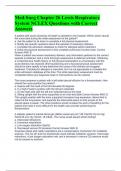
A patient with acute shortness of breath is admitted to the hospital. Which action should the nurse take during the initial assessment of the patient? a. Ask the patient to lie down to complete a full physical assessment. b. Briefly ask specific questions about this episode of respiratory distress. c. Complete the admission database to check for allergies before treatment. d. Delay the physical assessment to first complete pulmonary function tests. Correct Answer ANS: B When a patient has severe respiratory distress, only information pertinent to the current episode is obtained, and a more thorough assessment is deferred until later. Obtaining a comprehensive health history or full physical examination is unnecessary until the acute distress has resolved. Brief questioning and a focused physical assessment should be done rapidly to help determine the cause of the distress and suggest treatment. Checking for allergies is important, but it is not appropriate to complete the entire admission database at this time. The initial respiratory assessment must be completed before any diagnostic tests or interventions can be ordered. The nurse prepares a patient with a left-sided pleural effusion for a thoracentesis. How should the nurse position the patient? a. Supine with the head of the bed elevated 30 degrees b. In a high-Fowler's position with the left arm extended c. On the right side with the left arm extended above the head d. Sitting upright with the arms supported on an over bed table Correct Answer ANS: D The upright position with the arms supported increases lung expansion, allows fluid to collect at the lung bases, and expands the intercostal space so that access to the pleural space is easier. The other positions would increase the work of breathing for the patient and make it more difficult for the health care provider performing the thoracentesis A diabetic patient's arterial blood gas (ABG) results are pH 7.28; PaCO2 34 mm Hg; PaO2 85 mm Hg; HCO3- 18 mEq/L. The nurse would expect which finding? a. Intercostal retractions b. Kussmaul respirations c. Low oxygen saturation (SpO2) d. Decreased venous O2 pressure Correct Answer ANS: B Kussmaul (deep and rapid) respirations are a compensatory mechanism for metabolic acidosis. The low pH and low bicarbonate result indicate metabolic acidosis. Intercostal retractions, a low oxygen saturation rate, and a decrease in venous O2 pressure would not be caused by acidosis.
Written for
- Institution
- Med-Surg
- Course
- Med-Surg
Document information
- Uploaded on
- February 21, 2024
- Number of pages
- 7
- Written in
- 2023/2024
- Type
- Exam (elaborations)
- Contains
- Questions & answers
Subjects
-
a patient with acute shortness of breath is admitt

Also available in package deal