BIOD 151 Module 3 Exam With Questions and Answers 100% Solved
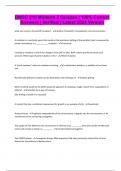
BIOD 151 Module 3 Exam With Questions and Answers 100% Solved Explain why someone who has hypergastrinemia (excessive secretion of gastrin) might develop gastric/stomach ulcers. - answerGastrin stimulates the secretions of pepsinogens and hydrochloric acid. Excess amounts would lead to erosion of the stomach lining. Explain in detail how the stomach contents enter the small intestine - answerThe pyloric sphincter (valve), located at the base of the stomach, relaxes causing a small quantity of chyme to pass through the opening into the first part of the small intestine. This initiates a reflex that causes the muscles of the sphincter to contract and close the opening temporarily. Then the sphincter relaxes again and allows more chyme to enter. Be able to label the following: Stomach Gallbladder Jejunum (not small intestine) Appendix (not large intestine) Rectum (not large intestine - answer A patient is experiencing vitamin toxicity. What type of vitamin would be causing this toxicity? Explain your answer. A. Water soluble vitamin B. Fat soluble vitamin C. All of the above - answerFat soluble vitamins are stored within the body's fat stores making it harder for the body to rid itself of them. Explain which digestive system functions are carried out by the large intestine. - answerAbsorption: In the large intestine water and electrolytes are reabsorbed and vitamins are absorbed. Defecation: Feces travel to the rectum where it is excreted via the anus. Describe parietal cells and chief cells: name their location, secretions and purposes. - answerThe parietal cells (located in the wall of the stomach body) secrete hydrochloric acid, generating a pH of 1.3-3.5. This very acidic pH kills many of the bacteria ingested along with food. In addition, the low pH stops the activity of salivary amylase. The secretion of hydrochloric acid is essential in the activation of pepsin. Chief cells: secrete pepsinogen. Pepsinogen (a pre-enzyme) is secreted by the chief cells in the stomach. Hydrochloric
Written for
- Institution
- BIOD 151
- Course
- BIOD 151
Document information
- Uploaded on
- February 19, 2024
- Number of pages
- 6
- Written in
- 2023/2024
- Type
- Exam (elaborations)
- Contains
- Questions & answers
Subjects
-
biod 151 module 3 exam with questions and answers

Also available in package deal