Module 2- genetics Exam With Questions and Answers 100% Solved
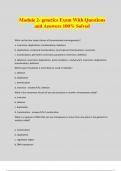
Module 2- genetics Exam With Questions and Answers 100% Solved What are the four major classes of chromosomal rearrangements? a. inversions, duplications, translocations, deletions b. duplications, reciprocal translocations, nonreciprocal translocations, inversions c. translocations, pericentric inversions, paracentric inversions, deletions d. deletions, inversions, duplications, point mutations - answera. inversions, duplications, translocations, deletions Which type of mutation is most likely to result in lethality? a. deletion b. duplication c. translocation d. inversion - answera. deletion What is the movement of part of one chromosome to another chromosome called? a. inversion b. deletion c. duplication d. translocation - answerd. translocation What is a segment of DNA that can use transposase to move from one place in the genome to another called? a. translocation b. duplication c. regulatory region d. DNA transposon e. retrotransposon - answerd. DNA transposon An acentric fragment is one result of crossing-over between a normal chromosome and a chromosome that has undergone what kind of mutation? a. duplication b. pericentric inversion c. reciprocal translocation d. paracentric inversion - answerd. paracentric inversion Karyotypes generally remain constant within a species because a. rearrangements occur frequently. b. changes in chromosome number occur infrequently. c. genetic instabilities produced by genomic changes are usually at a selective disadvantage d. genetic imbalances are often at a selective advantage. - answerc. genetic instabilities produced by genomic changes are usually at a selective disadvantage Despite selection against chromosomal variations, a. related species almost always have the same karyotype. b. related species almost always have different karyotypes. c. closely related species diverge by many chromosomal rearrangements. d. distantly related species diverge by only a few chromosomal rearrangements. - answerb. related species almost always have different karyotypes. In a deletion heterozygote, the normal chrom
Written for
- Institution
- Genetics
- Course
- Genetics
Document information
- Uploaded on
- February 19, 2024
- Number of pages
- 10
- Written in
- 2023/2024
- Type
- Exam (elaborations)
- Contains
- Questions & answers
Subjects
-
module 2 genetics exam with questions and answers

Also available in package deal