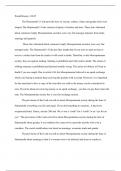
Mariam AL Katheeri notes all rights reserved
Cells :
- DNA is double stranded, 2 backbones, deoxyribose sugar
- RNA is single stranded, 1 backbone, has U instead T, ribose sugar
- Prokaryotes do not have membrane bound organelles
Organelle presence function
Cell membrane both Support cell
Cytoskeleton Both Structure for
cell
Mitochondria both Energy provider
Nucleus Eukaryotes Holds DNA
Nucleolus both
Golgi apparatus Eukaryotes Packaging
ER&SR Eukaryotes protein and
dispersing
Vacuole plant only Store water and
Eukaryote other molecules
like carbs
Ribosomes both Protein
synthesis
Peroxisome both Toxic waste,
break down
H2O2, catalyze
enzyme
plasmodesmata plants Allows small
molecules to go
through
, Mariam AL Katheeri notes all rights reserved
ATP and Respiration:
- Anaerobic (no oxygen present) → Fermentation, in cytoplasm, recycling
of
- Aerobic (oxygen present → 38 ATP created in total, in mitochondria and
cytoplasm
- glycolysis, in which glucose molecules are broken down to form pyruvic
acid molecules; the Krebs cycle, in which pyruvic acid is further broken
down and the energy in its molecule is used to form high-energy
compounds such as NADH; the electron transport system, in which
electrons are transported along a series of coenzymes and cytochromes
and the energy in the electrons is released;
1. Glycolysis:
- 2 ATP
- 2 NADH
- 2 pyruvate acids
- glucose is broken down to 2 pyruvates acids
- in cytoplasm
TIP: If there is no oxygen provided then the ATP cycle will go to
Anaerobic/Fermentation. Produce lactic acid which is in
cytoplasm only (glycolysis on repeat)
2. Krebs Cycle or Citric acid cycle:
- Before entering 2 pyruvates are oxidized and become Acetyl-CoA ( 2
pyruvates = 2 Carbons of each 3 +coenzyme A = Acetyl-CoA + 2Carbon
Dioxide)
Cells :
- DNA is double stranded, 2 backbones, deoxyribose sugar
- RNA is single stranded, 1 backbone, has U instead T, ribose sugar
- Prokaryotes do not have membrane bound organelles
Organelle presence function
Cell membrane both Support cell
Cytoskeleton Both Structure for
cell
Mitochondria both Energy provider
Nucleus Eukaryotes Holds DNA
Nucleolus both
Golgi apparatus Eukaryotes Packaging
ER&SR Eukaryotes protein and
dispersing
Vacuole plant only Store water and
Eukaryote other molecules
like carbs
Ribosomes both Protein
synthesis
Peroxisome both Toxic waste,
break down
H2O2, catalyze
enzyme
plasmodesmata plants Allows small
molecules to go
through
, Mariam AL Katheeri notes all rights reserved
ATP and Respiration:
- Anaerobic (no oxygen present) → Fermentation, in cytoplasm, recycling
of
- Aerobic (oxygen present → 38 ATP created in total, in mitochondria and
cytoplasm
- glycolysis, in which glucose molecules are broken down to form pyruvic
acid molecules; the Krebs cycle, in which pyruvic acid is further broken
down and the energy in its molecule is used to form high-energy
compounds such as NADH; the electron transport system, in which
electrons are transported along a series of coenzymes and cytochromes
and the energy in the electrons is released;
1. Glycolysis:
- 2 ATP
- 2 NADH
- 2 pyruvate acids
- glucose is broken down to 2 pyruvates acids
- in cytoplasm
TIP: If there is no oxygen provided then the ATP cycle will go to
Anaerobic/Fermentation. Produce lactic acid which is in
cytoplasm only (glycolysis on repeat)
2. Krebs Cycle or Citric acid cycle:
- Before entering 2 pyruvates are oxidized and become Acetyl-CoA ( 2
pyruvates = 2 Carbons of each 3 +coenzyme A = Acetyl-CoA + 2Carbon
Dioxide)