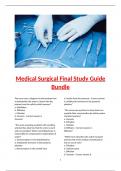
Medical Surgical Comprehensive Final Study Guide Bundle
Medical Surgical Final Study Guide Bundle The nurse uses a diagram to demonstrate how in dehydration the water is drawn into the plasma from the cells by which process? a. Distillation b. Diffusion c. Filtration d. Osmosis - Correct answer d. Osmosis" "The nurse assessing a patient with vomiting and diarrhea observes that the urine is scant and concentrated. Which controlling factor is responsible for compensatory reabsorption of water? a. Osmoreceptors in the hypothalamus b. Antidiuretic hormone in the posterior pituitary c. Baroreceptors in the carotid sinus d. Insulin from the pancreas - Correct answer b. Antidiuretic hormone in the posterior pituitary" "The nurse uses a picture to show how ions equalize their concentration by which passive transport process? a. Osmosis b. Filtration c. Titration d. Diffusion - Correct answer d. Diffusion" "Which term describes the active transport process that moves sodium and potassium into or out of cells? a. Filtration b. Sodium pump c. Diffusion d. Osmosis - Correct answer b. Sodium pump" "The patient taking furosemide (Lasix) to correct excess edema shows a weight loss of 5.5 pounds in 24 hours. The nurse calculates that this weight loss is equivalent to how many liters (L) of fluid? a. 1 L b. 1.5 L c. 2.0 L d. 2.5 L - Correct answer d. 2.5 L" "The nurse is caring for a patient with a potassium level of 2.9 mEq/L. The nurse should carefully monitor the patient for which potential problem? a. Excessive urinary output b. Abdominal distention c. Increased reflexes d. Hyperactive bowel sounds - Correct answer b. Abdominal distention" "While the nurse is washing the face of a patient in renal failure, the patient demonstrates a spasm of the lips and face. Which laboratory value corresponds with the nurse's assessment findings? a. Potassium of 3.4 mEq/L b. Calcium of 7.9 mg/dL c. Sodium of 140 mEq/L d. Phosphorus of 2.8 mg/dL - Correct answer b. Calcium of 7.9 mg/dL" "Which finding is most important for the nurse to confirm prior to hanging an intravenous (IV) bag containing potassium? a. Verify a blood pressure of at least 60 mm Hg diastolic. b. Check for urine output of at least 30 mL/hr. c. Ensure filter placement on the IV line. d. Verify a pulse of at least 50 beats/min. - Correct answer b. Check for urine output of at least 30 mL/hr" "Which statement demonstrates that the patient accurately understands the nurse's teaching related to a low-sodium diet? a. "I can have all the dried fruits I want." b. "I'm looking forward to a tall glass of tomato juice." c. "I'm going to eat my favorite avocado and orange salad." d. "I'm going to eat a cheeseburger with extra ketchup." - Correct answer c. "I'm going to eat my favorite avocado and orange salad."" "The nurse is caring for an 80-year-old patient. Which finding is the best early indicator of dehydration in this patient? a. Reduced skin turgor b. Constipation c. Increased temperature d. Thirst - Correct answer b. Constipation" "The patient with long-term obstructive pulmonary disease has a pH of 7, HCO3- of 18 mEq/L, and a PaCO2 of 40 mm Hg. These laboratory values are consistent with which acid-base imbalance? a. Respiratory alkalosis b. Metabolic alkalosis c. Respiratory acidosis d. Metabolic acidosis - Correct answer d. Metabolic acidosis" "The nurse is caring for a young patient with asthma. Which activity should the nurse encourage in order to help prevent respiratory acidosis? a. Engage in deep-breathing exercises every 2 hours. b. Drink 8 ounces of fluid every 4 hours. c. Ambulate for 15 minutes twice a day. d. Sleep with the head of the bed elevated 45 degrees. - Correct answer a. Engage in deep-breathing exercises every 2 hours." "The patient who has had diarrhea for the last 3 days has blood gases of pH of 7.1, HCO3- of 20 mEq/L, and PCO2 of 36 mm Hg. These laboratory values are consistent with which acid-base imbalance? a. Respiratory alkalosis b. Metabolic alkalosis c. Respiratory acidosis d. Metabolic acidosis - Correct answer d. Metabolic acidosis" "The nurse is caring for a patient with metabolic acidosis. Which assessment finding reveals that the compensatory mechanism to correct this imbalance is in effect? a. Increased urinary output b. Reduced abdominal distention c. Kussmaul respirations d. Decreased blood pressure - Correct answer c. Kussmaul respirations" "The nurse assesses the patient's IV insertion site and observes that the vein is hard, the skin is red and tender, and a blood return in the IV line. After removing the IV catheter, which action should the nurse take next? a. Obtain an arm board to properly secure the IV. b. Elevate the arm above the level of the heart. c. Clean the site with alcohol and apply cool compresses. d. Apply a warm moist pack. - Correct answer d. Apply a warm moist pack" "Because there are no IV pumps available for the immediate infusion of an IV medication, the nurse must calculate the flow rate for 500 mL to run for 4 hours, using a set that delivers 15 gtt/mL. Which flow rate is correct? a. 30 gtt/min b. 35 gtt/min c. 40 gtt/min d. 45 gtt/min - Correct answer a. 30 gtt/min" "The count of the solution in the IV container at the beginning of the shift is 800 mL. A new 1000-mL bag was hung during the shift and has 650-mL left at the end of the shift. What amount should the nurse record as the IV fluid intake for the shift? a. 1000 mL b. 1050 mL c. 1100 mL d. 1150 mL - Correct answer d. 1150 mL" "After selecting an appropriate fluid, which action should the nurse take to correctly flush a PRN lock? a. Flush forcefully to clear the lumen. b. Use slow, gentle pressure to clear the lumen. c. Flush hard enough to clear resistance. d. Aspirate for blood return prior to flushing. - Correct answer b. Use slow, gentle pressure to clear the lumen." "The nurse is caring for a patient who has been on total parenteral nutrition (TPN) for 48 hours. Which action demonstrates effective nursing care? a. Checking the patient's blood glucose level according to facility protocol. b. Increasing the infusion rate if the prescribed intake falls behind. c. Informing the patient that TPN can only be administered via a central line for 1 week. d. Monitoring the peripheral IV site of TPN infusion for signs of infiltration at least every 8 hours. - Correct answer a. Checking the patient's blood glucose level according to facility protocol." "The nurse is assessing a patient with renal failure and notes fatigue, muscle cramps, confusion, and headache. Which laboratory abnormality corresponds with these findings? a. Potassium of 3.3 mEq/L b. Sodium of 129 mEq/L c. Calcium of 8.2 mg/dL d. Chloride of 105 mEq/L - Correct answer b. Sodium of 129 mEq/L" "The nurse is caring for a patient who has received epoetin alfa (Epogen) 2 to 3 weeks prior to a scheduled surgery. Which statement best explains the goal for Epogen administration prior to surgery? a. The patient will only require a single antibiotic immediately prior to surgery. b. The patient will have greater numbers of white blood cells (WBCs) following surgery. c. The patient will not require a blood transfusion during surgery. d. The patient will maintain stable potassium levels during surgery. - Correct answer c. The patient will not require a blood transfusion during surgery." "The nurse is performing a preoperative assessment on a patient scheduled for surgery today. The patient reports drinking two glasses of wine daily, smoking one pack of cigarettes daily ´ 20 years, completing a round of corticosteroids for asthma control 2 days ago, and taking a dose of passion flower extract yesterday. Which action should the nurse take next? a. Supply the patient with information on a smoking cessation class. b. Educate the patient regarding the dangers of drinking alcohol on a daily basis. c. Provide the patient with information regarding the dangers of using herbal medications. d. Notify the physician immediately regarding the patient's recent use of corticosteroids. - Correct answer d. Notify the physician immediately regarding the patient's recent use of corticosteroids." "The nurse is caring for a presurgical patient. The patient asks the nurse why her height and weight are recorded. How should the nurse respond? a. "This information helps us to correctly calculate the anesthesia dose." b. "Height and weight are important predictors of blood loss." c. "This information is used to assess respiratory volume." d. "Height and weight help us anticipate your fluid needs." - Correct answer a. "This information helps us to correctly calculate the anesthesia dose."" "The nurse is reviewing the presurgical patient's laboratory reports and notes an elevated aspartate aminotransferase (AST) and bilirubin. The nurse understands that this patient is most at risk for which potential complication? a. Excessive bleeding during or after surgery b. An increased serum albumin level c. Postsurgical respiratory infection d. Delayed wound healing - Correct answer a. Excessive bleeding during or after surgery" "The patient received a preoperative dose of lorazepam (Ativan) 20 minutes ago. Which safety precaution should the nurse take? a. Monitor respiratory status. b. Raise the bed rails. c. Elevate the head of the bed 30 degrees. d. Take seizure precautions. - Correct answer b. Raise the bed rails." "The nurse is caring for an 82-year-old presurgical patient. Which abnormal finding is most important for the nurse to report immediately? a. Respiratory rate of 22 breaths/min b. Report of extreme thirst c. Dizziness d. Temperature of 99.8° F - Correct answer d. Temperature of 99.8° F" "The patient refuses to take off her diamond wedding band prior to going to the operating room. What action should the nurse take first? a. Document the patient's refusal to remove the jewelry. b. Tape the ring to finger, covering the ring. c. Request that the patient sign a waiver to release the hospital from responsibility. d. Alert the surgery team to the presence of the jewelry. - Correct answer b. Tape the ring to finger, covering the ring." "The nurse is caring for an Asian patient who received atropine as a preoperative drug. For which problem should the nurse should carefully monitor the patient? a. Oliguria b. Hyperventilation c. Hypotension d. Tachycardia - Correct answer d. Tachycardia" "Which patient statement indicates a need for further instruction about the emotional preparation for surgery? a. "I'm going to hug my surgeon tomorrow." b. "My fate is in the hands of my surgeon. I'm frightened about the outcome." c. "I'll be ready for a cheeseburger when I get back." d. "I know I may have some pain, but this gallbladder will be gone when I wake up." - Correct answer b. "My fate is in the hands of my surgeon. I'm frightened about the outcome."" "Which action should the nurse take prior to administering the preoperative doses of Demerol and atropine? a. Ensure that a family member is present. b. Remove the patient's underwear. c. Verify that a consent form is signed. d. Raise each of the bed rails. - Correct answer c. Verify that a consent form is signed." "Which person is responsible for verifying that the consent form is signed and that the surgical site? a. The scrub nurse b. The surgeon c. The anesthesiologist d. The circulating nurse - Correct answer d. The circulating nurse" "The nurse warns the patient that, in order to retard the growth of microorganisms, the operating room temperature must be maintained in which range? a. 60 to 65° F b. 66 to 70° F c. 71 to 74° F d. 75 to 77° F - Correct answer b. 66 to 70° F" "The nurse is caring for a patient in the immediate preoperative period. Which action best demonstrates compliance with the National Patient Safety Goals protocol? a. The nurse accompanies the patient to the operating room. b. The nurse raises all side rails and elevates the head of the bed to 30 degrees. c. The nurse verifies and marks the surgical site. d. The nurse identifies all prosthetic devices before the time-out. - Correct answer c. The nurse verifies and marks the surgical site." "The nurse clarifies the difference between regional anesthesia and procedural sedation anesthesia. Which statement about procedural sedation anesthesia is true? a. Procedural sedation anesthesia uses both intravenous (IV) sedation and regional anesthesia. b. Procedural sedation anesthesia uses both general anesthesia and IV sedation. c. Procedural sedation anesthesia uses both alternative medicine herbs and regional anesthesia. d. Procedural sedation anesthesia uses both IV sedation and local anesthesia. - Correct answer a. Procedural sedation anesthesia uses both intravenous (IV) sedation and regional anesthesia." "During the course of surgery, a patient exhibits tachycardia, diaphoresis, and rising body temperature. Which is the circulating nurse's priority intervention? a. Monitor the patient for any further changes in condition. b. Note the patient's oxygen saturation and blood pressure. c. Ask the scrub nurse to verify the assessment findings. d. Alert the anesthesiologist and surgeon immediately. - Correct answer d. Alert the anesthesiologist and surgeon immediately." "The nurse is caring for a postsurgical patient whose surgical procedure lasted 3 hours. Which complication should the nurse anticipate? a. Thrombophlebitis b. Muscle spasms c. Joint pain d. Hyperthermia - Correct answer c. Joint pain" "The nurse is caring for a patient who has just been given medication to reverse neuromuscular blocking agents. The nurse is aware that the patient is in which general anesthetic stage? a. Induction b. Introduction c. Emergence d. Maintenance - Correct answer c. Emergence" "The LPN/LVN is in the patient's room while the charge nurse is obtaining the patient's signature on the surgical consent form. The patient states, "I didn't really understand what my surgeon explained, but I trust him completely." How should the nurse respond? a. "I need to contact your surgeon so your questions can be answered." b. "I can answer any questions that you might have regarding your surgery." c. "As long as you are comfortable, then you may sign the consent form." d. "Maybe we should call your surgeon to be sure it is okay to sign the consent." - Correct answer a. "I need to contact your surgeon so your questions can be answered."" "The postanesthesia care unit (PACU) nurse determines that the patient's Aldrete score is 9. Which statement correctly describes the meaning of this score? a. The patient is at an increased risk for postoperative respiratory complications. b. The patient's condition warrants close monitoring. c. The patient is experiencing severe pain. d. The patient will soon be transferred to the postoperative unit. - Correct answer d. The patient will soon be transferred to the postoperative unit." "The nurse is caring for a patient recovering in the PACU. The patient awakens confused and disoriented. What action should the nurse take first? a. Take the patient's vital signs. b. Encourage the patient to return to sleep. c. Reorient and reassure the patient. d. Document that the patient is awake and disoriented. - Correct answer c. Reorient and reassure the patient." "The PACU nurse is caring for a semiconscious patient immediately following abdominal surgery. The nurse correctly places the patient in which position? a. Supine b. Semi-Fowler c. Lateral d. Trendelenburg - Correct answer c. Lateral" "The PACU nurse is caring for an unconscious patient. Assessment reveals diminished breath sounds bilaterally. Which action should the nurse take? a. Hyperventilate the patient with an Ambu bag. b. Increase bi-nasal oxygen to 3 L/min. c. Elevate the head of bed 45 degrees. d. Document "diminished breath sounds in both lower lobes." - Correct answer d. Document "diminished breath sounds in both lower lobes."" "The nurse is caring for a patient during the first postoperative day. Which goal works to prevent atelectasis and is most appropriate for the nursing care plan? a. Patient will turn, cough, and deep-breathe every 4 hours. b. Patient will "huff-cough" every 2 hours. c. Patient will use the incentive spirometer twice a day. d. Patient will resume diet as soon as possible. - Correct answer b. Patient will "huff-cough" every 2 hours." "The nurse is caring for a 90-year-old postoperative patient whose oxygen saturation is frequently dropping below 90%. Which age-related change is most likely related to this finding? a. Prolonged use of a walker b. Poor fluid intake c. Weakened respiratory muscles d. Increased elasticity of costal cartilages - Correct answer c. Weakened respiratory muscles" "Which assessment finding on a patient who had a right total knee replacement this morning should be reported to the charge nurse immediately? a. Pain level of 8 at operative site b. Capillary refill of right toe of 7 seconds c. Right foot warm to touch d. Swelling of right knee - Correct answer b. Capillary refill of right toe of 7 seconds" "Anti-embolic stockings are in place on the obese postsurgical patient. Which statement accurately describes the standard of care in regard to anti-embolic stockings? a. The stockings should remain in place continually for the first 24 hours. b. The stockings should fit tightly at the knee and ankle. c. The stockings should be removed approximately 20 minutes every shift. d. The stockings should be removed when ambulating. - Correct answer c. The stockings should be removed approximately 20 minutes every shift." "The nurse has been assigned to care for several postoperative patients. Which patient is most likely to develop thrombophlebitis? a. A patient status post outpatient cholecystectomy with a history of blood clots. b. A patient who is 6 days postoperative for total right hip replacement with a history of left-sided stroke. c. A patient who underwent major abdominal surgery and was dehydrated upon admission. d. A patient who is 2 days postoperative for hernia repair with a history of diabetes. - Correct answer b. A patient who is 6 days postoperative for total right hip replacement with a history of left-sided stroke." "The patient's initial vital signs immediately on return from surgery include: blood pressure (BP) of 140/90; pulse (P) of 80; respirations (R) of 14; and temperature (T) of 98° F. One hour later the vital signs are: BP of 130/84; P of 72; R of 16; and T of 96.8° F. What action should the nurse take next? a. Add a blanket for warmth to the patient. b. Notify the charge nurse of a probable hemorrhage. c. Raise the head of the bed 45 degrees. d. Document the assessment findings. - Correct answer d. Document the assessment findings." "The nurse is caring for a patient who has had spinal anesthesia. The nurse correctly questions which order? a. Patient to lie flat for 6 to 8 hours. b. Resume diet as tolerated. c. Use incentive spirometer every hour while awake. d. Notify physician immediately if headache occurs. - Correct answer d. Notify physician immediately if headache occurs." "The nurse is caring for a patient who had spinal anesthesia. Which drink is the best choice for the nurse to offer the patient? a. Tea b. Orange juice c. Milk d. Water - Correct answer a. Tea" "When caring for a 10-hour postabdominal surgery patient, which finding the nurse should report to the charge nurse? a. 20 mL of clear green emesis b. Pain level of 5/10 c. No urine output since surgery d. A weak cough ability - Correct answer c. No urine output since surgery" "The nurse is caring for a surgical patient who complains of excessive gas. Which action should the nurse take? a. Offer iced fluids. b. Arrange for large meal servings. c. Provide a straw for drinking fluids. d. Ambulate the patient in the hall. - Correct answer d. Ambulate the patient in the hall." "The postoperative patient complains of pain only 1 hour after having been medicated with an opioid, which cannot be repeated for three more hours. What action should the nurse take? a. Give one-half of the prescribed dose now. b. Contact the prescriber. c. Ambulate the patient in the hall. d. Reposition the patient. - Correct answer d. Reposition the patient" "Which action is most important for the nurse to take prior to ambulating the postsurgical patient for the first time? a. Raise the head of the bed. b. Dangle the patient's legs over side of bed. c. Offer the patient some fluids. d. Apply a gait belt to the patient. - Correct answer a. Raise the head of the bed." "The nurse educates the postsurgical patient about which potential effect of smoking on postsurgical recovery? a. Increased probability of hemorrhage b. Increased blood pressure c. Delayed healing d. Increased need for pain medication - Correct answer c. Delayed healing" "When the postoperative patient refuses to cough due to incisional pain, which action should the nurse take first? a. Encourage deep breathing instead of coughing. b. Splint the abdomen with a pillow. c. Explain the importance of controlled coughing. d. Administer pain medication. - Correct answer b. Splint the abdomen with a pillow." "The nurse is educating the patient about vitamins and wound healing. The nurse explains that which vitamin will enhance wound healing the most? a. Vitamin A b. Vitamin B c. Vitamin C d. Vitamin E - Correct answer c. Vitamin C" "The nurse is caring for a patient following abdominal surgery. The patient asks the nurse when he will be able to eat a normal diet. Which response is best? a. "It will depend on how well you tolerate advancing from a clear liquid diet." b. "We will have to wait until your surgeon orders a regular diet for you." c. "Most patients are able to eat regular foods within 2 to 3 days following abdominal surgery." d. "Once you have bowel sounds and are passing gas, you may have clear liquids, and your diet will be advanced based upon your tolerance." - Correct answer d. "Once you have bowel sounds and are passing gas, you may have clear liquids, and your diet will be advanced based upon your tolerance."" "The nurse is teaching a patient about infection prevention. The nurse points out that covering the mouth and nose with a tissue for a sneeze reduces the probability of infection spreading by which route? a. Droplet b. Airborne c. Direct contact d. Indirect contact - Correct answer a. Droplet" "The nurse is providing infection control teaching to a patient. Which patient statement warrants additional patient teaching? a. "It is important that I get my whooping cough vaccination as directed by my health care provider." b. "Getting plenty of sleep each night will help my immune system." c. "I should wash my hands before preparing my food." d. "It is important that I take my antibiotic until my symptoms have completely resolved." - Correct answer d. "It is important that I take my antibiotic until my symptoms have completely resolved."" "When the patient complains, "If this viral infection I have right now can't be helped by antibiotics, why am I taking this expensive acyclovir?" How should the nurse respond? a. "Acyclovir is an antiviral drug that kills viruses." b. "Acyclovir is given to many patients with viral infections." c. "Acyclovir is an antiviral drug that prevents your infection from becoming worse." d. "Acyclovir helps strengthen your immune system." - Correct answer c. "Acyclovir is an antiviral drug that prevents your infection from becoming worse."" "The clinic nurse offers suggestions to a patient who is planning a trip to Mexico that will help prevent a protozoan infection. Which suggestion is most helpful? a. "Ask the doctor for a prophylactic prescription for an antiviral drug." b. "Broad-spectrum antibiotics will be most helpful if you contract a protozoan infection." c. "Be sure to practice good hand hygiene while on your vacation." d. "It would be best if you drank bottled water while on your trip." - Correct answer d. "It would be best if you drank bottled water while on your trip."" "While assessing an obese resident in a long-term care facility, the nurse finds a red, moist rash under the patient's breasts, in the axilla, and in the inguinal fold. Based on this assessment, the nurse reports to the charge nurse that the resident probably has which type of infection? a. A fungal infection b. A bacterial infection c. An allergic reaction d. Contact dermatitis - Correct answer a. A fungal infection" "A frustrated patient with a fungal infection complains, "Why is the infection taking so long to heal?" Which response is most appropriate? a. "Fungal infections are essentially incurable." b. "Fungi form spores, which make them difficult to kill." c. "Fungi can be considered natural flora and are protected by the body." d. "Fungi can alter the patient's DNA and RNA." - Correct answer b. "Fungi form spores, which make them difficult to kill."" "The nurse explains to the patient who is using Prilosec (a proton pump inhibitor) that the drug reduces the amount of which natural protector in the stomach lining? a. Lactic acid b. Lysozyme c. Cilia d. Fatty acids - Correct answer b. Lysozyme" "How should the home health nurse advise the patient to treat a fever of 100° F? a. Take aspirin as needed. b. Take Tylenol every 4 to 6 hours. c. Bathe in cool water before bed. d. Do nothing at all. - Correct answer d. Do nothing at all." "The home health nurse is providing dietary recommendations to keep the immune system healthy. The patient demonstrates understanding by increasing intake of which foods? a. Eggs and beans b. Celery and water c. Pasta and bread d. Olive oil and peanuts - Correct answer a. Eggs and beans" "The nurse is caring for several patients and determines which patient to be most at risk for developing an infection related to a decreased anti-inflammatory response? a. A patient who has been experiencing high levels of stress for the last 3 months. b. A patient with a glycosylated Hgb level of 6.7%. c. A patient with osteoarthritis who was recently diagnosed. d. A patient who is scheduled for laparoscopic cholecystectomy in 2 weeks related to gallstones. - Correct answer a. A patient who has been experiencing high levels of stress for the last 3 months." "To which entity should the home health nurse make a referral in order to supply a home-bound older adult with a daily meal? a. A community food bank b. The Salvation Army c. An agency supplying food stamps d. Meals on Wheels - Correct answer d. Meals on Wheels" "The nurse uses a visual aid to demonstrate how which antibody attaches to the antigen to clear the pathogen from the body? a. IgA b. IgD c. IgG d. IgM - Correct answer d. IgM" "The nurse explains that exposure to a pathogen stimulates the macrophages to migrate to the area of infection to ingest and destroy the pathogen. This statement describes which process? a. Pathogen neutralization b. Immune response c. Antibody action d. Phagocytosis - Correct answer d. Phagocytosis" "The patient complains of the unsightly swelling of her lip at the site of an infection. The nurse explains that the swelling is part of the inflammatory response and performs which action? a. Stores blood b. Acts as a compression wall c. Provides an antibody reservoir d. Produces leukocytes - Correct answer b. Acts as a compression wall" "The nurse is providing infection control teaching to a group of patients. Which statement demonstrates that the patient understands the nurse's teaching? a. "I should take an antibiotic at the first sign of an infection." b. "Hand hygiene is one of the most effective ways I can prevent the spread of infection." c. "Vaccinations only prevent a disease from becoming severe." d. "If I eat a nutritious diet, it will be difficult for me to get an infection." - Correct answer b. "Hand hygiene is one of the most effective ways I can prevent the spread of infection."" "The nurse discusses and demonstrates proper hand hygiene to an immunocompromised patient and his wife. Which statement indicates a need for additional teaching? a. "It is okay for my wife to wear artificial nails as long as she washes her hands properly." b. "I should always wash my hands before I eat." c. "Hand gels work as well as handwashing under most circumstances." d. "I should use friction and wash my hands for about 20 seconds if I am using soap and water." - Correct answer a. "It is okay for my wife to wear artificial nails as long as she washes her hands properly."" "The nurse explains that a vaccination provides defense against infection via which type of immunity? a. Innate immunity b. The inflammatory response c. Antibody-mediated immunity d. Cell-mediated immunity - Correct answer c. Antibody-mediated immunity" "The nurse is planning care for a patient and determines that Expanded Precautions are warranted when performing care for a patient with which infection? a. Active tuberculosis (TB) b. Bacterial pneumonia c. A urinary tract infection (UTI) caused by E. coli d. A fungal infection of the groin and axilla - Correct answer a. Active tuberculosis (TB)" "The nurse is caring for a patient with C. difficile infection. Which action is most important for the nurse to take? a. Only use alcohol-based hand cleanser for hand hygiene. b. Always wear an impervious mask. c. Don proper eye protection before providing care. d. Notify housekeeping to use appropriate cleaning agents. - Correct answer d. Notify housekeeping to use appropriate cleaning agents." "The nurse is caring for a patient with general sepsis. Which finding should first alert the nurse to a potential complication that warrants immediate attention? a. Increased lethargy b. Sudden coughing c. Elevated blood pressure d. Cloudy urine - Correct answer a. Increased lethargy" "The nurse who suffers an accidental needle stick following administration of an intramuscular injection to a patient anticipates that facility protocol will suggest immediate treatment with which type of immunotherapy? a. IgM b. IgD c. Ig A d. IgG - Correct answer d. IgG" "The nurse provides discharge teaching about antibiotic therapy. Which statement indicates that the patient requires additional teaching? a. "I should wait 3 days after my symptoms resolve before stopping my antibiotic." b. "I should try to take my medication as evenly spaced apart as possible." c. "If I start feeling worse, I should call my health care provider." d. "I should not share my medication with anyone." - Correct answer a. "I should wait 3 days after my symptoms resolve before stopping my antibiotic."" "In order to provide the optimum nursing care, it is important for the nurse to know that the standard of pain and pain control is best determined by which person? a. Physician b. Nurse c. Patient's family d. Patient - Correct answer d. Patient" "The nurse clarifies the basics of the gate theory of pain control. Which information should the nurse include? a. Pain is perceived as opening a "gate" to pain symptoms. b. The "gate" can be closed to pain by the use of nonpainful stimuli. c. The "gate" swings back and forth, first allowing pain, then blocking it. d. The patient can be trained to close the "gate" to pain. - Correct answer b. The "gate" can be closed to pain by the use of nonpainful stimuli." "When giving care to a 30-year-old Hispanic male, which action can most likely be attributed to the patient's cultural beliefs about pain? a. The patient maintains a stoic affect about pain. b. The patient prefers a pill to an injection. c. The patient ignores somatic interventions such as heat and massage. d. The patient confesses to pain but refuses pain medication. - Correct answer a. The patient maintains a stoic affect about pain." "The nurse is caring for a patient who is having constant nociceptor pain. Which intervention best addresses the patient's pain during the perception phase of pain? a. Administer nonsteroidal anti-inflammatory drugs (NSAIDs) for moderate pain. b. Ask the physician if an opioid could be ordered to treat the patient's pain when severe. c. Engage the patient in conversation regarding his family, hobbies, and plans following discharge from the facility. d. Determine if the patient typically takes a neurotransmitter uptake blocker medication for pain control. - Correct answer c. Engage the patient in conversation regarding his family, hobbies, and plans following discharge from the facility." "The patient is experiencing phantom pain following the amputation of her foot. Which type of pain is most associated with phantom pain? a. Nociceptive b. Mild c. Uncontrollable d. Neuropathic - Correct answer d. Neuropathic" "The nurse explains that the pain threshold and pain tolerance are different. Which statement about the pain threshold is true? a. Pain threshold is the point at which pain is perceived. b. Pain threshold is the point at which the person responds to pain. c. Pain threshold is the point at which pharmacologic intervention is required. d. Pain threshold is the point at which signs such as grimacing or groaning are observed. - Correct answer a. Pain threshold is the point at which pain is perceived." "The patient who had abdominal surgery this morning refuses the opioid pain medication for fear of addiction. How should the nurse respond? a. "Opioids are addictive, whereas nonsteroidal anti-inflammatory drugs (NSAIDs) are not." b. "Addiction is mainly a matter of attitude." c. "Fewer than 3% of people become addicted to drugs used for pain relief." d. "Although addiction does occur, it is quickly reversed." - Correct answer c. "Fewer than 3% of people become addicted to drugs used for pain relief."" "Which student nurse's note in the patient's record features proper documentation of a pain assessment? a. Pt. complains of local sharp pain (4/5) in lower abdomen upon standing. b. Pt. complains of stomach pain after eating (3/5). c. Pt. reports standing makes his stomach hurt. d. Pt. reports sharp pain in stomach. - Correct answer a. Pt. complains of local sharp pain (4/5) in lower abdomen upon standing." "The nurse is educating the home health patient about indications for acetaminophen. Which information should the nurse include in the teaching plan? a. Take acetaminophen as frequently as needed. b. Take acetaminophen before pain becomes severe. c. Take acetaminophen when pain becomes unbearable. d. Take acetaminophen sparingly and with caution. - Correct answer b. Take acetaminophen before pain becomes severe." "While bathing a patient, the nurse notes that a transdermal patch that was meant to be on the patient for 3 days is now gone on the second day. What action should the nurse take? a. Document the loss and apply a fresh patch to be replaced in 3 days. b. Report the loss to the charge nurse. c. Document the loss, replace the patch, and continue with the original schedule for replacement. d. Remind the patient that oral pain relief will be available until the patch is replaced in 24 hours. - Correct answer a. Document the loss and apply a fresh patch to be replaced in 3 days." "The patient on frequent doses of meperidine (Demerol) complains of constipation. Which initial intervention is best? a. Offer fruit such as prunes or apricots. b. Request an order for an enema. c. Report the condition to the charge nurse. d. Increase oral fluid intake. - Correct answer d. Increase oral fluid intake." "Because of the threat of lowering the seizure threshold, the home health nurse would suggest that the 85-year-old patient limit the use of which pain medication? a. Ibuprofen (Motrin) b. Naproxen (Aleve) c. Tramadol (Ultram) d. Acetaminophen (Tylenol) - Correct answer c. Tramadol (Ultram)" "The home health nurse educates the 75-year-old patient about the warm compresses he is using on his swollen elbow. Which information is most important to include in the teaching plan? a. Apply the warm compress directly on the skin. b. Allow the compress to remain in place for 15 to 20 minutes. c. Take aspirin 30 minutes prior to applying the compress. d. Alternate the warm compress with an ice pack every 10 minutes. - Correct answer b. Allow the compress to remain in place for 15 to 20 minutes." "The hospitalized postsurgical patient is reluctant to take the opioid pain medication because of drowsiness. Which response is most informative for the nurse to make? a. "Mental stimulation after the medication will keep you more alert." b. "Sleep and pain relief promote healing." c. "Drowsiness is an undesirable side effect." d. "The medication should be taken only before bedtime." - Correct answer b. "Sleep and pain relief promote healing."" "To help with pain control, how should the nurse time the distraction activities for a patient? a. To coincide with mealtimes b. To bridge the time between administration and onset c. To occur just before bedtime d. To awaken the patient in the morning - Correct answer b. To bridge the time between administration and onset" "A patient reports pain relief after having received a placebo. Which conclusion is most accurate for the nurse to determine? a. The patient was not actually experiencing pain. b. The patient was relieved of the anxiety that there is no ready source of pain remedy. c. The patient was demonstrating "attention-seeking" behavior. d. The patient was being manipulative. - Correct answer b. The patient was relieved of the anxiety that there is no ready source of pain remedy." "The nurse is caring for a 45-year-old male Arab patient who is in pain. Which action can most likely be attributed to the patient's cultural belief about pain? a. The patient never requests pain medication. b. The patient asks for pain relief to control pain. c. The patient becomes irritable and demanding when in pain. d. The patient hides pain from his family. - Correct answer b. The patient asks for pain relief to control pain." "The nurse is caring for a patient that is receiving intravenous morphine sulfate. The patient breaks out in hives and begins to itch. What should the nurse do first? a. Obtain the patient's vital signs. b. Stop the infusion. c. Report the patient's condition to the charge nurse. d. Give the prescribed antihistamine. - Correct answer b. Stop the infusion." "The nurse is planning to teach a family member about effective massage techniques. Which information is most important to include in the teaching plan? a. Use heat and a mild menthol cream for comfort. b. Pound painful areas with the sides of the hands. c. Gently and firmly massage of areas of inflammation. d. Use long, firm strokes while avoiding areas of inflammation. - Correct answer d. Use long, firm strokes while avoiding areas of inflammation" "The nurse explains that acupressure and acupuncture are effective pain relief modalities that focus on specific body areas. Which term best describes these therapies? a. Triangulation b. Hot spots c. Meridians d. Zones - Correct answer c. Meridians" "The nurse is caring for a patient who is 1-day postoperative following a colon resection. The patient has degenerative joint disease and uses a pain medication patch to control this chronic pain. Which consideration is most important when planning care for this patient? a. Understand that the pain medication patch will control the postoperative pain. b. Realize that this patient will most likely require more pain medication than most patients undergoing a colon resection. c. Recognize that the patient will be afraid to ask for additional pain medication for fear of being viewed as addicted to pain medicine. d. Expect the patient to forget about the pain caused from the degenerative joint disease. - Correct answer b. Realize that this patient will most likely require more pain medication than most patients undergoing a colon resection" "The nurse is planning care plans for multiple patients. Which patient does the nurse anticipate will experience the highest level of pain? a. 28-year-old experiencing pain related to a metatarsal fracture b. 45-year-old experiencing pain following a laparoscopic cholecystectomy c. 67-year-old experiencing chronic back pain d. 79-year-old experiencing pain related to osteoarthritis - Correct answer d. 79-year-old experiencing pain related to osteoarthritis" "The 40-year-old female who was diagnosed with a benign growth in her colon is concerned about the growth spreading. Which explanation best allays the patient's anxiety? a. "Benign growths arrest their growth on their own." b. "Benign growths never interfere with normal structures or functions." c. "Benign growths are easily controlled with radiation." d. "Benign growths are surrounded by fibrous tissue that prevents spread." - Correct answer d. "Benign growths are surrounded by fibrous tissue that prevents spread."" "The 26-year-old patient with a malignant neoplasm has experienced a 10-pound weight loss in 3 weeks. To which factor is this patient's rapid weight loss most likely related? a. Disinterest in eating food in general b. Changes in the nutritional content of the patient's diet c. The malignancy's high nutritional demand d. A self-imposed rigid diet regimen - Correct answer c. The malignancy's high nutritional demand" "The nurse recognizes the staging T3, N2, M2 of the patient's cancer. Which interpretation is correct? a. Small tumor with fewer than two lymph nodes involved. b. Large tumor that is localized. c. Small tumor with adjacent nodes involved. d. Large tumor with extensive lymph node involvement. - Correct answer d. Large tumor with extensive lymph node involvement." "The nurse assesses several patients in the outpatient clinic. Which patient has the greatest risk for developing cancer? a. 23-year-old car repairman who repaints cars b. 30-year-old overweight certified public accountant in New York who has smoked for 4 years and rarely exercises c. 45-year-old farmer from Texas who has worked on his family's cotton farm since the age of 12 d. 60-year-old ski instructor in Colorado - Correct answer c. 45-year-old farmer from Texas who has worked on his family's cotton farm since the age of 12" "The nurse recognizes that smoking is a "promoter" that, although not a carcinogen itself, allows cancer to occur faster in the patients. Which factor is also a promoter of cancer? a. Obesity b. Occupational hazards c. Cocaine abuse d. Heavy alcohol intake - Correct answer d. Heavy alcohol intake" "The nurse is caring for an x-ray technician who wears a badge that is monitored frequently to measure the amount of radiation he has absorbed. The nurse advises the technician that he has the highest risk for developing which type of cancer? a. Bladder cancer b. Leukemia c. Melanoma d. Lung cancer - Correct answer b. Leukemia" "The nurse is outlining a diet that would be helpful in the prevention of cancer. Which instructions should the nurse include? a. Eliminate all red meat. b. Use margarine instead of butter. c. Avoid foods with vitamin B complex. d. Eat a variety of citrus fruits. - Correct answer d. Eat a variety of citrus fruits." "The nurse is advising a young college student who wants a tan before spring break. Which method is safest for the student to use? a. Take advantage of morning sun while using sunscreen with an SPF of 30. b. Use a spray-on tanning solution. c. Use a sun lamp for a maximum of 20 minutes a day. d. Use a tanning salon for no more than 10 minutes per visit. - Correct answer b. Use a spray-on tanning solution." "The nurse is educating the 40-year-old female patient about the American Cancer Society (ACS) recommendations for early detection of cancer. Which information should she include when teaching? a. Obtain a Pap smear every year. b. Get an annual fecal occult blood examination. c. Plan a sigmoidoscopy every 5 years. d. Obtain a mammogram every year. - Correct answer d. Obtain a mammogram every year." "The nurse assesses a man who is scheduled for a prostate-specific antigen (PSA) test. The nurse understands that which situation could delay the test? a. The patient reports he ate shellfish 48 hours previously. b. The patient reports that he has a history of an enlarged prostate. c. The patient reports having a recent urinary tract infection (UTI). d. The patient's temperature is 99.0° F. - Correct answer c. The patient reports having a recent urinary tract infection (UTI)." "The nurse is planning care for the patient who is on a protocol of bleomycin. Since bleomycin is an antitumor antibiotic, which intervention should the nurse add to the care plan? a. Assess hearing acuity. b. Measure urinary output. c. Weigh daily to assess fluid retention. d. Monitor for cardiac arrhythmias. - Correct answer d. Monitor for cardiac arrhythmias." "The nurse is caring for a patient with cancer who is receiving vincristine. Which precaution is most important for the nurse to take? a. Prevent the patient from getting chilled. b. Administer a stool softener as ordered. c. Offer the patient a soft toothbrush. d. Feed the patient a snack during the infusion. - Correct answer b. Administer a stool softener as ordered." "The nurse is teaching a 50-year-old male patient who is taking estrogens as treatment of prostate cancer. The nurse should educate the patient about which expected side effect? a. Blurred vision b. Gynecomastia c. Enlarged gonads d. Acne - Correct answer b. Gynecomastia" "The nurse is instructing a patient who is on a biologic response modifier (BRM) colony-stimulating drug. The nurse teaches that about which desired action from this medication? a. Increased appetite b. Increased hair growth c. Enhanced recovery of bone marrow d. Decreased cholesterol - Correct answer c. Enhanced recovery of bone marrow" "The patient on radiation therapy has developed diarrhea. Which food should the nurse suggest to help slow the diarrhea? a. Broccoli b. Cauliflower c. Cheese and crackers d. Apples and pears - Correct answer c. Cheese and crackers" "The nurse is constructing a teaching plan about fatigue management for a patient who is taking radiation treatments. Which information should the nurse include? a. Prioritize activities and alternate rest with periods of activity. b. Plan to spend at least 4 to 5 hours of the day in bed. c. Discontinue pain medications that may cause drowsiness.
Written for
- Institution
- Med surg
- Course
- Med surg
Document information
- Uploaded on
- February 17, 2024
- Number of pages
- 72
- Written in
- 2023/2024
- Type
- Exam (elaborations)
- Contains
- Questions & answers
Subjects
-
medical surgical final study guide bundle

Also available in package deal