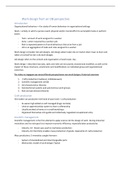
A2: The Water Cycle
Topic 5
, Stores
5.1: Global Hydrological Cycle • There are 4 main stores of water:
• Oceans (97% of worlds total water)
The Global Hydrological Cycle • Cryosphere: Water frozen into snow/ice (1.9%)
• The global hydrological cycle is a closed • Terrestrial surface groundwater (1.1%)
system. It does not have any external inputs or • Atmosphere (0.001%)
outputs. • When looking at freshwater alone, the stores are very different:
• The volume of water in the cycle is constant • Ice caps & Glaciers (68.7%)
• Groundwater (30.1%)
and finite.
• Rivers & lakes (1.2%)
• The system has three components:
• With freshwater, there are two types of stores that are categorised:
• Stores: Reservoirs where water is held
• Blue Water: Water stored in rivers, streams & lakes
• Fluxes: Flows that move water between
• Green Water: Water stored in soil & vegetation
stores
• Processes: Physical mechanisms which drive • Water stores have different Residence times:
the fluxes between stores. • The average time a water molecule will spend in a store or reservoir.
• The more easily pollution can occur, the shorter the residence time.
• The energy forms driving the cycle are:
• Solar Energy • Generally, the larger the water store, the longer the residence time.
• Gravitational Potential Energy • Some stores are non-renewable:
• Fossil water: Ancient, deep groundwater from previous pluvial (wetter)
climatic periods
• Cryosphere (water stored as snow or ice)
Flows & Processes
• Flows are transfers of water from one store to another.
• They are achieved by processes such as:
• Precipitation (movement of water from atmosphere to ground)
• Evaporation (Change of state of water to water vapour)
• Transpiration (Diffusion of water from vegetation to atmosphere)
• Groundwater Flow (Transfer of percolated water via porous rocks)
Humans & the Hydrological Cycle
• For humans, the most important part of the hydrological cycle is the access to
freshwater. The global water budget limits this amount.
• The accessible sources (rivers & lakes) only make up 1% of freshwater that is
easily accessible for human use.
• Evaluative point: This might increase in the future with the development of
technology.
Topic 5
, Stores
5.1: Global Hydrological Cycle • There are 4 main stores of water:
• Oceans (97% of worlds total water)
The Global Hydrological Cycle • Cryosphere: Water frozen into snow/ice (1.9%)
• The global hydrological cycle is a closed • Terrestrial surface groundwater (1.1%)
system. It does not have any external inputs or • Atmosphere (0.001%)
outputs. • When looking at freshwater alone, the stores are very different:
• The volume of water in the cycle is constant • Ice caps & Glaciers (68.7%)
• Groundwater (30.1%)
and finite.
• Rivers & lakes (1.2%)
• The system has three components:
• With freshwater, there are two types of stores that are categorised:
• Stores: Reservoirs where water is held
• Blue Water: Water stored in rivers, streams & lakes
• Fluxes: Flows that move water between
• Green Water: Water stored in soil & vegetation
stores
• Processes: Physical mechanisms which drive • Water stores have different Residence times:
the fluxes between stores. • The average time a water molecule will spend in a store or reservoir.
• The more easily pollution can occur, the shorter the residence time.
• The energy forms driving the cycle are:
• Solar Energy • Generally, the larger the water store, the longer the residence time.
• Gravitational Potential Energy • Some stores are non-renewable:
• Fossil water: Ancient, deep groundwater from previous pluvial (wetter)
climatic periods
• Cryosphere (water stored as snow or ice)
Flows & Processes
• Flows are transfers of water from one store to another.
• They are achieved by processes such as:
• Precipitation (movement of water from atmosphere to ground)
• Evaporation (Change of state of water to water vapour)
• Transpiration (Diffusion of water from vegetation to atmosphere)
• Groundwater Flow (Transfer of percolated water via porous rocks)
Humans & the Hydrological Cycle
• For humans, the most important part of the hydrological cycle is the access to
freshwater. The global water budget limits this amount.
• The accessible sources (rivers & lakes) only make up 1% of freshwater that is
easily accessible for human use.
• Evaluative point: This might increase in the future with the development of
technology.