APPLICATIONS OF ORGANIC CHEMISTRY ESSAY
UNIT 14B - 2024 COMPLETE SOLUTIONS
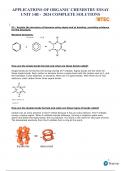
P2 - Explain the structure of benzene using sigma and pi bonding, providing evidence
for the structure.
Benzene structure:
How are the single bonds formed and what are these bonds called?
Single bonds are formed by the strong overlap of P-orbitals. Sigma bonds are the name for
these single bonds. Each carbon in benzene forms a sigma bond with the carbon next to it, and
the hydrogen is also attached. In benzene, there are 12 sigma bonds. With three out of four
electrons, each carbon forms three sigma bonds.
How are the double bonds formed and what are these types of bonds called?
Carbon has an extra electron in the P-orbital because it has an extra electron. The P-orbitals
occupy a space region. When P-orbitals overlap sideways, forming a negative space area
above and below the sigma bond, this is produced. A pi bond is the name for this type of bond.
The delocalized electrons from the P-orbitals form a ring at this point.
1
,APPLICATIONS OF ORGANIC CHEMISTRY ESSAY
UNIT 14B - 2024 COMPLETE SOLUTIONS
How is the ring of delocalised electrons formed?
When an atom's valence electron does not stay in its respective shell and begins to move around
freely in the valence shells of its covalently bonded molecule, this is known as delocalisation. The
extra energy provided by the ring orbitals of the delocalized electrons from the "pi" bonds, which
are spread out over the entire covalently bonded molecule, is known as delocalisation energy.
Because the electrons do not stay on one atom and continue to rotate, the molecule is more stable.
It's also known as the stabilisation energy because it keeps the entire molecule in place.
2
, APPLICATIONS OF ORGANIC CHEMISTRY ESSAY
UNIT 14B - 2024 COMPLETE SOLUTIONS
3
UNIT 14B - 2024 COMPLETE SOLUTIONS
P2 - Explain the structure of benzene using sigma and pi bonding, providing evidence
for the structure.
Benzene structure:
How are the single bonds formed and what are these bonds called?
Single bonds are formed by the strong overlap of P-orbitals. Sigma bonds are the name for
these single bonds. Each carbon in benzene forms a sigma bond with the carbon next to it, and
the hydrogen is also attached. In benzene, there are 12 sigma bonds. With three out of four
electrons, each carbon forms three sigma bonds.
How are the double bonds formed and what are these types of bonds called?
Carbon has an extra electron in the P-orbital because it has an extra electron. The P-orbitals
occupy a space region. When P-orbitals overlap sideways, forming a negative space area
above and below the sigma bond, this is produced. A pi bond is the name for this type of bond.
The delocalized electrons from the P-orbitals form a ring at this point.
1
,APPLICATIONS OF ORGANIC CHEMISTRY ESSAY
UNIT 14B - 2024 COMPLETE SOLUTIONS
How is the ring of delocalised electrons formed?
When an atom's valence electron does not stay in its respective shell and begins to move around
freely in the valence shells of its covalently bonded molecule, this is known as delocalisation. The
extra energy provided by the ring orbitals of the delocalized electrons from the "pi" bonds, which
are spread out over the entire covalently bonded molecule, is known as delocalisation energy.
Because the electrons do not stay on one atom and continue to rotate, the molecule is more stable.
It's also known as the stabilisation energy because it keeps the entire molecule in place.
2
, APPLICATIONS OF ORGANIC CHEMISTRY ESSAY
UNIT 14B - 2024 COMPLETE SOLUTIONS
3