Fundamentals Practice HESI Quiz 100% Complete 202
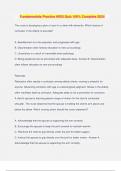
Fundamentals Practice HESI Quiz 100% Complete 2024 The nurse is developing a plan of care for a client with dementia. Which feature of confusion in the elderly is accurate? A. Bewilderment is to be expected, and progresses with age B. Disorientation often follows relocation to new surroundings C. Uncertainty is a result of irreversible brain pathology D. Being perplexed can be prevented with adequate sleep -Answer-B. Disorientation often follows relocation to new surroundings Rationale: Relocation often results in confusion among elderly clients--moving is stressful for anyone. Advancing confusion with age is a stereotypical judgment. Stress in the elderly often manifests itself as confusion. Adequate sleep is not a prevention for confusion. A client's spouse is learning passive range-of-motion for the client's contracted shoulder. The nurse observes that the spouse is holding the client's arm above and below the elbow. Which nursing action should the nurse implement? A. Acknowledge that the spouse is supporting the arm correctly B. Encourage the spouse to keep the joint covered to maintain warmth C. Reinforce the need to grip directly under the joint for better support D. Instruct the spouse to grip directly over the joint for better motion -Answer-A. Acknowledge that the spouse is supporting the arm correctly Rationale: The client's spouse is correctly holding the arm above and below the elbow to perform passive range-of motion to the contracted shoulder. The nurse should acknowledge this fact. The joint that is being exercised should be uncovered while the rest of the body should remain covered for warmth and privacy. An older client had a hemiarthroplasty of the left hip yesterday due to a fracture resulting from a fall. In reviewing hip precautions with the client, which instruction should the nurse include in this client's teaching plan? A. In 8 weeks you will be able to bend at the waist to reach items on the floor B. Place a pillow between your knees while lying in bed to prevent hip dislocation C. It is safe to use a walker to get out of bed, but you need assistance when walking D. Take pain medication 30 minutes after your physical therapy sessions -Answer-B. Place a pillow between your knees while lying in bed to prevent hip dislocation Rationale: The client's affected hip joint following a hemiarthroplasty (partial hip replacement) is at risk of dislocation for 6 months to a year following the procedure. Hip precautions to prevent dislocation include placing a pillow between the knees to maintain abduction of the hips. Clients should be instructed to avoid bending at the waist, to seek assistance for both standing and walking until they are stable on a walker or cane, and to take pain medication 20 to 30 minutes prior to physical therapy sessions, rather than waiting until the pain level is high after their therapy. A client who is 5 foot 5 inches tall and weighs 200 pounds is scheduled for surgery the next day. Which question is most important for the nurse to include during the preoperative assessment? A. "What is your daily calorie consumption?" B. "What vitamin and mineral supplements do you take?" C. "Do you feel that you are overweight?" D. "Will a clear liquid diet be okay after surgery?" -Answer-B. "What vitamin and mineral supplements do you take?" Rationale: In the preoperative assessment, the nurse should assess the client's use of vitamin and mineral supplements. These products may impact medications used during the operative period. The nature of the surgery and anesthesia will determine the need for a clear liquid diet, rather than the client's preference. Addressing long-term diet therapy is best done after surgery and recovery. The nurse assigns an unlicensed assistive personnel (UAP) to obtain vital signs from a very anxious client. What instructions should the nurse give the UAP? A. Remain calm with the client and record abnormal results in the chart B. Notify the medication nurse immediately if the pulse or blood pressure is low C. Report the results of the vital signs to the nurse D. Reassure the client that the vital signs are normal -Answer-C. Report the results of the vital signs to the nurse Rationale: Interpretation of vital signs is the responsibility of the nurse, so the unlicensed assistive personnel (UAP) should report vital sign measurements to the nurse. Any instructions requiring the UAP to interpret the vital signs causes the UAP to function beyond the scope of the UAP's authority. During the admission interview, which technique is most efficient for the nurse to use when obtaining information about signs and symptoms of a client's primary health problem? A. Restatement of responses B. Open-ended questions C. Closed-ended questions D. Problem-seeking responses -Answer-C. Closed-ended questions Rationale: Lay descriptors of health problems can be vague and nonspecific. To efficiently obtain specific information, the nurse should use closed-ended questions (C) that focus on common signs and symptoms about a client's health problem. (A, B, and D) are use
Written for
- Institution
- Fundamental HESI
- Course
- Fundamental HESI
Document information
- Uploaded on
- February 12, 2024
- Number of pages
- 17
- Written in
- 2023/2024
- Type
- Exam (elaborations)
- Contains
- Questions & answers
Subjects
-
fundamentals practice hesi quiz 100 complete 202

Also available in package deal