1.1.2. Animal and Plant
Recap Cells
We previously covered the
different types of cells,
specifically eukaryotic cells
(animal and plant cells) and
prokaryotic cells (bacterial cells). Animal Plant Bacteria
You should understand the
differences in the structures of Eukaryotic or
Eukaryotic Eukaryotic Prokaryotic
both types of cells. Prokaryotic
Magnification was also covered,
with common orders of Unicellular or
Either Multicellular Unicellular
magnitude in standard form. Multicellular
Cell Membrane ✓ ✓ ✓
Nucleus ✓ ✓ ✗
Cytoplasm ✓ ✓ ✓
Key Aims Mitochondria ✓ ✓ ✗
1. Animal Cell Structure Cell Wall ✗ Cellulose Peptidoglycan
2. Plant Cell Structure
3. Bacterial Cell Structure
4. Cell Sizes Vacuole ✗ ✓ ✓
Chloroplasts ✗ ✓ ✗
Animal Cell Structure
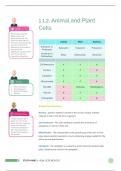
Nucleus - genetic material is stored in the circular nucleus. Genetic
AQA Specification
material is vital to the life of an organism.
Students should be able to
explain how the main sub-
cellular structures, including the Cell membrane - The cell membrane controls the movement of
nucleus, cell membranes, substances in and out of the cell
mitochondria, chloroplasts in
plant cells and plasmids in
bacterial cells are related to Mitochondria - the mitochondria is the powerhouse of the cell. It is the
their functions.
place where aerobic respiration occurs, producing energy needed for the
cell to survive and function.
Cytoplasm - the cytoplasm is a solvent in which chemical reactions take
place. Enzymes are found in the cytoplasm
Recap Cells
We previously covered the
different types of cells,
specifically eukaryotic cells
(animal and plant cells) and
prokaryotic cells (bacterial cells). Animal Plant Bacteria
You should understand the
differences in the structures of Eukaryotic or
Eukaryotic Eukaryotic Prokaryotic
both types of cells. Prokaryotic
Magnification was also covered,
with common orders of Unicellular or
Either Multicellular Unicellular
magnitude in standard form. Multicellular
Cell Membrane ✓ ✓ ✓
Nucleus ✓ ✓ ✗
Cytoplasm ✓ ✓ ✓
Key Aims Mitochondria ✓ ✓ ✗
1. Animal Cell Structure Cell Wall ✗ Cellulose Peptidoglycan
2. Plant Cell Structure
3. Bacterial Cell Structure
4. Cell Sizes Vacuole ✗ ✓ ✓
Chloroplasts ✗ ✓ ✗
Animal Cell Structure
Nucleus - genetic material is stored in the circular nucleus. Genetic
AQA Specification
material is vital to the life of an organism.
Students should be able to
explain how the main sub-
cellular structures, including the Cell membrane - The cell membrane controls the movement of
nucleus, cell membranes, substances in and out of the cell
mitochondria, chloroplasts in
plant cells and plasmids in
bacterial cells are related to Mitochondria - the mitochondria is the powerhouse of the cell. It is the
their functions.
place where aerobic respiration occurs, producing energy needed for the
cell to survive and function.
Cytoplasm - the cytoplasm is a solvent in which chemical reactions take
place. Enzymes are found in the cytoplasm