1.1.1 Eukaryotes and
Prokaryotes
Key Aims
Eukaryotic Cells
1. Eukaryotic Cells - Structure
and Properties
2. Prokaryotic Cells - Structure A eukaryotic cell contains a nucleus.
and Properties
3. Size and Scale
• Plant and animal cells are eukaryotic. A eukaryotic cell tends to be
fairly large and complex. Animal and plant cells are both eukaryotic
cells.
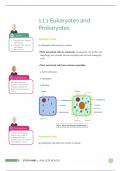
• Plant and animal cells have common organelles:
• Cell membranes
AQA Specification
• Cytoplasm
Plant and animals cells
(eukaryotic cells) have a cell
• Nucleus
membrane, cytoplasm and
genetic material enclosed in a
nucleus.
Fig 1. Plant and Animal Cell Structure.
AQA Specification
Bacterial cells (prokaryotic
cells) are much smaller in
comparison. They have Prokaryotic Cells
cytoplasm and a cell membrane
surrounded by a cell wall.
A prokaryotic cell does not contain a nucleus.
Prokaryotes
Key Aims
Eukaryotic Cells
1. Eukaryotic Cells - Structure
and Properties
2. Prokaryotic Cells - Structure A eukaryotic cell contains a nucleus.
and Properties
3. Size and Scale
• Plant and animal cells are eukaryotic. A eukaryotic cell tends to be
fairly large and complex. Animal and plant cells are both eukaryotic
cells.
• Plant and animal cells have common organelles:
• Cell membranes
AQA Specification
• Cytoplasm
Plant and animals cells
(eukaryotic cells) have a cell
• Nucleus
membrane, cytoplasm and
genetic material enclosed in a
nucleus.
Fig 1. Plant and Animal Cell Structure.
AQA Specification
Bacterial cells (prokaryotic
cells) are much smaller in
comparison. They have Prokaryotic Cells
cytoplasm and a cell membrane
surrounded by a cell wall.
A prokaryotic cell does not contain a nucleus.