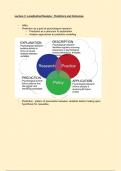
Lecture 3: Longitudinal Designs : Predictors and Outcomes
- AIMs:
- Prediction as a goal of psychological research
• Prediction as a precursor to explanation
• Analytic approaches to predictive modelling
- Prediction ; pattern of association between variables before making open
hypothesis for casualties
,- Looked at 100 papers on child development,
- Coded based on description , prediction or explanation as a goal
- Prediction is undervalued ( shown in graph)
- Investigated whether chosen design was appropriate for the chosen goal
, - Majority used longitudinal design; appropriate if predictors should precede the
outcomes
- Sum: Correlational studies significant for predictions
- Graph shows two relationships ( predicting GPA, with study time in graph 1
and GPA with ‘ goof – off time’ in graph 2 ( example of predictive relationship).
Correlational; predictive relationship between two variables, rather than causal –
e.g., attachment as a predictor factor, gender. Test predictor variable early on .
Predication as a precursor to explanation: why should studies of predictor outcome
relations precede intervention designs and RCTs?
Analytic approaches to predictive modelling:
Multiple Regression:
- Predicts score on outcome variable ( criterion Variable) on the basis of
several predictor variables
- Is a family of techniques that distinguishes between predictors , i.e., forced
entry (more quantitative machine generated way) and hierarchical
regression(more theory based)
- Techniques differ in the extent to which theory guides analysis
- Tabachnik et al 2014- using multivariate statistics
- Used a lot in social psychology- not exclusive to longitudinal studies
- When multiple variables measured at one point of time
- AIMs:
- Prediction as a goal of psychological research
• Prediction as a precursor to explanation
• Analytic approaches to predictive modelling
- Prediction ; pattern of association between variables before making open
hypothesis for casualties
,- Looked at 100 papers on child development,
- Coded based on description , prediction or explanation as a goal
- Prediction is undervalued ( shown in graph)
- Investigated whether chosen design was appropriate for the chosen goal
, - Majority used longitudinal design; appropriate if predictors should precede the
outcomes
- Sum: Correlational studies significant for predictions
- Graph shows two relationships ( predicting GPA, with study time in graph 1
and GPA with ‘ goof – off time’ in graph 2 ( example of predictive relationship).
Correlational; predictive relationship between two variables, rather than causal –
e.g., attachment as a predictor factor, gender. Test predictor variable early on .
Predication as a precursor to explanation: why should studies of predictor outcome
relations precede intervention designs and RCTs?
Analytic approaches to predictive modelling:
Multiple Regression:
- Predicts score on outcome variable ( criterion Variable) on the basis of
several predictor variables
- Is a family of techniques that distinguishes between predictors , i.e., forced
entry (more quantitative machine generated way) and hierarchical
regression(more theory based)
- Techniques differ in the extent to which theory guides analysis
- Tabachnik et al 2014- using multivariate statistics
- Used a lot in social psychology- not exclusive to longitudinal studies
- When multiple variables measured at one point of time