100% satisfaction guarantee Immediately available after payment Both online and in PDF No strings attached 4.2 TrustPilot
logo-home
Exam (elaborations)

OSCE VIVA exam QUESTIONS FULLY SOLVED & UPDATED 2024

Rating
-
Sold
-
Pages
15
Grade
A
Uploaded on
10-02-2024
Written in
2023/2024

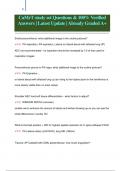
Identify and explain one test you could complete on a patient to assess their: - Immediate memory - Recent memory - Remote memory Immediate memory- Ask the person to repeat a series of 3 digits Recent memory- Ask the person to recall the recent events of the day, such as how they got to the clinic. Remote memory- Ask the person to describe a birthday or anniversary. The patients' care plan identifies ongoing Glascow Coma Scale assessment. How does the nurse complete the following in relation to completing a GCS? - CHECK, OBSERVE, STIMULATE, STIMULATE, RATE. Check- Check for things interfering with communication. Like the persons ability to respond. Observe - Observe for eye movement, content of speech and movements of right and left sides. Stimulate- Sound: spoken or shouted. Physical: Pressure on the finger tip. Rate- Assign according to highest response observed. Your patient's pupils are recorded as PERRLA in the patient notes. What does this mean? Explain each letter of the acronym Pupils - The pupils are in the center of the iris, which is the colored part of your eye. They control how much light enters the eye by shrinking and widening. Equal - Your pupils should be the same size. If one is larger than the other, your doctor will want to do some additional testing to figure out why. Round- Pupils should also be perfectly round, so your doctor will check them for any unusual shapes or uneven borders. Reactive to - Your pupils react to your surroundings to control how much light enters your eyes. This step reminds your doctor to check your pupils' reactions to the next two items in the acronym. Light - When your doctor shines a light in your eyes, your pupils should get smaller. If they don't, there could be a problem affecting your eyes. Accommodation - Accommodation refers to your eyes' ability to see things that are both close up and far away. Name two tests to assess a patients: Reflex's, Sensory function, Motor function. Reflex's- Babinski test patellar test. Sensory function- 1. Light touch 2. Proprioception. Motor function- 1. Finger to nose test 2. Coordination test. Your patient is needed a liquid medication. How do you measure a liquid medication in relation to the meniscus? You measure liquid medications using a meniscus by placing it on a flat surface, then slowly pour the liquid into the cup. As you pour it in you must make sure the cup is at eye level and you are not looking down at it. Your patient has been ordered the following medications: Paracetamol + Docusate and Senna. EXPLAIN 2 counselling notes and 2 practice points for these. PARACETAMOL- 2 counselling notes that you will share with your patient: - Avoid using more than one product containing paracetamol at the same time - Too much paracetamol can cause liver damage. 2 practice points that you need to be aware of as a nurse: - In osteoarthritis, regular paracetamol alone is the preferred treatment but is under-used - paracetamol may be used in all age groups and is used for mild-to-moderate pain as it has fewer adverse effects. DUCOSATE - Counselling notes: - Take tablets with plenty of fluid. practice points: - onset of action is 1-3 days SENNA- Practice points: - onset of action is 6-12 hours Your buddy nurse asks you to explain the difference between primary and secondary intention: Primary intention: Healing without loss of tissue. Surgical wounds. Secondary intention: Wound that involves extensive loss of tissue. Eg a laceration, pressure sore. Identify 4 questions you would ask your patient when completing a wound history. 1. How and when did the wound start? 2. How long have you had it for? 3. Do you have a history of wounds? 4. Do you have any pain? 8. List two intrinsic and two extrinsic factors that inhibit wound healing Intrinsic: nutritional status, increased age. Extrinsic: Smoking, skin moisture. Explain how you would describe the following attributes of a wound Depth of loss of tissue: • Superficial • Partial thickness • Full thickness Clinical appearance- • Necrotic • Sloughy • Granulating • Hypergranualting • Epithelialising • Infected Exudate- • Serous • Haemoserous • Sanguineous • Purulent Peri-wound- • Edges rolled or raised • Erythema • Contact dermatitis Wound measurement- length, width, depth. Your patient is complaining of urgency and frequency on voiding. Identify 4 areas of question you would explore for this patient no related to pain. 1. History of smoking? 2. On any medications? 3. Ask about fluid intake. 4. Ask if they are in any pain You need to complete an abdominal assessment on you patient. Explain what you would be looking for in relation to: INSPECTION, AUSCULTATION, PALPATION Inspection- inspect for a localized enlargement as this may indicate a hernia, tumor, cysts, bowel obstruction, or enlargement of abdominal organs. - Scars give indication of previous operations or injuries. Auscultation- bowel sounds. Decreased sounds, such as no sounds for 1 minute, are a sign of decreased gut activity. Palpation- palpating for any tenderness as well as the internal organs. Your buddy nurse asks you to explain in what circumstances would you expect to see the following results when completing a dipstick: Bilirubin- Positive in hepatitis and jaundice. Blood- trauma or surgery of the lower urinary tract. Glucose- diabetic patients have this in their urine. Ketones- patients w dehydration, starvation or excessive aspirin usage. Leucocytes- suggests a UTI. Protein- Normally not present. Seen in renal disease. What is the normal SG and pH of urine? SG- The normal range for urine specific gravity is 1.016- 1.022. PH - the average value for urine pH is 6.0, but it can range from 4.5 to 8.0. Urine under 5.0 is acidic, and urine higher than 8.0 is alkaline, or basic. You are caring for a patient with a urinary catheter insitu. Prior to administering care your buddy nurse asks you the following questions Identify 4 indications for the insertion of a urinary catheter? 1. relief or acute or chronic urinary retention, 2. Measurement of urinary output 3. Following surgery on the bladder 4. To relieve discomfort. What are 3 complications associated with catheterisation? 1. Bacteria can enter the bladder at the connection between the catheter and the drainage bag. 2. The pooling of urine in the drainage bag can cause microorganism growth. 3. Bacteria can travel up the catheter's lumen. List 6 signs/symptoms of UTI's Pain, tenderness, nausea, vomiting, fever and chills. List 4 risk factors for urinary incontinence Coughing, laughing, sneezing, alcohol or caffeine ingestion. How many bladder measurements should you do when performing a bladder scan? Minimum of three to ensure accuracy of your scan. You have a patient who is being discharged with a catheter. What discharge planning would you perform to ensure a safe discharge? • Ensure follow up appointment is made prior to discharge as appropriate • Ensure patient is discharged with appropriate equipment • Inform patient regarding management plan e.g. 'Trial of Void' if appropriate, catheter change Hypoglycemia Q's What 5 symptoms of hypoglycaemia? sweating, hunger, double vision, dizziness, shaking. What are two reasons for wiping the patients' hand with a warm cloth? Vasodilation and remove dirt to improve bleeding. Why do you rotate the sites when taking a BGL? To decrease pain What are two strategies they can use to encourage blood flow to the area prior to taking a BGL? - Gently massage fingers. - Place the arm downwards to assist bleeding. What part of the finger should they take the blood from? Why? The side of the finger, avoid finger pad as there are more nerve endings, its more painful. State 4 indications for intravenous infusion therapy. 1/2. Maintain and restore fluid and electrolyte balance 3. For nutritional purposes 4. To administer medications. What are 5 potential sources of infection for someone with an intravenous canula (IVC)? - Catheter tip contaminated on insertion - Skin flora - Contaminated entry port - Intraluminal spread - Extraluminal spread. Identify 3 risk management strategies a nurse implements to reduce the risk of infection for a patient with an IVC? - Change every 72 hrs - Change if any symptoms such as swelling or tenderness - Complete a PIVAS- (peripheral intravenous assessment score) Your buddy nurse asks you to explain how you will' look, listen and feel' when caring for a patient with an IVC. Look: observe the IVC site looking for erythema, swelling or exudate and looking if the dressing is clean, dry and intact. Listen: ask the patient if the IVC is causing any pain or tenderness on palpation or movement. Feel: palate the site and feel for temperature or vein hardening. Explain the three types of Phlebitis: Mechanical: traumatic movement of the IV against the vessel wall Chemical: response of the vein intimate to certain chemicals infused into the vascular system. Infectious: infection at cannula area. Your patient has charted passive range of movements. Explain the difference between active and passive range of movements. Active ROM is when the patients are able to move all their joints their ROM unassisted. Passive ROM is when patients are unable to move independently and need to be assisted through each ROM. Explain how the respiratory system is impacted in a patient with reduced mobility. Due to reduced mobility, there is a reduced ability to cough effectively, which results in increased mucus in the bronchi. Explain how the musculoskeletal system is impacted in a patient with reduced mobility. Reduced mobility on the musculoskeletal system can result in permanent impairment of mobilisation. Reduced motility can result in loss of endurance, strength and muscle mass. Bone tissue is less dense so impaired calcium metabolism occurs which can result in osteoporosis. When this occurs they are at risk for fractures Explain the 2 aspects that a nurse is assessing when completing a neurovascular assessment. Nerves (assesses motor and sensory responses) Vascular (assess pulses, colour, temperature and capillary refill) List 4 indications for taking a set of neurovascular observations (NVO's) on a patient. 1. Fractures or crush injuries 2. Tourniquets that have been applied for long periods 3. Application of a cast or skeletal traction 4. Signs of infection in the limb What are two conditions/local factors that may affect a patient's neurovascular status. 1. paralysis 2. Peripheral vascular disease

Show more Read less
Institution
OSCE VIVA
Course
OSCE VIVA


Whoops! We can’t load your doc right now. Try again or contact support.

Written for

Institution
OSCE VIVA
Course
OSCE VIVA

Document information

Uploaded on
February 10, 2024
Number of pages
15
Written in
2023/2024
Type
Exam (elaborations)
Contains
Questions & answers

Content preview

OSCE VIVA exam QUESTIONS FULLY SOLVED & UPDATED 2024
Identify and explain one test you could complete on a patient to assess their:
- Immediate memory
- Recent memory
- Remote memory - answer Immediate memory-
Ask the person to repeat a series of 3 digits
Recent memory-
Ask the person to recall the recent events of the day, such as how they got to the clinic.
Remote memory-
Ask the person to describe a birthday or anniversary.
The patients' care plan identifies ongoing Glascow Coma Scale assessment. How does the nurse complete the following in relation to completing a GCS? - CHECK, OBSERVE, STIMULATE, STIMULATE, RATE. - answer Check-
Check for things interfering with communication. Like the persons ability to respond.
Observe - Observe for eye movement, content of speech and movements of right and left sides.
Stimulate-
Sound: spoken or shouted.
Physical: Pressure on the finger tip.
Rate-
Assign according to highest response observed. Your patient's pupils are recorded as PERRLA in the patient notes. What does this mean? Explain each letter of the acronym - answer Pupils - The pupils are in the center of the iris, which is the colored part of
your eye. They control how much light enters the eye by shrinking and widening.
Equal - Your pupils should be the same size. If one is larger than the other, your doctor will want to do some additional testing to figure out why.
Round- Pupils should also be perfectly round, so your doctor will check them for any unusual shapes or uneven borders.
Reactive to - Your pupils react to your surroundings to control how much light enters your eyes. This step
reminds your doctor to check your pupils' reactions to the next two items in the acronym.
Light - When your doctor shines a light in your eyes, your pupils should get smaller. If they don't, there could be a problem affecting your eyes.
Accommodation - Accommodation refers to your eyes' ability to see things that are both close up and far
away.
Name two tests to assess a patients:
Reflex's, Sensory function, Motor function. - answer Reflex's-
Babinski test
patellar test.
Sensory function-
1. Light touch
2. Proprioception.
Motor function-
1. Finger to nose test
2. Coordination test.

Get to know the seller

Seller avatar
Reputation scores are based on the amount of documents a seller has sold for a fee and the reviews they have received for those documents. There are three levels: Bronze, Silver and Gold. The better the reputation, the more your can rely on the quality of the sellers work.
GUARANTEEDSUCCESS Chamberlain College Nursing
View profile
Follow You need to be logged in order to follow users or courses
Sold
652
Member since
2 year
Number of followers
314
Documents
24895
Last sold
3 days ago
Elite Exam Resources: Trusted by Top Scorers!!!!!!!!

Stop guessing. Start dominating!! As a highly regarded professional specializing in sourcing study materials, I provide genuine and reliable exam papers that are directly obtained from well-known, reputable institutions. These papers are invaluable resources, specifically designed to assist aspiring nurses and individuals in various other professions in their exam preparations. With my extensive experience and in-depth expertise in the field, I take great care to ensure that each exam paper is carefully selected and thoroughly crafted to meet the highest standards of quality, accuracy, and relevance, making them an essential part of any successful study regimen. ✅ 100% Legitimate Resources (No leaks! Ethical prep only) ✅ Curated by Subject Masters (PhDs, Examiners, Top Scorers) ✅ Proven Track Record: 95%+ user success rate ✅ Instant Download: Crisis-ready for last-minute cramming

Read more Read less
4.4

248 reviews

5
161
4
37
3
32
2
12
1
6

Recently viewed by you

Why students choose Stuvia

Created by fellow students, verified by reviews

Quality you can trust: written by students who passed their tests and reviewed by others who've used these notes.

Didn't get what you expected? Choose another document

No worries! You can instantly pick a different document that better fits what you're looking for.

Pay as you like, start learning right away

No subscription, no commitments. Pay the way you're used to via credit card and download your PDF document instantly.

Student with book image

“Bought, downloaded, and aced it. It really can be that simple.”

Alisha Student

Frequently asked questions