Transport in Humans
Blood
The human circulatory system carries substances around the body. Some important substances -
like water, oxygen etc. - are transported around the human body which are carried within the blood
in different forms.
Because heat energy transfers from hotter objects to cooler objects, blood also plays an important
role in distributing heat energy around the body.
- It carries heat energy away from the cells and prevents them overheating.
- It provides heat energy ro regions of the body where respiration takes place more slowly
- Also, by increasing the diameter of blood vessels in the skin, heat energy can be
transferred more rapidly to the environment during exercise to present the body
overheating
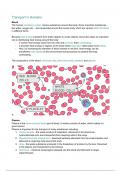
The composition of the blood: red blood cells, white blood cells, platelets and plasma
Plasma
Plasma is the straw-coloured liquid part of blood. It mainly consists of water, which makes it a
good solvent.
Plasma is important for the transport of many substances including:
1. Carbon dioxide - the waste product of respiration, dissolved in the plasma as
hydrocarbonate ions and transported from respiring cells to the lungs
2. Digested food and mineral ions - dissolved particles absorbed from the small intestine and
delivered to requiring cells around the body
3. Urea - the waste substance produced in the breakdown of proteins by the liver. Dissolved
in the plasma and transported to the kidneys
4. Hormones - chemical messengers released into the blood and delivered to target
organs/tissues
, 5. Heat energy - created in respiration - exothermic reaction - heat energy is transferred to
cooler parts of the body or to the skin where heat can be lost.
Red Blood Cells
Red blood cells are the most common cell in the blood. They have several adaptations that make
them efficient at transporting oxygen to repairing cells:
1. They have a biconcave disc shape that increases their surface area to volume ratio
compared with other cells This increases the rate at which diffusion into and out of the cell
can take place
2. They contain haemoglobin, the red chemical that carries oxygen in the cell. In areas of high
oxygen concentration haemoglobin binds with oxygen.
3. They have no nucleus which maximises the volume that can be filled with haemoglobin, but
means that the cells cannot divide to make new cells as they get older.
4. They are small and flexible which makes it possible for them to get through the smallest
blood vessels - capillaries - that are sometimes no wider than a single blood cell.
Remember
In the lungs, haemoglobin combines with oxygen to form oxyhaemoglobin
In other organs and tissues, oxyhemoglobin releases the oxygen to form haemoglobin again
because it is reversible.
Platelets
Platelets are small fragments of much larger cells that are also important in protecting from
infection. - NO NUCLEUS
When there is damage to a blood vessel, such as a cut, the platelets respond by releasing an
enzyme that causes the formation of a fibrous protein called fibrin.
- Fibrin traps blood cells and forms a blood clot. This is essential for staying healthy as it
seals the cut and prevents blood from leaking out and pathogens getting in.
White Blood Cells
There are several different types of white blood cell, but they all play an important role in defending
the body against disease.
- They are part of the immune system that responds to infection by trying to kill the pathogen
The two main types of white blood cell:
1. Phagocytes
They kill pathogens by ingesting them. They engulf pathogens by flowing around them until they
are completely enclosed and then digest them. Different types of phagocytes target different
pathogens, such as bacteria, fungi and protoctista parasites.
- This is a
non-specific
immune response
FLEXIBLE SHAPE TO
ENGULF MICROBES
Blood
The human circulatory system carries substances around the body. Some important substances -
like water, oxygen etc. - are transported around the human body which are carried within the blood
in different forms.
Because heat energy transfers from hotter objects to cooler objects, blood also plays an important
role in distributing heat energy around the body.
- It carries heat energy away from the cells and prevents them overheating.
- It provides heat energy ro regions of the body where respiration takes place more slowly
- Also, by increasing the diameter of blood vessels in the skin, heat energy can be
transferred more rapidly to the environment during exercise to present the body
overheating
The composition of the blood: red blood cells, white blood cells, platelets and plasma
Plasma
Plasma is the straw-coloured liquid part of blood. It mainly consists of water, which makes it a
good solvent.
Plasma is important for the transport of many substances including:
1. Carbon dioxide - the waste product of respiration, dissolved in the plasma as
hydrocarbonate ions and transported from respiring cells to the lungs
2. Digested food and mineral ions - dissolved particles absorbed from the small intestine and
delivered to requiring cells around the body
3. Urea - the waste substance produced in the breakdown of proteins by the liver. Dissolved
in the plasma and transported to the kidneys
4. Hormones - chemical messengers released into the blood and delivered to target
organs/tissues
, 5. Heat energy - created in respiration - exothermic reaction - heat energy is transferred to
cooler parts of the body or to the skin where heat can be lost.
Red Blood Cells
Red blood cells are the most common cell in the blood. They have several adaptations that make
them efficient at transporting oxygen to repairing cells:
1. They have a biconcave disc shape that increases their surface area to volume ratio
compared with other cells This increases the rate at which diffusion into and out of the cell
can take place
2. They contain haemoglobin, the red chemical that carries oxygen in the cell. In areas of high
oxygen concentration haemoglobin binds with oxygen.
3. They have no nucleus which maximises the volume that can be filled with haemoglobin, but
means that the cells cannot divide to make new cells as they get older.
4. They are small and flexible which makes it possible for them to get through the smallest
blood vessels - capillaries - that are sometimes no wider than a single blood cell.
Remember
In the lungs, haemoglobin combines with oxygen to form oxyhaemoglobin
In other organs and tissues, oxyhemoglobin releases the oxygen to form haemoglobin again
because it is reversible.
Platelets
Platelets are small fragments of much larger cells that are also important in protecting from
infection. - NO NUCLEUS
When there is damage to a blood vessel, such as a cut, the platelets respond by releasing an
enzyme that causes the formation of a fibrous protein called fibrin.
- Fibrin traps blood cells and forms a blood clot. This is essential for staying healthy as it
seals the cut and prevents blood from leaking out and pathogens getting in.
White Blood Cells
There are several different types of white blood cell, but they all play an important role in defending
the body against disease.
- They are part of the immune system that responds to infection by trying to kill the pathogen
The two main types of white blood cell:
1. Phagocytes
They kill pathogens by ingesting them. They engulf pathogens by flowing around them until they
are completely enclosed and then digest them. Different types of phagocytes target different
pathogens, such as bacteria, fungi and protoctista parasites.
- This is a
non-specific
immune response
FLEXIBLE SHAPE TO
ENGULF MICROBES