Hesi Case Study Susan Wilson #2 MNB Comprehensive Questions with correct Answers |LATEST 2024
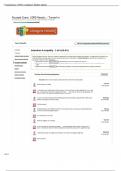
Hesi Case Study Susan Wilson #2 MNB Comprehensive Questions with correct Answers |LATEST 2024 Susan is 40 1/2 wks gestation and in labor. She states her cxns are 5-6 minutes apart. she states that she has been nauseated off and on for the last 24 hrs and has little to eat or drink; that she has urinated only once in the last 12 hrs Based on Susan's assessment data and hx, you ID which of the following as a priority nsg dx for her at this time? - Deficient Fluid Vol r/t inadequate intake of liquids Susan says she was lying in bed and suddenly felt a puddle underneath her. Sudden passing of a lg amt of fluid indicates that her mb's have ruptured (often the 1st sign of labor) - this fluid is amniotic fluid. With regard to Susan's ROMs, which questions are important? - - What was the color of the fluid? - What time did your water break? After confirming the time the her mb's ruptured, you determine that she has had bloody show. this is the release of brownish or blood tinged cervical mucous, also occurs in early labor. She is not having back pain which would suggest that the fetus was in a posterior position which would make labor more difficult. You place her on the Toco after performing Leopold's maneuvers to determine the position of the baby. In Leopold's, you palpate a somewhat round, soft, and irregular fetal part in the uterine fundus at the RUQ a smooth, convex contour along the Rt side of the abd, and a firm, round fetal part over the pelvic inlet Based on your assessment, you determine that the fetus is in a: - Cephalic presentation Based on your assessment, you position the US transducer on her abd at the: - RLQ Normal FHR is 110 - 160 bpm. The baby's HR is 135 w/ accelerations to 150 during cxns and a return to baseline after cxns. (Fetal tachycardia is a baseline FHR > 160 and lasting > 10 min) FHR increases can be associated w/ a variety of factors. These include: - - Maternal fever or infection - Fetal anemia - The mom receiving the drug Brethine (terbutaline) - The mom receiving the drug Yutopar (ritodrine) side note: maternal dehydration or hyperthyroidism can also cause fetal tachycardia. Fetal tachycardia can be an early sign of fetal hypoxia Variability in FHR is seen as irregular fluctuations from the baseline. In this 10 min tracing, the baseline FHR is 135, but the rate fluctuates from 130 - 140 consistently. the avg fluctuation of 10 bpm constitutes moderate variability. Moderate variability is a reassuring FHR pattern. This is important because it reflects the intactness of the fetal neurologic system, fetal oxygenation, and fetal O2 reserve. Variability indirectly indicates fetal tolerance of labor. A decrease in variability can occur when the fetus is asleep and typically lasts no longer than 30 min. a smooth baseline that lasts longer than 30 min suggests fetal distress Susan has been monitored for 15 min. Which of the following actions on your part is indicated? - Continue to monitor the FHR To measure the frequency of Susan's cxns you examine a 10 min strip and : - Determine the time from the beginning of 1 cxn to the beginning of the next (Note: You can also count from the peak of 1 cxn to the peak of the next to determine frequency) Susan's cxns are now every 5-6 min and lasting 30-45 seconds You perform a vaginal exam to check for shortening and thinning of her cervix. This is called: - Effacement She is at 3 cm and 80% effaced. You also determine that the fetus is at 0 station. John is curious about what you mean by "the fetus is at 0 station". Your response is based on the knowledge that 0 station means that: - The baby's presenting part is at the level of the mother's ischial spines Station advances from -5 to +5 as the presenting part of the fetus descends thru the pelvis. At -5, the presenting part is below the level of the iliac crests at the pelvic inlet. At +4 to +5, the presenting part is well past the ischial spines at the level of the ischial tuberosities, and birth is imminent Based on your assessment of Susan (3 cm , 80%, 0 station) and your interpretation of her data, you determine that she is now in which stage of labor? - Stage 1 (Note: Stage 1 begins w/ onset of cxns and ends w/ complete dilation of the cervix. Stage 2 begins w/ complete dilation and ends w/ delivery of the neonate. Stage 3 begins w/ delivery of the neonate and ends w/ expulsion of the placenta. Stage 4 is considered to be the first 1-2 hrs after delivery) Susan has decided to rest in bed for a while. Which of the following positions are acceptable? - - Left lateral - Right lateral (note: left lateral should be encouraged as the optimal position. It does not impede maternal circulation and promotes placental perfusion. The right later is acceptable; it does not interfere w/ maternal circulation or placental perfusion) You remind Susan that it is important for her to try to urinate q2h. the rationale for this is that a distended bladder can: - - Cause difficulty in voiding after delivery - Interfere w/ fetal descent - Increase the pain associated w/ uterine cxns As her labor progresses, cxns b/c stronger, relaxation and breathing techniques b/c less effective in alleviating discomfort. Susan asks for something to take the edge off. You examine her and find her to be 5-6 cm, 100%, 0 station. You call the dr. and receive an order for Stadol (butorphanol tartrate) 1 mg IVP In response to the order for Stadol, which of the following is indicated? - Administer the Stadol as ordered You determine that Susan is now in which phase of stage 1 labor? - Active phase (Note: she completed the latent phase {early labor when the cervix is 0-3 cm dilated) shortly after admission. she is now in active labor. During the active phase of stage 1, the cervix is 4-7 cm and mom b/c more focused as cxns b/c more painful. Increasing apprehension is common and companionship is very important. The transition phase of stage 1 occurs when the cervix is 8-10 cm. In the 2nd stage of labor, the cervix is flly dilated and the neonate is born) The active phase of the 1st stage is AKA the "phase of maximum slope" because cervical dilation proceeds at the most rapid pace during this time. The cervix dilates an avg of 3.5 cm / hr in primigravidas, and as much as 9 cm / hr in multiparous women. Cxns are moderate to strong and reg. They occur q 2-5 min and last about 1 min. A number of factors may affect the length of time a woman;s labor will last. These include: - - The parity of the mother - Maternal activity and position - Fetal position and size Susan's husband John has become demanding and fatigued, but mentions feeling guilty about needing a break. What is the best nsg action to take at this time? - Suggest that John take a short break and have another family member coach Susan temporarily FHR remains at 135 w/ moderate variability present. However, when there is a cxn, the FHR decreases in a pattern that looks like an upside down cxn
Written for
- Institution
-
Chamberlain College Nursing
- Course
-
2023 NUR301 HESI
Document information
- Uploaded on
- February 9, 2024
- Number of pages
- 11
- Written in
- 2023/2024
- Type
- Exam (elaborations)
- Contains
- Questions & answers
Subjects
-
hesi case study susan wilson 2 mnb