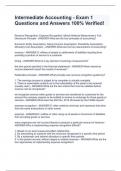
Intermediate Accounting - Exam 1 Questions and Answers 100% Verified!
Revenue Recognition, Expense Recognition, Mixed-Attribute Measurement, Full-Disclosure Principle - ANSWER-What are the four principles of accounting? Economic Entity Assumption, Going Concern Assumption, Periodicity Assumption, Monetary Unit Assumption - ANSWER-What are the four assumptions of accounting? revenue - ANSWER-D: inflows of assets or settlements of liabilities resulting from providing a product or service to a customer timing - ANSWER-What is a key element of earnings measurement? the time period specified in the financial statements - ANSWER-When should an income statement report the results of revenues? Realization principle - ANSWER-What principle was revenue recognition guided by? 1. The earnings process is judged to be complete or virtually complete. 2. There is reasonable certainty as to the collectability of the asset to be received (usually cash) - ANSWER-What are the two criteria that must be satisfied before revenue can be recognized? we recognize revenue when goods or services are transferred to customers for the amount the company expects to be entitled to receive in exchange for those goods or services - ANSWER-What does the ASU No. 2014-09 issued by the FASB require? expense recognition - ANSWER-D: often matches revenues and expenses that arise from the same transactions or other events expense - ANSWER-D: outflow or other using up of assets or incurrence of liabilities from providing goods or services many expenses are not incurred directly to produce a particular amount of revenue - ANSWER-Why is implementing expense recognition difficult? 1. Based on an exact cause-and-effect relationship 2. By associating an expense with the revenues recognized in a specific time period 3. By a systematic and rational allocation to specific time periods 4. In the period incurred, without regard to related revenues - ANSWER-What are the four approaches to implementing expense recognition? 1. Historical Cost 2. Net Realizable Value 3. Current Cost 4. Present Value 5. Future Value - ANSWER-What are the five attributes of the mixed-attribute measurement? historical cost - ANSWER-D: original transaction value adjusted for depreciation and amortization; bases measurement on the amount given or received in the exchange transaction (aka: original transaction value) historical cost for assets - ANSWER-D: the value of what is given in exchange (usually cash) for the asset at its initial acquisition historical cost for liabilities - ANSWER-D: the current cash equivalent received in exchange for assuming the liability
Written for
- Institution
- Intermediate Accounting -
- Course
- Intermediate Accounting -
Document information
- Uploaded on
- February 9, 2024
- Number of pages
- 8
- Written in
- 2023/2024
- Type
- Exam (elaborations)
- Contains
- Questions & answers
Subjects
-
intermediate accounting exam 1 questions and ans
-
intermediate accounting exam 1 stuvia
-
revenue recognition expense recognition mixed at
-
economic entity assumption going concern assumpti

Also available in package deal