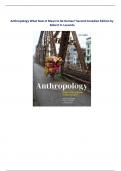
Anthropology What Does It Mean to Be Human? Second Canadian Edition by
Robert H. Lavenda
, CHAPTER 1
WHAT IS ANTHROPOLOGY?
MULTIPLE CHOICE QUESTIONS
1. In the textbook, "anthropology" is defined as the study of ________.
a) human nature, human society, human language, and the human past
b) the remains of earlier societies and peoples
c) the ways of life of contemporary peoples
d) the physical and mental capacities of human beings
2. The authors define "holism" as ________.
a) trying to study everything possible about a group of people
b) integrating what is known about human beings and their activities
c) studying human biology and culture at the same time
d) fitting together economics, political science, religious studies, and biology
3. To say that anthropology is comparative means that ________.
a) each anthropologist studies many different societies during his or her career
b) anthropological generalizations draw on evidence from the widest possible range of societies
c) anthropologists use data from many different academic disciplines
d) there is no one way for the anthropologist to do research
4. ________ is NOT listed in the text as an element of the anthropological perspective.
a) Holism
b) Comparison
c) Evolution
d) Culturalism
5. A ________ study examines how economics, politics, religion, and kinship shape one another in a specific
society.
a) detailed
b) cultural
c) holistic
d) comparative
6. An anthropologist studying a social group observes that people shake hands when greeting one another and
,concludes that handshaking is universal among humans. This study is faulty because it was not ________.
a) holistic
b) evolutionary
c) ethnocentric
d) comparative
7. When we say that anthropology is a field-based discipline, we mean that ________.
a) information about particular social groups comes through direct contact with them
b) anthropologists working in universities intersperse teaching and other tasks with field research
c) research connects anthropologists directly with the lived experiences of other people and to the material
evidence that people have left
d) All of the above
8. According to the text, culture consists of ________.
a) sets of learned behaviours and ideas that humans acquire as members of society
b) elements of human experience that require education and good taste, such as fine art, classical music, and
literature
c) sets of innate behaviours that enable humans to function in a complex world
d) those practices that distinguish one group of humans from another
9. North Americans typically do not eat insects because they have learned to label insects as inedible. This
explanation is based on ________.
a) culture
b) biology
c) ethnocentrism
d) genetic programming
10. When we state that humans are biocultural organisms, we mean that ________.
a) human biology makes culture possible, and human culture makes human biological survival possible
b) biology is more important than culture for humans
c) human culture predates our biological organism
d) humans evolved independently of our ability to create culture
11. Traditionally, North American anthropology has been divided into ________ subfields.
a) two
b) three
c) four
d) five
12. According to the text, ________ is NOT a major subfield of North American anthropology.
a) Archaeology
b) Cultural anthropology
c) Biological anthropology
d) Physiological anthropology
13. The following statement is NOT associated with the traditional North American model of anthropology:
________.
a) This configuration reflects anthropology's commitment to holism.
, b) This configuration is associated with anthropology's successful fight against 19th century scientific racism.
c) This configuration constitutes a protected "trading zone" within which fresh concepts and knowledge from a
variety of research traditions are brought together.
d) This model is widespread in Europe and other parts of the world.
14. Social groupings that allegedly reflect biological differences are called ________.
a) populations
b) cultures
c) races
d) ethnicities
15. Nineteenth-century attempts to group all humans into unambiguous categories called "races" were based on
________.
a) observable physical features, such as skin color, hair type, and skull shape
b) supposed mental and moral attributes
c) existing beliefs about the inherent biological superiority of some races and the inferiority of others
d) All of the above
16. Michel Bouchard's research on status and stigma among French-speakers in Alberta shows that ________.
a) young children know which language is dominant
b) French is spoken only by people who have recently arrived in Alberta from Quebec
c) French-speaking children in Alberta believe that they belong to a high-status-group
d) media campaigns can reduce the stigma felt by linguistic minorities
17. By the early twentieth century, some anthropologists and biologists concluded that the concept of "race" was
________.
a) justified by the increasingly scientific biological research on humans
b) a cultural label invented by humans to sort people into groups
c) a political liability, although the evidence was increasingly strong in its favor
d) a label that recognized important cultural and biological differences between groups
18. After discrediting scientific racism and moving away from the classification of humans into distinct races,
biological anthropologists shifted their attention to ________.
a) patterns of variation and adaptation within the human species as a whole
b) the material remains of the human past
c) present-day social arrangements in human groups
d) human symbolic communication
19. ________ refers to the systematic oppression of members of one or more socially defined "races" by members
of another socially defined "race" that is justified in terms of the supposed inherent biological superiority of the
rulers and the supposed inherent biological inferiority of those they rule.
a) Ethnocentrism
b) Hierarchy
c) Racism
d) Hegemony
20. Primatologists are biological anthropologists who study ________.
a) the closest living relatives of humans
Robert H. Lavenda
, CHAPTER 1
WHAT IS ANTHROPOLOGY?
MULTIPLE CHOICE QUESTIONS
1. In the textbook, "anthropology" is defined as the study of ________.
a) human nature, human society, human language, and the human past
b) the remains of earlier societies and peoples
c) the ways of life of contemporary peoples
d) the physical and mental capacities of human beings
2. The authors define "holism" as ________.
a) trying to study everything possible about a group of people
b) integrating what is known about human beings and their activities
c) studying human biology and culture at the same time
d) fitting together economics, political science, religious studies, and biology
3. To say that anthropology is comparative means that ________.
a) each anthropologist studies many different societies during his or her career
b) anthropological generalizations draw on evidence from the widest possible range of societies
c) anthropologists use data from many different academic disciplines
d) there is no one way for the anthropologist to do research
4. ________ is NOT listed in the text as an element of the anthropological perspective.
a) Holism
b) Comparison
c) Evolution
d) Culturalism
5. A ________ study examines how economics, politics, religion, and kinship shape one another in a specific
society.
a) detailed
b) cultural
c) holistic
d) comparative
6. An anthropologist studying a social group observes that people shake hands when greeting one another and
,concludes that handshaking is universal among humans. This study is faulty because it was not ________.
a) holistic
b) evolutionary
c) ethnocentric
d) comparative
7. When we say that anthropology is a field-based discipline, we mean that ________.
a) information about particular social groups comes through direct contact with them
b) anthropologists working in universities intersperse teaching and other tasks with field research
c) research connects anthropologists directly with the lived experiences of other people and to the material
evidence that people have left
d) All of the above
8. According to the text, culture consists of ________.
a) sets of learned behaviours and ideas that humans acquire as members of society
b) elements of human experience that require education and good taste, such as fine art, classical music, and
literature
c) sets of innate behaviours that enable humans to function in a complex world
d) those practices that distinguish one group of humans from another
9. North Americans typically do not eat insects because they have learned to label insects as inedible. This
explanation is based on ________.
a) culture
b) biology
c) ethnocentrism
d) genetic programming
10. When we state that humans are biocultural organisms, we mean that ________.
a) human biology makes culture possible, and human culture makes human biological survival possible
b) biology is more important than culture for humans
c) human culture predates our biological organism
d) humans evolved independently of our ability to create culture
11. Traditionally, North American anthropology has been divided into ________ subfields.
a) two
b) three
c) four
d) five
12. According to the text, ________ is NOT a major subfield of North American anthropology.
a) Archaeology
b) Cultural anthropology
c) Biological anthropology
d) Physiological anthropology
13. The following statement is NOT associated with the traditional North American model of anthropology:
________.
a) This configuration reflects anthropology's commitment to holism.
, b) This configuration is associated with anthropology's successful fight against 19th century scientific racism.
c) This configuration constitutes a protected "trading zone" within which fresh concepts and knowledge from a
variety of research traditions are brought together.
d) This model is widespread in Europe and other parts of the world.
14. Social groupings that allegedly reflect biological differences are called ________.
a) populations
b) cultures
c) races
d) ethnicities
15. Nineteenth-century attempts to group all humans into unambiguous categories called "races" were based on
________.
a) observable physical features, such as skin color, hair type, and skull shape
b) supposed mental and moral attributes
c) existing beliefs about the inherent biological superiority of some races and the inferiority of others
d) All of the above
16. Michel Bouchard's research on status and stigma among French-speakers in Alberta shows that ________.
a) young children know which language is dominant
b) French is spoken only by people who have recently arrived in Alberta from Quebec
c) French-speaking children in Alberta believe that they belong to a high-status-group
d) media campaigns can reduce the stigma felt by linguistic minorities
17. By the early twentieth century, some anthropologists and biologists concluded that the concept of "race" was
________.
a) justified by the increasingly scientific biological research on humans
b) a cultural label invented by humans to sort people into groups
c) a political liability, although the evidence was increasingly strong in its favor
d) a label that recognized important cultural and biological differences between groups
18. After discrediting scientific racism and moving away from the classification of humans into distinct races,
biological anthropologists shifted their attention to ________.
a) patterns of variation and adaptation within the human species as a whole
b) the material remains of the human past
c) present-day social arrangements in human groups
d) human symbolic communication
19. ________ refers to the systematic oppression of members of one or more socially defined "races" by members
of another socially defined "race" that is justified in terms of the supposed inherent biological superiority of the
rulers and the supposed inherent biological inferiority of those they rule.
a) Ethnocentrism
b) Hierarchy
c) Racism
d) Hegemony
20. Primatologists are biological anthropologists who study ________.
a) the closest living relatives of humans