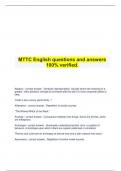
MTTC English questions and answers 100% verified.
MTTC English questions and answers 100% verified. Allegory - correct answer. Symbolic representation. Usually where the meaning of a greater, often abstract, concept is conveyed with the aid of a more corporeal object or idea. "Faith is like a stony uphill climb..." Alliteration - correct answer. Repetition of similar sounds. "The Wicked Witch of the West." Analogy - correct answer. Comparison between two things. Some are similes, some are metaphors. Archetype - correct answer. Universally understood symbol, term, or pattern of behavior. A prototype upon which others are copied, patterned or emulated. "Romeo and Juliet are an archetype of eternal love and a star-crossed love story." Assonance - correct answer. Repetition of similar vowel sounds. Connotation - correct answer. Secondary meaning of a word. Goes beyond literal or dictionary meaning. Consonance - correct answer. Repetition of similar constant sounds. Denotation - correct answer. Dictionary definition of a word or literal meaning. Diction - correct answer. Style of speaking or writing as dependent upon choice of words. Some modern day writers use terms such as 'thy', 'thee' and 'wherefore' to imbue a Shakespearean mood to their work. Epilogue - correct answer. Afterword after the last chapter is over. Epithet - correct answer. Descriptive device that usually adds to a person or place's regular name. "Alexander the Great" is an epithet refering to Alexander III of Macedon. Euphemism - correct answer. Using a milder form of a negative description instead of its original. Usually about sex, crimes, violence, "embarrassing" things... Hyperbole - correct answer. Exaggeration. Litote - correct answer. Understatement. Way of saying something unpleasant without directly using negativity. "He's definitely not a rocket scientist" instead of "He is not smart." Malapropism - correct answer. Practice of substituting words to convey the speaker is flustered or confused. "Our watch, sir, have indeed comprehended two auspicious persons" instead of "Our watch, sir, have indeed apprehended two suspicious persons." Metaphor - correct answer. Comparison in which one thing said to be another. Motif - correct answer. Element, subject, idea or concept that is constantly present through the piece. "A handsome prince falling in love with a damsel in distress." Onomatopoeia - correct answer. Words that imitate sounds they describe. Simile - correct answer. Comparison using "like" or "as." Spoonerism - correct answer. Interchanging the first letters of some words to create a humorous setting. Syntax - correct answer. Study of the parts of speech; the structure of sentences and what determines which words go where Semantics - correct answer. The study of meaning; how the way in which words are put together creates meaning Phonology - correct answer. Study of the sound of languages; how speech sounds are used to convey meaning Morphology - correct answer. "Mental dictionary"; mental system of rules that helps us form and understand words Epic Poetry - correct answer. Long narrative telling the story of a hero, usually taking a journey of great mythic or historical significance "Beowulf," John Milton's "Paradise Lost," and Edmund Spenser's "The Faerie Queene" Dramatic Poetry - correct answer. An imagined, single speaker addresses a silent listener, usually not the reader Couplet - correct answer. A pair of successive rhyming lines, usually of the same length Closed Couplet - correct answer. When the pair of lines in a couplet form a sentence Sonnet - correct answer. Poem of 14 lines with a set rhyme scheme that varies, brought to England by Sir Thomas Wyatt and Henry Howard English (or Shakespearean), Italian, and Petrarchan sonnet types Ballad - correct answer. Form of poetry in a narrative song, usually sung John Keats's "La Belle Dame sans Merci," Thomas Hardy's "During Wind and Rain," and Edgar Allan Poe's "Annabel Lee" Biographical, deconstructionist, feminist, formalist, historical, mythological, psychological, reader-response, sociological - correct answer. Types of criticism Formalist/New Criticism - correct answer. Approach that analyzes the inherent features of a text. Focus is not on author, historical context, or our own rxns, but on the text itself. Focus on things like grammar, symbols, images...
Written for
- Institution
- MTTC English
- Course
- MTTC English
Document information
- Uploaded on
- February 8, 2024
- Number of pages
- 6
- Written in
- 2023/2024
- Type
- Exam (elaborations)
- Contains
- Questions & answers
Subjects

Also available in package deal