Task 1
Signal theory: digital signalling methods; representng data electronically (bits, bytes,
packet structures); synchronous transmission; asynchronous transmission; error
detecton; error correcton; bandwidth limitaton; bandwidth noise; channel types e.g.,
telephone, high frequency (HF) radio, microwave, satellite; other issues e.g., bandwidth,
data compression.
Digital signalling methods – (DSP)
Data Signalling methods (DSP) is the use of signals used in real world for example voice,
audio and pressure which are digitalized and then with the use of maths signals are
processed into the data.
For data to get from one destnaton to another it needs to be transmited from a computer
by means of signals. Signals consist of binary code, which when sent is traveling as binary
through cables such as fbre optc, copper or anything that is good at transmitng energy.
Good example of binary to decimal diference is 27 in decimal would be 011011 in binary
where “0” stands for of and “1” for on.
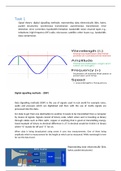
When data is being broadcasted using waves it uses two measurements. One of them being
amplitude which is measurement for the height at which can be measured. While wavelength is how
far can the data travel.
Representng data electronically (bits,
bytes, packet structures)
Signal theory: digital signalling methods; representng data electronically (bits, bytes,
packet structures); synchronous transmission; asynchronous transmission; error
detecton; error correcton; bandwidth limitaton; bandwidth noise; channel types e.g.,
telephone, high frequency (HF) radio, microwave, satellite; other issues e.g., bandwidth,
data compression.
Digital signalling methods – (DSP)
Data Signalling methods (DSP) is the use of signals used in real world for example voice,
audio and pressure which are digitalized and then with the use of maths signals are
processed into the data.
For data to get from one destnaton to another it needs to be transmited from a computer
by means of signals. Signals consist of binary code, which when sent is traveling as binary
through cables such as fbre optc, copper or anything that is good at transmitng energy.
Good example of binary to decimal diference is 27 in decimal would be 011011 in binary
where “0” stands for of and “1” for on.
When data is being broadcasted using waves it uses two measurements. One of them being
amplitude which is measurement for the height at which can be measured. While wavelength is how
far can the data travel.
Representng data electronically (bits,
bytes, packet structures)