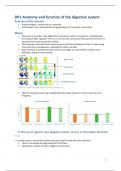
DP1 Anatomy and function of the digestive system
Anatomy of the stomach
• Proximal region = mainly acts as a reservoir
• Distal region = for mixing and churning (grinding, lot of muscular contraction)
Mixing
• Chromium is a marker, they added this to the feed in order to how the Cr is distributed in
the stomach after ingestion. The Cr is in red. So when the animal has just been fed, the Cr is
located at the same location for all diets.
• Then the pig is mixing the feed, and you can see that the distribution of the Cr is becoming
more and more homogeneous, especially for white rice diets.
• But if you look at roasted almonds, which is quit rigids, you see that the mixing is more
difficult to achieve for the animal.
• Most of mixing and churning is happening in the distal stomach, so that is why the pH is
dropping.
Pectin
= a complex starch, derived from plants and used as gel in foods like jams and jellies.
• Pectin is increasing the jelly properties of the feed
• Absorption of water, animals struggle to eat the feed
1
,Brown rice provides a more heterogeneous feed with preserved bran during digestion compared to
white rice, which is softer and easier for the animal to break down.
2
,Analytical work involves two distinct phases:
1. Preanalytical Phase: This phase is pivotal, as any errors here are irreparable.
- Sampling
- Sample preparation
- Storage
2. Analytical Phase:
- Performing the analyses
- Evaluation of results
Sulfuric acid is used to break down protein because it's a really strong acid and it can break down
oxidation bonds.
➔ Amount of protein = amount of nitrogen * 6.25
➔ To find out how much protein is in something, we multiply the amount of nitrogen by 6.25
because, on average, 16% of amino acids is nitrogen.
Crude fat = everything that remains after direct extraction of fat with petroleum ether -> which is not
solvent = not soluble in water.
➔ Even though sugar and fiber both have parts made of glucose, the bond holding glucose in
fiber is stronger than in sugar.
Soluble fermentable carbohydrates are a kind of sugar in the food. We find it by taking away some
fiber from total fiber, including things like pectin, fructans, and oligosaccharides.
The Van Soest method involves:
• Solvent and fractions
• NDF and ADF: using this method is challenging and not suitable for monogastric animals.
• Pectins
• Fructans
• Oligosaccharides
Crude fiber = hemicellulose + cellulose
➔ NSP = Non-Starch Polysaccharides
➔ NDF = Neutral Detergent Fiber, like pectins, fructans, and oligosaccharides.
➔ ADF = Acid Detergent Fiber
Key considerations include the analysis of dietary fiber, NSP, and adherence to the Van Soest method.
Soluble fermentable carbohydrates = dietary fiber – NDF
3
, Duodenum
= absorption and digestion
Brunner's glands =
• Secrete bicarbonate rich mucus
Jejunum
= similar to duodenum but with more blood supply and can
absorb larger macronutrients
Ileum
Goblet cells
• Secrete alkaline mucus
Peyer's patches
Summary
The anatomy of the stomach involves distinct regions serving different functions, such as acting as a
reservoir in the proximal region and facilitating mixing and churning in the distal region. Mixing in the
stomach is influenced by factors such as feed composition, with pectin increasing the gel-like
properties of feed and impacting water absorption. Analytical work in nutrition involves preanalytical
and analytical phases, with sulfuric acid used to break down proteins for analysis and methods like
the Van Soest method utilized for fiber analysis. The duodenum is primarily responsible for
absorption and digestion, with specialized glands like Brunner's glands in the duodenum and goblet
cells in the ileum contributing to digestive processes.
Exam Questions
1. Describe the role of pectin in feed composition and its effects on digestion in animals.
2. Explain the importance of the preanalytical phase in nutritional analysis, detailing its
components and importance.
3. How does the anatomy of the stomach contribute to the mixing and churning of feed during
digestion? Provide examples.
4. Discuss the methods used in nutritional analysis, focusing on the Van Soest method and its
applications.
5. Compare the functions of the duodenum, jejunum, and ileum in digestion and absorption,
highlighting their unique characteristics.
6. What are Brunner's glands and goblet cells, and how do they contribute to digestive
processes in the small intestine?
4
Anatomy of the stomach
• Proximal region = mainly acts as a reservoir
• Distal region = for mixing and churning (grinding, lot of muscular contraction)
Mixing
• Chromium is a marker, they added this to the feed in order to how the Cr is distributed in
the stomach after ingestion. The Cr is in red. So when the animal has just been fed, the Cr is
located at the same location for all diets.
• Then the pig is mixing the feed, and you can see that the distribution of the Cr is becoming
more and more homogeneous, especially for white rice diets.
• But if you look at roasted almonds, which is quit rigids, you see that the mixing is more
difficult to achieve for the animal.
• Most of mixing and churning is happening in the distal stomach, so that is why the pH is
dropping.
Pectin
= a complex starch, derived from plants and used as gel in foods like jams and jellies.
• Pectin is increasing the jelly properties of the feed
• Absorption of water, animals struggle to eat the feed
1
,Brown rice provides a more heterogeneous feed with preserved bran during digestion compared to
white rice, which is softer and easier for the animal to break down.
2
,Analytical work involves two distinct phases:
1. Preanalytical Phase: This phase is pivotal, as any errors here are irreparable.
- Sampling
- Sample preparation
- Storage
2. Analytical Phase:
- Performing the analyses
- Evaluation of results
Sulfuric acid is used to break down protein because it's a really strong acid and it can break down
oxidation bonds.
➔ Amount of protein = amount of nitrogen * 6.25
➔ To find out how much protein is in something, we multiply the amount of nitrogen by 6.25
because, on average, 16% of amino acids is nitrogen.
Crude fat = everything that remains after direct extraction of fat with petroleum ether -> which is not
solvent = not soluble in water.
➔ Even though sugar and fiber both have parts made of glucose, the bond holding glucose in
fiber is stronger than in sugar.
Soluble fermentable carbohydrates are a kind of sugar in the food. We find it by taking away some
fiber from total fiber, including things like pectin, fructans, and oligosaccharides.
The Van Soest method involves:
• Solvent and fractions
• NDF and ADF: using this method is challenging and not suitable for monogastric animals.
• Pectins
• Fructans
• Oligosaccharides
Crude fiber = hemicellulose + cellulose
➔ NSP = Non-Starch Polysaccharides
➔ NDF = Neutral Detergent Fiber, like pectins, fructans, and oligosaccharides.
➔ ADF = Acid Detergent Fiber
Key considerations include the analysis of dietary fiber, NSP, and adherence to the Van Soest method.
Soluble fermentable carbohydrates = dietary fiber – NDF
3
, Duodenum
= absorption and digestion
Brunner's glands =
• Secrete bicarbonate rich mucus
Jejunum
= similar to duodenum but with more blood supply and can
absorb larger macronutrients
Ileum
Goblet cells
• Secrete alkaline mucus
Peyer's patches
Summary
The anatomy of the stomach involves distinct regions serving different functions, such as acting as a
reservoir in the proximal region and facilitating mixing and churning in the distal region. Mixing in the
stomach is influenced by factors such as feed composition, with pectin increasing the gel-like
properties of feed and impacting water absorption. Analytical work in nutrition involves preanalytical
and analytical phases, with sulfuric acid used to break down proteins for analysis and methods like
the Van Soest method utilized for fiber analysis. The duodenum is primarily responsible for
absorption and digestion, with specialized glands like Brunner's glands in the duodenum and goblet
cells in the ileum contributing to digestive processes.
Exam Questions
1. Describe the role of pectin in feed composition and its effects on digestion in animals.
2. Explain the importance of the preanalytical phase in nutritional analysis, detailing its
components and importance.
3. How does the anatomy of the stomach contribute to the mixing and churning of feed during
digestion? Provide examples.
4. Discuss the methods used in nutritional analysis, focusing on the Van Soest method and its
applications.
5. Compare the functions of the duodenum, jejunum, and ileum in digestion and absorption,
highlighting their unique characteristics.
6. What are Brunner's glands and goblet cells, and how do they contribute to digestive
processes in the small intestine?
4