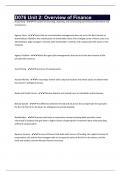
D076 Unit 2: Overview of Finance
Accounting - The system of recording, reporting, and summarizing past financial information and transactions. Agency Costs - Costs that are incurred when management does not act in the best interest of shareholders; related to the maximization of shareholder value; firms mitigate some of these costs is by attempting to align managers' interests with shareholders' interests and compensate with shares in the company Agency Problem - When the agent (the management) does not act in the best interest of the principal (the owners). Asset Pricing - The process of valuing assets. Auction Market - A secondary market with a physical location and where prices are determined by investors' willingness to pay. Banks and Credit Unions - Receive deposits and extend loans to individuals and businesses. Bid-ask Spread - The difference between the bid and ask prices that compensate the specialist for the risk that he or she bears for willingness to provide liquidity. Bondholders - A person who loans a corporation money by buying debt securities; more interested in projects that give them a higher chance of getting their investment back while providing sufficient compensation Business Finance - An area of finance that deals with sources of funding, the capital structure of corporations, the actions that managers take to increase the value of the firm to its owners, and the tools and analysis used to allocate financial resources. Capital - A financial asset that can be used by a firm or individual. Examples of capital may be machinery or cash held by a firm. Capital Markets - A type of financial market used for long-term assets that are held for greater than one year. Capital Structure - The mixture of debt and equity used to finance a firm. Cash Management - Managing the day-to-day finance operations of a firm. Central Banks - Ensure that a nation's economy remains healthy by controlling the amount of money circulating in the economy (example: Federal Reserve Bank). Corporate Bonds - A debt instrument that is issued by a corporation in order to raise capital. Credit Analysts - A commercial bank position with the responsibility to assess the riskiness of lending to borrowers and determining whether or not loans should be extended to potential bank clients. Current Market Value - What someone would pay right now for an asset. Dealer Market - A secondary market made up of multiple dealers that hold an inventory of securities and quote prices. Efficient market - A market in which prices fully reflect all the available information about a specific security. Estates - Everything that a person owns or controls, especially at death. Ethical Dilemma - An issue in the process of deciding between multiple options where no option is completely acceptable from an ethical standpoint. Ethics - Following accepted standards of moral conduct that guide a person's behavior; may be formed by social norms, cultural background, or religious beliefs and influences Finance - The study of managing and allocating funds at the personal or business level. Financial Institutions - An area of finance that includes firms or organizations that exist to accept a wide variety of deposits, to offer investment products to individuals and businesses, to provide loans, or to broker financial transactions. Financial Managers - A person who makes strategic financial decisions in a corporation; are interested in safe but successful projects to keep their jobs secure and their compensation steady; can also be owners of the corporation through stock compensation and may actually be willing to take on riskier projects that the bondholders may not prefer Financial Policy Implementation - Incorporating new finance ideas within a firm. Harvest - Generating cash or stock from the sales or IPO of companies in the portfolio of investments. Initial Public Offering (IPO) - When a privately held company first offers shares of stock to outside investors to raise capital, therefore becoming a publicly owned company. Insurance Companies - Charge premiums to invest in bonds and stocks to pay claims.
Written for
- Institution
- D076 WGU
- Course
- D076 WGU
Document information
- Uploaded on
- February 7, 2024
- Number of pages
- 15
- Written in
- 2023/2024
- Type
- Exam (elaborations)
- Contains
- Questions & answers
Subjects
-
d076 unit 2 overview of finance

Also available in package deal