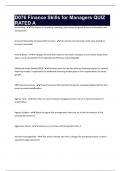
D076 Finance Skills for Managers QUIZ RATED A
Accounting - The system of recording, reporting, and summarizing past financial information and transactions. Accounts Receivable Turnover (AR Turnover) - An activity ratio found by credit sales divided by accounts receivable. Activity Ratios - A category of ratios that measure how well a company uses its assets to generate sales or cash, showing the firm's operational efficiency and profitability. Additional Funds Needed (AFN) - Another name for the discretionary financing needed or external financing needed. It represents the additional financing needed given a firm's expectations for future growth. Affirmative Covenants - A bond covenant that describes things the company pledges itself to do in order to protect bondholders. Agency Costs - Costs that are incurred when management does not act in the best interest of shareholders. Agency Problem - When the agent (the management) does not act in the best interest of the principal (the owners). Aggressive Assets - Companies or securities with beta greater than 1. Annual Percentage Rate - The annual interest rate that is charged for borrowing money or that is earned through investment. Annuity - A stream of cash flows of an equal amount paid every consecutive period. Annuity Due - A series of equal payments made at the beginning of consecutive periods. Asset Pricing - The process of valuing assets. Auction Market - A secondary market with a physical location and where prices are determined by investors' willingness to pay. Average Collection Period (ACP) - An activity ratio found by the number of days in a year (365) divided by AR turnover. Balance Sheet Forecasting - Using sales growth and the profit forecast to construct a pro forma balance sheet to understand the future implications of the sources and uses of finances. Banks and Credit Unions - Receive deposits and extend loans to individuals and businesses. Benchmarking - The process of completing a financial analysis to compare a firm's financial performance to that of other similar firms. Beta - A variable that describes how the price of a security varies with the market. Bid-ask Spread - The difference between the bid and ask prices that compensate the specialist for the risk that he or she bears for willingness to provide liquidity. Board of Directors - A group of people who jointly supervise the activities of an organization. Bond Indenture - A legal contract that governs the relationship between a firm and its bondholders. Bondholders - A person who loans a corporation money by buying debt securities. Business Finance - An area of finance that deals with sources of funding, the capital structure of corporations, the actions that managers take to increase the value of the firm to its owners, and the tools and analysis used to allocate financial resources. Cannibalization - The reduction in sales of a company's own products due to introduction of another similar product. Capital - A financial asset that can be used by a firm or individual. Examples of capital may be machinery or cash held by a firm. Capital Asset Pricing Model (CAPM) - A model used to determine the risk-return relationship for an asset. Capital Budgeting - The process of evaluation and planning for purchases of long-term assets. Capital Budgeting Criteria - Metrics and calculations used to determine whether a project or asset will add value and be a worthwhile investment. Capital Investment - The sum of money invested in a business to purchase long-term assets to further its objective of maximizing owner wealth. Capital Markets - A type of financial market used for long-term assets that are held for greater than one year.
Written for
- Institution
- D076 WGU
- Course
- D076 WGU
Document information
- Uploaded on
- February 7, 2024
- Number of pages
- 19
- Written in
- 2023/2024
- Type
- Exam (elaborations)
- Contains
- Questions & answers
Subjects
-
d076 finance skills for managers quiz rated a

Also available in package deal