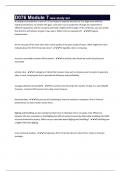
D076 Module 7 new study set
A company currently has a ratio of 1.5 but hopes to improve the ratio to 2 to align more with the industry benchmark. To achieve this goal, costs were cut in production through an investment in efficient equipment, and the company achieved a higher profit margin. If this continues, you are certain that the firm will achieve its goal in two years. What is this an example of? - Progress measurement A firm has paid off its short-term loans more quickly in the past couple of years. What might this trend indicate about the firm's financial ratios? - Its liquidity ratio is increasing. accounts receivable turnover (AR turnover) - an activity ratio found by credit sales/account receivable activity ratio - a category of ratios that measure how well a company uses its assets to generate sales or cash, showing the firm's operational efficiency and profitability average collection period (ACP) - an activity ratio found by the number of days in a year 365/AR Turnover. converts AR Turnover into a day count measure. benchmarking - the process of completing a financial analysis to compare a firm's financial performance to that of other similar firms. BigDog and SmallDog are two companies that have an identical return on equity. One difference between the two companies is that BigDog has 40% of assets financed by debt while SmallDog has 100% of assets financed by equity. What can you conclude about BigDog and SmallDog? - SmallDog has a higher ROA than BigDog. cross-sectional analysis - comparing a firm's financial ratios to other firms' ratios or industry averages. current assets - items that will generate cash within the next year current liabilities - obligations that will require cash within the next year current ratio - a liquidity ratio found by current assets/current liabilites. a direct comparison of the two variables. a higher ratio if usually interpreted as a better likelihood that the firm will be able to meet its short-term obligations. debt ratio - a financing ratio found by total liabilities/total assets debt-to-equity ratio - a financing ratio found by total liabilities/total equity DuPont Framework - An expanded formula of the return of equity, net margin times total asset turnover times leverage multiplier, which represent the components of profitability, activity (efficiency), and financing. financial risk - increased volatility in earnings as a result of using debt fixed asset turnover (FAT) - an activity ratio found by sales/fixed assets. tells you how many dollars in sales the firm generates per dollar of fixed assets. fixed assets - include all non-current assets, or total assets minus current assets For what purpose are market ratios used? - To evaluate the current share price of a public firm's stock gross margin - a profitability ratio found by gross profit/sales
Written for
- Institution
- D076 WGU
- Course
- D076 WGU
Document information
- Uploaded on
- February 7, 2024
- Number of pages
- 8
- Written in
- 2023/2024
- Type
- Exam (elaborations)
- Contains
- Questions & answers
Subjects
-
d076 module 7 new study set

Also available in package deal