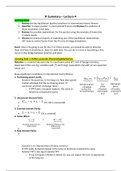
IF Summary – Lecture 4
Learning Goals
1. Review the key equilibrium (parity) conditions in international macro-finance
2. Describe “6 major puzzles” in international finance and Review the evidence of
these anomalies in the data
3. Review the possible explanations for the puzzles using the example of home bias
in equity puzzle
4. Discuss the practical aspects of exploiting one of the equilibrium relationships,
UIP. How to control losses from the FX carry strategy drawdowns.
Exam: How is he going to ask for this? For these puzzles, you should be able to describe
them and how it should be vs. how it is with data. You can do it in text or by plotting a line.
Focus on the bridge between empirics and data!
Learning Goal 1: Define economic (financial) globalization:
Notation: it = nominal interest rate; St = spot home price of 1 unit of foreign currency;
lowercase letters are log; variables with (*) are foreign equivalents and with (e) are expected
values at t
Basic equilibrium conditions in international macro/finance
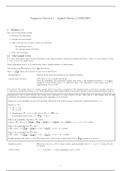
1. Purchasing power parity
- Answers the question: In the long run, how does goods
market arbitrage link the purchasing power of
currencies and their exchange rates?
o If PPP holds, European basket is the same as
American converted to euros
-
2. Uncovered Interest Parity
• (FX risk is uncovered)
•
3. Covered Interest Parity
• (FX is covered)
4. Fisher Effect
•
5. Real Interest Parity
•
- Increase in S is depreciation of home currency!
- IF PPP holds, European basket is the same as American converted to euros
- Relative PPP is the log of nominal PPP
o If e.g. European inflation Is below US, you can expect the Euro to appreciate
in the long-run
, - Slide 5: If q increases (US consumer basket), our goods are relatively cheaper which
causes the home currency to lose value and depreciate
- Fisher effect: If home interest rate on the same risky asset/deposit is higher than
foreign, it means expected inflation in home is higher than foreign
o Result is the real interest rate: Real cost of borrowing
Learning Goal 2: Describe 6 major puzzles economic (financial) globalization:
Standard Models of int’l finance use 2 major assumptions (e.g. World CAPM)
Efficient Markets
- Competitive markets; No transaction costs; No default/political/credit risk premium;
Prices reflect all available information
“Representative” rational & risk-neutral investors/consumers:
- Similar preferences and time discounting; rational expectations (people make choices
based on their rational outlook, available information and past experiences): risk-
neutral (no extra premium for risks)
6 major puzzles:
1. Home bias in trade
- International good markets are far more segmented than predicted
- People have a strong preference for home goods (E.g. Japan, India, Korea)
- Gravity model: Value of trade between any pair of countries diminishes with
distance
o Research design: Dependent variable is the log of the ratio of bilateral trade
share to destination country's internal trade share!
o Findings: Relative distance decreases trade, while common language
increases trade! Geography and country dummies explain 93% of trade
(R2=0.9)
o In contrast to frictionless models of trade, in which countries should diversify
trade!
2. Feldstein-Horioka puzzle (small OECD current account balances relative
to savings and investment)
- Prediction by standard theory: Saving flows to countries with most productive
investment opportunities, implying that savings rate are uncorrelated with
investment rates!
- Research design: long-term (decade) averages of National Saving to GDP vs National
Investment to GDP or the changes of I/GDP and S/GDP between the first and last
time observation, per country.
- Findings: National savings are highly correlated with domestic investment rates (long
period averages, 1960-74); Also holds in 1990s and after the crisis of 2008! Also
proven with OLS regression exhibiting positive and significant coefficients
- Implications: Countries rely very little on external finance to fund investment;
investors do not take advantage of global markets to allocate their savings to the
most productive use or borrow at the best terms
3. Home bias in Equity portfolio holdings (EHB)
Learning Goals
1. Review the key equilibrium (parity) conditions in international macro-finance
2. Describe “6 major puzzles” in international finance and Review the evidence of
these anomalies in the data
3. Review the possible explanations for the puzzles using the example of home bias
in equity puzzle
4. Discuss the practical aspects of exploiting one of the equilibrium relationships,
UIP. How to control losses from the FX carry strategy drawdowns.
Exam: How is he going to ask for this? For these puzzles, you should be able to describe
them and how it should be vs. how it is with data. You can do it in text or by plotting a line.
Focus on the bridge between empirics and data!
Learning Goal 1: Define economic (financial) globalization:
Notation: it = nominal interest rate; St = spot home price of 1 unit of foreign currency;
lowercase letters are log; variables with (*) are foreign equivalents and with (e) are expected
values at t
Basic equilibrium conditions in international macro/finance
1. Purchasing power parity
- Answers the question: In the long run, how does goods
market arbitrage link the purchasing power of
currencies and their exchange rates?
o If PPP holds, European basket is the same as
American converted to euros
-
2. Uncovered Interest Parity
• (FX risk is uncovered)
•
3. Covered Interest Parity
• (FX is covered)
4. Fisher Effect
•
5. Real Interest Parity
•
- Increase in S is depreciation of home currency!
- IF PPP holds, European basket is the same as American converted to euros
- Relative PPP is the log of nominal PPP
o If e.g. European inflation Is below US, you can expect the Euro to appreciate
in the long-run
, - Slide 5: If q increases (US consumer basket), our goods are relatively cheaper which
causes the home currency to lose value and depreciate
- Fisher effect: If home interest rate on the same risky asset/deposit is higher than
foreign, it means expected inflation in home is higher than foreign
o Result is the real interest rate: Real cost of borrowing
Learning Goal 2: Describe 6 major puzzles economic (financial) globalization:
Standard Models of int’l finance use 2 major assumptions (e.g. World CAPM)
Efficient Markets
- Competitive markets; No transaction costs; No default/political/credit risk premium;
Prices reflect all available information
“Representative” rational & risk-neutral investors/consumers:
- Similar preferences and time discounting; rational expectations (people make choices
based on their rational outlook, available information and past experiences): risk-
neutral (no extra premium for risks)
6 major puzzles:
1. Home bias in trade
- International good markets are far more segmented than predicted
- People have a strong preference for home goods (E.g. Japan, India, Korea)
- Gravity model: Value of trade between any pair of countries diminishes with
distance
o Research design: Dependent variable is the log of the ratio of bilateral trade
share to destination country's internal trade share!
o Findings: Relative distance decreases trade, while common language
increases trade! Geography and country dummies explain 93% of trade
(R2=0.9)
o In contrast to frictionless models of trade, in which countries should diversify
trade!
2. Feldstein-Horioka puzzle (small OECD current account balances relative
to savings and investment)
- Prediction by standard theory: Saving flows to countries with most productive
investment opportunities, implying that savings rate are uncorrelated with
investment rates!
- Research design: long-term (decade) averages of National Saving to GDP vs National
Investment to GDP or the changes of I/GDP and S/GDP between the first and last
time observation, per country.
- Findings: National savings are highly correlated with domestic investment rates (long
period averages, 1960-74); Also holds in 1990s and after the crisis of 2008! Also
proven with OLS regression exhibiting positive and significant coefficients
- Implications: Countries rely very little on external finance to fund investment;
investors do not take advantage of global markets to allocate their savings to the
most productive use or borrow at the best terms
3. Home bias in Equity portfolio holdings (EHB)