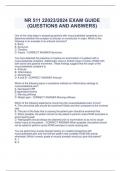
NR /2024 EXAM GUIDE (QUESTIONS AND ANSWERS)
NR /2024 EXAM GUIDE (QUESTIONS AND ANSWERS) One of the initial steps in assessing patients with musculoskeletal complaints is to determine whether the complain is articular or nonarticular in origin. Which of the following in an example of an articular structure? A. Bone B. Synovium C. Tendons D. Fascia - CORRECT ANSWER-Synovium You have detected the presence of crepitus on examination of a patient with a musculoskeletal complaint. Additionally, there is limited range of motion (ROM) with both active and passive movement. These findings suggest that the origin of the musculoskeletal complaint is: A. Articular B. Inflammatory C. Nonarticular D. A and B - CORRECT ANSWER-Articular Which of the following signs or symptoms indicate an inflammatory etiology to musculoskeletal pain? A. Decreased CRP B.hyperalbuminemia C. Morning stiffness D. Weight gain - CORRECT ANSWER-Morning stiffness Which of the following statements concerning the musculoskeletal exam is true? A. The uninvolved side should be examined initially and then compared to the involved side B. The part of the body that is causing the patient pain should be examined first C. When possible, the patient should not be asked to perform active ROM exercises to avoid causing pain D. Radiographs should always be obtained prior to examination so as not to cause further injury to the patient. - CORRECT ANSWER-When possible, the patient should not be asked to perform active ROM exercises to avoid causing pain You are performing muscle strength testing on a patient presenting with musculoskeletal pain and find that the patient has complete ROM with gravity eliminated. Which numeric grade of muscle strength would you give this patient? A. 1 B. 2 C. 3 D. 4 E. 5 - CORRECT ANSWER-B Mrs. Gray is a 55-year-old woman who presents with tightness, pain, and limited movement in her right shoulder. She denies any history of trauma. Her exam reveals a 75% reduction in both active and passive range of motion of the right shoulder. Mrs. Gray is also experiencing tenderness with motion and pain at the deltoid insertion. Her medical history is significant for type 1 diabetes mellitus and hypertension. Her social history reveals that she is a secretary and that she is right-handed. Bas - CORRECT ANSWER-HX of DM Jennifer is an 18-year-old girl who comes to the emergency room after a fall during a soccer game. Jennifer explains that she fell on her left side and kept her arm out straight to break her fall. She has been experiencing severe pain and limited range of motion in her left shoulder. The clinician has diagnosed Jennifer with a dislocated shoulder. Which of the following statements are true concerning shoulder dislocation? A. Posterior dislocations are more common than anterior dislocations B. T - CORRECT ANSWER-There is a risk of neurovascular and neurosensory trauma, so the clinician should check for distal pulses Mrs. Anderson is a 35-year-old woman who has been recently diagnosed with carpal tunnel syndrome. She has two young children and asks the clinician what the chances are that they will also develop carpal tunnel syndrome. Which of the following responses would be correct regarding the risk of developing carpal tunnel syndrome? - Carpal tunnel syndrome commonly occurs in families. Genetic factors are thought to account for about half the risk of developing carpal tunnel. - Only people with occupa - CORRECT ANSWER-Carpal tunnel syndrome commonly occurs in families. Genetic factors are thought to account for about half the risk of developing carpal tunnel. Which of the following statements is true regarding the treatment of carpal tunnel syndrome? A. The goal of TX is to prevent flexion and extension movements of the wrist B. Splints are used in carpal tunnel syndrome, because they allow for free movement the fingers and thumb while maintaining the wrist in a neutral position C Corticosterioid injections are discouraged in the treatment of CTS because of the risks for median nerve damage, scarring, and infection D. All of the above - CORRECT ANSWER-All of the above Sam is a 25-year-old man who has been diagnosed with low back strain based on his history of localized low back pain and muscle spasm along with a normal neurological examination. As the clinician, you explain to Sam that low back pain is a diagnosis of exclusion. Which of the following symptoms would alert the clinician to the more serious finding of a herniated nucleus pulposus or ruptured disc? A. Morning stiffness and limited mobility of the L spine B. Unilateral radicular pain symptoms that - CORRECT ANSWER-Unilateral radicular pain symptoms that extend below the knee and are equal to or greater than the back pain The clinician has instructed Sam, a 25 year old patient with low back strain, to use NSAIDs to manage his symptoms of pain and discomfort. Which of the following statements would be most appropriate when teaching Sam about NSAIDs? A. You should start with the lowest dose that is effective in managing your pain, because long-term use of NSAIDs can result in GI disorders such as ulcers and hemorrhage. B You should start with the lowest dose that is effective in managing your pain to avoid developi - CORRECT ANSWER-You should start with the lowest dose that is effective in managing your pain, because long-term use of NSAIDs can result in GI disorders such as ulcers and hemorrhage. Janet is 30y/o woman who has been diagnosed with a herniated disc at the L5-S1. She is currently in the emergency room with suspicion of cauda equina compression. Which of the following is a sign or symptom of cauda equina compression? A. Paresthesia of the perineum & buttock B. A reduced or absent ankle reflex C. Numbness in the lateral foot D. Gastrocnemius weakness - CORRECT ANSWER-Paresthesia of the perineum & buttock Which of the following statements is true concerning the management of the client with a herniated disc? A. Muscle relaxants and narcotics can be used to control moderate pain but should be d/c after 3 weeks of use B. An epidural injection is helpful in reducing leg pain that has persisted for at least 3 weeks after the herniation occurred C. Intolerable pain for more than a 3 month period is an indication for surgical intervention D All of the above - CORRECT ANSWER-Intolerable pain for more than a 3 month period is an indication for surgical intervention John is a 16 y/o boy presents to your office after hurting his knee in a football game. He described twisting his knee & then being able to extend it completely. John tells you he heard a pop when the injury occurred & has been experiencing localized pain. You suspect a meniscal tear. Which test would be most appropriate to assess for the presence of a meniscal tear? A. Lachman test B. Vulgus stress test C. McMurray circumduction test D. Varus stress test - CORRECT ANSWER-McMurray circumduction tes
Written for
- Institution
- NR 511
- Course
- NR 511
Document information
- Uploaded on
- February 6, 2024
- Number of pages
- 35
- Written in
- 2023/2024
- Type
- Exam (elaborations)
- Contains
- Questions & answers
Subjects
- the nurse se
-
nr exam guide questions and answer
-
one of the initial steps in assessing patients wit
-
you have detected the presence of crepitus on exam
-
which of the following signs or symptoms indicate

Also available in package deal