ELECTRIC CIRCUITS
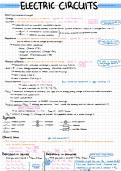
(Electricity movemento f charge)
-
Charge is property a electron
symbol:Q unit:Coulomb (C)
·
a of proton or an
&charges
Current is the rate of flow of charge symbol:I unit:Ampere (AL It
q
=
·
are
in
↳>
measured with an ammeter connected in series
↳P direction (unless otherwise stated) is conventional current direction (flow oft charges from +
to->
3
-
L
>
conventional current direction
if no assume conventional current
E
arrow - >
electron
=
direction
current
·
Resistance is a material's opposition to the flow of
e lectric current
symbol:R unit: Ohm (F)
-mergen
how difficult for
Li.e. i t is the
charges to more
through unter
↳> Factors affectresistance:
that
·
temp (Itemp =
PR)
·
length of wirelfilament (Plength TR) =
·
diameter (I diameter/width $R) =
type of material
·
ge
Potential difference is the work done per unitpositive charge Symbol: V unit:Volt (V)
ete
·
↳ measured with
voltmeter connected in parallel over
any
2
points v Y
=
· emf/=max.
energy supplied by battery CONSTANT)
(ALWAYS:
↳)
measured when switch is OPEN flowing
(nocurrent
↳ cells in series - add
parallel: E
↳D cells in of 1
only
Internal resistance
Symbol:r Unit: Ohm (R) Rext external resistance (notincluding v)
=
·
↳>
cells in series - r r, re V3
+ +
=
↳ cells in parallel -t t, ri t3 =
+ +
·
Voad potential difference of battery (i.e. real of
amt
energy every charge will
have available to transfer)
↳
indicates V whole
of circuit
↳ NOT CONSTANT
↳ CLOSED (currentflowing)
measured when switch is
·
Vinternal resistance (Vost- energy percoulomb 'lost' inside the battery due to internal resistance (r)
emf Vload
= -
Viost
↳ no internal resistance 0 ...
Vost emf=Vload
.:
=
-
r =
0
Vy of IC
=
amount of will transfer to serific
charge resistor as it through it
·
energy a
passes
Symbols
· a
closed switch V voltmeter
X lamp, lightbulb
⑧ · open switch A ammeter resistor
in
Y
call
variable resistor
Filli-battery
Ohm's law ⑬ use subscripts!!!
The current potential difference
through a conductor is directly proportional to the across the conductor
at a temperature
constant
whole circuit Rext=Vd I
tot
Leg Ror**, Rp =
Vij
one resistor Ris =
Eis
Resistors in series Resistors in parallel
-res= less traffic
More your paleget,
-
more
you add in series PRext,' I tot
=
I
Rs R, Rx R3
=
+ +
than the
Ep: inverse
not it
the tip
3 mid
smallest
Ig IR, IR IRs
=
=
=
resistor Ip IR, Ik IR3
=
+
+
Can use 'dustbin trick' replace the
Voad=VR, VRz VR3 Sheet Up VR, VRz VR3
=
=
=
Rp
resistors in series with 1 resistor=
C... Rp p =
, Work done energy transferred
(W xE)
=
unit:Joules (J)
WV =
It
W IRt
=
W =
V
Power power:brightness of lightbulb lusually use
P= E)
(P E) unit:Watt(W) catch! D 2x R in
parallel -> lowest R highest P brightest
=
- =
=
P VI Power of lightbulb constantuse P V which
and to work out is constant
=
I
P IR
=
P E
=
emf1E
emf Vload+ Vost
=
3
emf=Vload+ Itotr
on
not formula sheet
emf=ItutRext + Itot r
emf=Itot (Rext +r)
The effectof changing a circuit (theory & multiple choice)
emf const
3 always
=
1. Determine ifRextinc. or dec. v const
=
emt
2. Use Itot=exttr to determine ifI tot inc. or dec.
3. Use Voad emf-Itotr
=
to determine ifload inc. or dec
of
Cost electricity
NOT
elec is sold in units'
(lunit-energy power
/Unit= 1 kWh *-DELIBERATELY DON'T USESI UNITS
W=Pt (from P E)
=
By
-i
Pt
nee
WorEsold=
⑭ S
EXPERIMENTS
1. Used to -> Uhm's
test law
↳ testi f
a resistor is ohmic (nota l l resistors are ahmicl
read off voltmeter
adae"
Results: ->
Peepsame in
x-axis V
=
(manipulating by adding more cells)
- read off ammeter
I
y-axis: (changes when
you add more cells)
I
K V
... IxV
Gradient: I t..R=aadient
=
2. Used to determine the resistanceof a resistor
same
RESUIES: off
-> read
ammeter
x-axis= I (as Rext
changes,
I tot
changes)
- Dreadoff voltmeter
V
y-axis
=
... vxI
*
change E R (YAY!can find resistance of
gradient:
=
W resistor using gradient!)
I
(Electricity movemento f charge)
-
Charge is property a electron
symbol:Q unit:Coulomb (C)
·
a of proton or an
&charges
Current is the rate of flow of charge symbol:I unit:Ampere (AL It
q
=
·
are
in
↳>
measured with an ammeter connected in series
↳P direction (unless otherwise stated) is conventional current direction (flow oft charges from +
to->
3
-
L
>
conventional current direction
if no assume conventional current
E
arrow - >
electron
=
direction
current
·
Resistance is a material's opposition to the flow of
e lectric current
symbol:R unit: Ohm (F)
-mergen
how difficult for
Li.e. i t is the
charges to more
through unter
↳> Factors affectresistance:
that
·
temp (Itemp =
PR)
·
length of wirelfilament (Plength TR) =
·
diameter (I diameter/width $R) =
type of material
·
ge
Potential difference is the work done per unitpositive charge Symbol: V unit:Volt (V)
ete
·
↳ measured with
voltmeter connected in parallel over
any
2
points v Y
=
· emf/=max.
energy supplied by battery CONSTANT)
(ALWAYS:
↳)
measured when switch is OPEN flowing
(nocurrent
↳ cells in series - add
parallel: E
↳D cells in of 1
only
Internal resistance
Symbol:r Unit: Ohm (R) Rext external resistance (notincluding v)
=
·
↳>
cells in series - r r, re V3
+ +
=
↳ cells in parallel -t t, ri t3 =
+ +
·
Voad potential difference of battery (i.e. real of
amt
energy every charge will
have available to transfer)
↳
indicates V whole
of circuit
↳ NOT CONSTANT
↳ CLOSED (currentflowing)
measured when switch is
·
Vinternal resistance (Vost- energy percoulomb 'lost' inside the battery due to internal resistance (r)
emf Vload
= -
Viost
↳ no internal resistance 0 ...
Vost emf=Vload
.:
=
-
r =
0
Vy of IC
=
amount of will transfer to serific
charge resistor as it through it
·
energy a
passes
Symbols
· a
closed switch V voltmeter
X lamp, lightbulb
⑧ · open switch A ammeter resistor
in
Y
call
variable resistor
Filli-battery
Ohm's law ⑬ use subscripts!!!
The current potential difference
through a conductor is directly proportional to the across the conductor
at a temperature
constant
whole circuit Rext=Vd I
tot
Leg Ror**, Rp =
Vij
one resistor Ris =
Eis
Resistors in series Resistors in parallel
-res= less traffic
More your paleget,
-
more
you add in series PRext,' I tot
=
I
Rs R, Rx R3
=
+ +
than the
Ep: inverse
not it
the tip
3 mid
smallest
Ig IR, IR IRs
=
=
=
resistor Ip IR, Ik IR3
=
+
+
Can use 'dustbin trick' replace the
Voad=VR, VRz VR3 Sheet Up VR, VRz VR3
=
=
=
Rp
resistors in series with 1 resistor=
C... Rp p =
, Work done energy transferred
(W xE)
=
unit:Joules (J)
WV =
It
W IRt
=
W =
V
Power power:brightness of lightbulb lusually use
P= E)
(P E) unit:Watt(W) catch! D 2x R in
parallel -> lowest R highest P brightest
=
- =
=
P VI Power of lightbulb constantuse P V which
and to work out is constant
=
I
P IR
=
P E
=
emf1E
emf Vload+ Vost
=
3
emf=Vload+ Itotr
on
not formula sheet
emf=ItutRext + Itot r
emf=Itot (Rext +r)
The effectof changing a circuit (theory & multiple choice)
emf const
3 always
=
1. Determine ifRextinc. or dec. v const
=
emt
2. Use Itot=exttr to determine ifI tot inc. or dec.
3. Use Voad emf-Itotr
=
to determine ifload inc. or dec
of
Cost electricity
NOT
elec is sold in units'
(lunit-energy power
/Unit= 1 kWh *-DELIBERATELY DON'T USESI UNITS
W=Pt (from P E)
=
By
-i
Pt
nee
WorEsold=
⑭ S
EXPERIMENTS
1. Used to -> Uhm's
test law
↳ testi f
a resistor is ohmic (nota l l resistors are ahmicl
read off voltmeter
adae"
Results: ->
Peepsame in
x-axis V
=
(manipulating by adding more cells)
- read off ammeter
I
y-axis: (changes when
you add more cells)
I
K V
... IxV
Gradient: I t..R=aadient
=
2. Used to determine the resistanceof a resistor
same
RESUIES: off
-> read
ammeter
x-axis= I (as Rext
changes,
I tot
changes)
- Dreadoff voltmeter
V
y-axis
=
... vxI
*
change E R (YAY!can find resistance of
gradient:
=
W resistor using gradient!)
I