Explain the features of a relational database and describe the advantages/
disadvantages of different database types
Hierarchical Database: A hierarchical database is a design that uses a one-to-many relationship
for data elements. Hierarchical database models use a tree structure that links a number of
disparate elements to one "owner," or "parent," primary record.
Advantages: It is in a structured format which means it is easier to locate what you need with
the need for a search query.
Disadvantages: It is slow to get to where you need to go due to the amount of files.
Flat File Database: A flat file database is a type of database that stores data in a single table.
This is unlike a relational database, which makes use of multiple tables and relations. Flat file
databases are generally in plain-text form, where each line holds only one record.
Advantages: Easy to understand due to being simple and is a good structure for small
databases.
Disadvantages: Searching process is slow due to no structure and there is little security.
Relational Database: Is a table that contains data about just one entity, tables must have a
primary key, tables are linked by primary and foreign keys. Also entities can relate to each
other in three different ways: one to one, one to many and many to many.
Advantages: Easy to understand data entry, you can also use a query search tool as well as
advanced analyzing capabilities.
Disadvantages: It is a complex systems and
takes some time to learn.
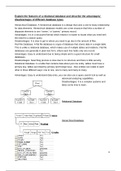
Relational Database
Hierarchical Database
0
disadvantages of different database types
Hierarchical Database: A hierarchical database is a design that uses a one-to-many relationship
for data elements. Hierarchical database models use a tree structure that links a number of
disparate elements to one "owner," or "parent," primary record.
Advantages: It is in a structured format which means it is easier to locate what you need with
the need for a search query.
Disadvantages: It is slow to get to where you need to go due to the amount of files.
Flat File Database: A flat file database is a type of database that stores data in a single table.
This is unlike a relational database, which makes use of multiple tables and relations. Flat file
databases are generally in plain-text form, where each line holds only one record.
Advantages: Easy to understand due to being simple and is a good structure for small
databases.
Disadvantages: Searching process is slow due to no structure and there is little security.
Relational Database: Is a table that contains data about just one entity, tables must have a
primary key, tables are linked by primary and foreign keys. Also entities can relate to each
other in three different ways: one to one, one to many and many to many.
Advantages: Easy to understand data entry, you can also use a query search tool as well as
advanced analyzing capabilities.
Disadvantages: It is a complex systems and
takes some time to learn.
Relational Database
Hierarchical Database
0