TNCC Practice Exam
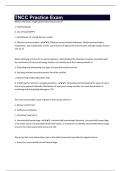
What is the key to a high-performance trauma team? a. Individual goals b. Use of TeamSTEPPS c. Identification of a single decision maker d. Effective communication - d. Effective communication Rationale: Skilled communication, cooperation, and coordination are the cornerstones of high-performance teams and high-quality trauma care (p. 5). When obtaining a history for an injured patient, understanding the kinematic concepts associated with the mechanism of injury and energy transfer can initially assist the trauma provider in: a. Evaluating and anticipating the types of injury that may be present b. Deciding whether law enforcement should be notified c. Determining needed laboratory tests d. Predicting the need for a surgical procedure - a. Evaluating and anticipating the types of injury that may be present Rationale: Mechanism of injury and energy transfer can assist the provider in evaluating and anticipating damage (p. 23). The major preventable cause of death in the trauma patient is: a. Airway compromise b. Ineffective ventilation c. Secondary head injury d. Uncontrolled hemorrhage - d. Uncontrolled hemorrhage Rationale: Uncontrolled hemorrhage is the major cause of preventable death after injury, so assessment to identify uncontrolled hemorrhage is key to the initial assessment process (p. 29). The across-the-room observation step in the initial assessment provides the opportunity to: a. Assess for uncontrolled internal hemorrhage
Written for
- Institution
- TNCC-Trauma Nursing Core Course
- Course
- TNCC-Trauma Nursing Core Course
Document information
- Uploaded on
- February 4, 2024
- Number of pages
- 7
- Written in
- 2023/2024
- Type
- Exam (elaborations)
- Contains
- Questions & answers
Subjects

Also available in package deal