GGZ2026 (NL/EN) Sexuality vvanbeek
LECTURES GGZ2026
Lecture 1 – Theories of sexual function
Masters and Johnson developed a linear model of sexual behavior which consists of a desire,
arousal, plateau, orgasm and recovery phase. You can question whether this model is valid.
For example, where does desire come from? Is it spontaneous?
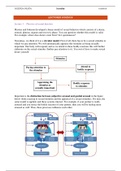
Nowadays, we think of it as a circular model. First of all, there has to be a sexual stimulus to
which we pay attention. We will automatically appraise this stimulus as being sexually
important. Our body will respond, and as we attend to these bodily reactions this will further
elaborate on the sexual stimulus (further pay attention to it). You sort of have to make sexual
desire yourself.
Stimulus
Paying attention to Attend to
the stimulus bodily response
Appraising the Bodily response
stimulus as to stimulus
sexually important
Important is the distinction between subjective arousal and genital arousal in the figure
below (body reacting to sexual stimulus and the appraisal of a sexual stimulus). For men, the
same model is applied, and these systems interact. For example, if your partner is really
aroused and you notice the bodily reaction of your partner, then you will be feeling more
aroused as well. Thus, these processes influence each other.
, GGZ2026 (NL/EN) Sexuality vvanbeek
When we think of determinants of sexuality, we think of individual features and the partner
features and responses. Besides, the relationship and the context are important as well. Thus,
sex is a dyadic (between two partners) and multi-componential process. You cannot simply
ask for individual experiences in an anamnesis.
In men, often the two types of arousal (subjective and genital arousal) come together, called
concordance (high concordance between subjective and genital arousal), because they have
peripheral feedback. When men have an erection, this signals the brain that they have an
erection, so that they must be aroused. In women, the genital response is not really observable
(there is no direct response in the brain to the genital response). Thus, in women, there is a
low concordance between subjective arousal and genital arousal.
When you show pornography to women in an experiment, most of them report not
feeling really aroused, although they actually show an genital response. Genital
arousal is not the most important response; how you feel if way more important.
Women who are raped also often show genital arousal, although they don’t want that.
When we think of sexual desire, we make a distinction between more active sexual desire
(spontaneous, but there has to be a stimulus, made easier by testosterone) and responsive
sexual desire (desire in reaction to a right stimulus). Women often show a more responsive
sexual desire, so that they only feel desire as soon as they start having sex. Men often are
more capable of having active sexual desire.
Sexual desire (sexual response) start automatically and occurs at the moment the sexual
memory labels a stimulus as sexual. Subjective sexual desire results from a positive cognitive
elaboration on the awareness of physical, genital responding (arousability). Ongoing sexual
responses are related to motivational behavior and based on the appraisal of context, stimulus
and expected outcome (sexual memory).
Sexual desire always consists of sexual responsivity (arousability; that your body is
able to respond to a sexual stimulus) and sexual motivation. The question is not ‘do I
feel sexual desire at the moment?’, but ‘am I motivated to open myself to sexual
desire?’ and ‘am I able to open myself to sexual desire’.
Sexual arousability is the capacity of the sexual system to react at sexual stimuli. Hormones
are really important; they determine how responsive the sexual system is. Oestrogens have an
effect on mood, on external features of attractiveness, but no direct effect on sexual system.
LECTURES GGZ2026
Lecture 1 – Theories of sexual function
Masters and Johnson developed a linear model of sexual behavior which consists of a desire,
arousal, plateau, orgasm and recovery phase. You can question whether this model is valid.
For example, where does desire come from? Is it spontaneous?
Nowadays, we think of it as a circular model. First of all, there has to be a sexual stimulus to
which we pay attention. We will automatically appraise this stimulus as being sexually
important. Our body will respond, and as we attend to these bodily reactions this will further
elaborate on the sexual stimulus (further pay attention to it). You sort of have to make sexual
desire yourself.
Stimulus
Paying attention to Attend to
the stimulus bodily response
Appraising the Bodily response
stimulus as to stimulus
sexually important
Important is the distinction between subjective arousal and genital arousal in the figure
below (body reacting to sexual stimulus and the appraisal of a sexual stimulus). For men, the
same model is applied, and these systems interact. For example, if your partner is really
aroused and you notice the bodily reaction of your partner, then you will be feeling more
aroused as well. Thus, these processes influence each other.
, GGZ2026 (NL/EN) Sexuality vvanbeek
When we think of determinants of sexuality, we think of individual features and the partner
features and responses. Besides, the relationship and the context are important as well. Thus,
sex is a dyadic (between two partners) and multi-componential process. You cannot simply
ask for individual experiences in an anamnesis.
In men, often the two types of arousal (subjective and genital arousal) come together, called
concordance (high concordance between subjective and genital arousal), because they have
peripheral feedback. When men have an erection, this signals the brain that they have an
erection, so that they must be aroused. In women, the genital response is not really observable
(there is no direct response in the brain to the genital response). Thus, in women, there is a
low concordance between subjective arousal and genital arousal.
When you show pornography to women in an experiment, most of them report not
feeling really aroused, although they actually show an genital response. Genital
arousal is not the most important response; how you feel if way more important.
Women who are raped also often show genital arousal, although they don’t want that.
When we think of sexual desire, we make a distinction between more active sexual desire
(spontaneous, but there has to be a stimulus, made easier by testosterone) and responsive
sexual desire (desire in reaction to a right stimulus). Women often show a more responsive
sexual desire, so that they only feel desire as soon as they start having sex. Men often are
more capable of having active sexual desire.
Sexual desire (sexual response) start automatically and occurs at the moment the sexual
memory labels a stimulus as sexual. Subjective sexual desire results from a positive cognitive
elaboration on the awareness of physical, genital responding (arousability). Ongoing sexual
responses are related to motivational behavior and based on the appraisal of context, stimulus
and expected outcome (sexual memory).
Sexual desire always consists of sexual responsivity (arousability; that your body is
able to respond to a sexual stimulus) and sexual motivation. The question is not ‘do I
feel sexual desire at the moment?’, but ‘am I motivated to open myself to sexual
desire?’ and ‘am I able to open myself to sexual desire’.
Sexual arousability is the capacity of the sexual system to react at sexual stimuli. Hormones
are really important; they determine how responsive the sexual system is. Oestrogens have an
effect on mood, on external features of attractiveness, but no direct effect on sexual system.