Introduction to Global Law II – Notes
1. Functionalism and Universalism in Comparative
Law
Functionalism
Functionalism – a method to study and compare legal systems in terms of how they
resolve problems; operates on the assumption that legal systems around the world solve
similar sets of socio-economic issues around the world (Zweigert and Kötz introduced
this)
Praesumptio similitudinis – a presumption that the practical results of different
countries’ laws covering the same problem are similar; relationship to universalism
Functional analysis begins with functional (factual, not legal) question about a socio-
economic problem
o Tertium comparationis - ‘second order language’ describing the factual, socio-
economic problem
Analyzing beyond positive law where behavior dictates that
o Non-legal forms of social ordering (e.g. divorce not common or regulated in
countries where polyamorous relationships are the norm)
How to approach foreign legal systems?
o Internal perspectives, not external
Which and how many countries to compare?
Examples of functional questions:
o Is someone who emits noxious gases from their property responsible for harm
caused to their neighbors by exposure to gas?
o Is a dog owner responsible for harm to wildlife caused by their unleashed dog?
o May a property owner harvest wildlife that is located on their own property at
will?
Specific types of wildlife: berries, deer, rabbits, etc.
‘At will’? Without license or authorization? Any time of year? Any
amount?
Functionalist cautions / criticisms
o If starting assumptions are false, then comparison falls apart
o What may seem similar or universal to one person, may seem otherwise to
another person
o Just because laws in two places may seem to have the same function, that doesn’t
mean that people treat them in the same way in different places, or that they are
meaningful in the same ways
o Functionalism is often used with the assumption that problems are the same
everywhere
o Focuses too much on the result, and too little on the process of legal concepts
,Universalism
Universalism in the historical perspective:
The Stoics on natural law:
o Nature is governed by reason
o Natural law arises out of human reasoning
o Natural law corresponds to moral duties
o Universal character of Nature & Reason
Structure of natural law:
o Higher-order principles
o Lower-order rules
Aristotle:
o Synesis: good judgement in framing rules
o Gnome: good judgement in deciding cases
Aquinas & universalism under Christianity:
o 4 types of law (Eternal, Natural, Divine, Human)
o Authority of positive law rooted in natural law
o Plurality of human laws supplementing universal natural law
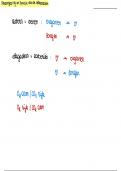
Diagramming universalism:
o
o Different rules governing the same principle emerge as a result of different
circumstances between cases
An example of legal comparison – unjust enrichment
Considering 2 different scenarios:
,1. Germany: § 812 BGB (claim for restitution)
a. Scenario 2: By transfer (transfer of land back to use to the landowner)
i. Limited by ‘directness of transfer’ principle: the loss of the plaintiff (C), and
the benefit to the defendant (E), must result from one and the same
transaction (no third party). Service provider doesn’t have grounds to claim
restitution, because his loss did not occur directly from the landowner’s gain.
ii. Exception to directness principle: if the improvement / benefit is to a thing /
chattel (rather than immovable / real estate), then the plaintiff can withhold
it from the owner and defendant until being paid
b. Scenario 1: Otherwise
i. If due to fault, this would fall under damages in tort law. But if purely
innocent, A is still liable to restore to the owner the right of value of the use
they made of the land.
2. France: Civil code Art. 1303 (introduced in Boudier judgement by Court of Cassation in
1892)
a. Action de in rem verso: no distinction between whether it comes about through ‘a
transfer’ or ‘otherwise’; no directness principle
b. But the enrichment must be ‘sans cause légitime’ (without legitimate cause)
i. Scenario 1 – simple case of unjust enrichment based on ‘interference’ with
the rights of the owner
ii. Scenario 2
1. If E (owner) and D (tenant) had a contractual agreement (or statutory
obligation) regarding the transfer of the fertilizer in the field (the
benefit), then the enrichment is with legitimate cause.
2. If no contract or statutory obligation, then E is liable to C (service
provider) for the unjust enrichment
3. Common law (UK / USA)
a. 1 – Benefit received by the defendant; 2 – At the plaintiff’s expense; 3 – It would
be unjust to retain the benefit
b. (US) 1937 Restatement of Law of Restitution
c. Germany’s distinction ‘by transfer’ (from or by the act of the plaintiff) or
‘otherwise’ (by the defendant’s own wrongful conduct) relevant
i. ‘Otherwise’ – scenario 1 – covered under tort law (trespass to land), but can
be waived to instead claim value of the use made of the meadowland under
unjust enrichment
ii. ‘By transfer’ – scenario 2 – potentially a ‘claim for restitution of benefits
conferred under a defective contract’
1. Alternatively, under Equity
a. UK: Constructive trust, if there is a ‘fiduciary relationship’
b. USA: constructive trust, no requirement of ‘fiduciary
relationship’; ‘when the defendant has in his position
identifiable property which he should hand over on the
ground that he would be unjustifiably enriched at the
plaintiff’s expense if he were allowed to keep it.’ – applies
only to chattels
, 2. The Comparative Law Method
Methods of comparative law
1. Analytic comparison
a. Focus on comparing the use of complex concepts and rules in different legal
systems
b. Comparing in order to find commonalities and differences in how these concepts
and rules are understood and used
c. Examples: ‘ownership’, ‘contract’, ‘standing’, ‘personhood’
d. Identifying an ‘ideal type’ of the concept
i. Comparing the degree to which each country’s particular formulation of
the concept fits this ideal depiction
e. Can infer an analysis of legal language to ascertain similarities or differences
f. Whereas the functional method is very pragmatic, the analytic method is more
concerned with subtle nuances and details in the jurisprudence of a concept
g. Criticism: such abstract and conceptual analysis may lead to a dissociation from
the social reality
2. Structural comparison
a. Comparison at a macro-level
i. (Functional & analytic methods are focused on micro-level issues –
particular socio-economic problems or concepts)
b. Comparison of structural elements considered to characterize or define entire
fields of law
i. E.g. property law structured on the principle that the State holds final
ownership of all land, which is then offered for limited periods of
concession to individuals vs. systems structured on the principle of
individual property ownership
ii. E.g. Administrative law structured on the ‘recours objectif’ whereby
individuals have standing to challenge the general lawfulness of
administrative actions vs. the ‘recours subjectif’ whereby individuals
must demonstrate harm to their specific, individual legal interests in
order to challenge the lawfulness of administrative actions
c. Looking at structures and concepts / collection of elements that form a complete
legal system
d. Useful for categorizing legal system into families
e. Loses nuance / detail in an effort to identify and compare underlying legal
structures
3. Law in Context
a. The way law works in practice, as far as it transpires from judicial decisions
b. Understanding the law an explaining why it is the way it is
c. How worldviews influence the way the law is shaped
d. Explains underlying societal problems – if there is no law governing problem x,
x may not be a problem in that country
1. Functionalism and Universalism in Comparative
Law
Functionalism
Functionalism – a method to study and compare legal systems in terms of how they
resolve problems; operates on the assumption that legal systems around the world solve
similar sets of socio-economic issues around the world (Zweigert and Kötz introduced
this)
Praesumptio similitudinis – a presumption that the practical results of different
countries’ laws covering the same problem are similar; relationship to universalism
Functional analysis begins with functional (factual, not legal) question about a socio-
economic problem
o Tertium comparationis - ‘second order language’ describing the factual, socio-
economic problem
Analyzing beyond positive law where behavior dictates that
o Non-legal forms of social ordering (e.g. divorce not common or regulated in
countries where polyamorous relationships are the norm)
How to approach foreign legal systems?
o Internal perspectives, not external
Which and how many countries to compare?
Examples of functional questions:
o Is someone who emits noxious gases from their property responsible for harm
caused to their neighbors by exposure to gas?
o Is a dog owner responsible for harm to wildlife caused by their unleashed dog?
o May a property owner harvest wildlife that is located on their own property at
will?
Specific types of wildlife: berries, deer, rabbits, etc.
‘At will’? Without license or authorization? Any time of year? Any
amount?
Functionalist cautions / criticisms
o If starting assumptions are false, then comparison falls apart
o What may seem similar or universal to one person, may seem otherwise to
another person
o Just because laws in two places may seem to have the same function, that doesn’t
mean that people treat them in the same way in different places, or that they are
meaningful in the same ways
o Functionalism is often used with the assumption that problems are the same
everywhere
o Focuses too much on the result, and too little on the process of legal concepts
,Universalism
Universalism in the historical perspective:
The Stoics on natural law:
o Nature is governed by reason
o Natural law arises out of human reasoning
o Natural law corresponds to moral duties
o Universal character of Nature & Reason
Structure of natural law:
o Higher-order principles
o Lower-order rules
Aristotle:
o Synesis: good judgement in framing rules
o Gnome: good judgement in deciding cases
Aquinas & universalism under Christianity:
o 4 types of law (Eternal, Natural, Divine, Human)
o Authority of positive law rooted in natural law
o Plurality of human laws supplementing universal natural law
Diagramming universalism:
o
o Different rules governing the same principle emerge as a result of different
circumstances between cases
An example of legal comparison – unjust enrichment
Considering 2 different scenarios:
,1. Germany: § 812 BGB (claim for restitution)
a. Scenario 2: By transfer (transfer of land back to use to the landowner)
i. Limited by ‘directness of transfer’ principle: the loss of the plaintiff (C), and
the benefit to the defendant (E), must result from one and the same
transaction (no third party). Service provider doesn’t have grounds to claim
restitution, because his loss did not occur directly from the landowner’s gain.
ii. Exception to directness principle: if the improvement / benefit is to a thing /
chattel (rather than immovable / real estate), then the plaintiff can withhold
it from the owner and defendant until being paid
b. Scenario 1: Otherwise
i. If due to fault, this would fall under damages in tort law. But if purely
innocent, A is still liable to restore to the owner the right of value of the use
they made of the land.
2. France: Civil code Art. 1303 (introduced in Boudier judgement by Court of Cassation in
1892)
a. Action de in rem verso: no distinction between whether it comes about through ‘a
transfer’ or ‘otherwise’; no directness principle
b. But the enrichment must be ‘sans cause légitime’ (without legitimate cause)
i. Scenario 1 – simple case of unjust enrichment based on ‘interference’ with
the rights of the owner
ii. Scenario 2
1. If E (owner) and D (tenant) had a contractual agreement (or statutory
obligation) regarding the transfer of the fertilizer in the field (the
benefit), then the enrichment is with legitimate cause.
2. If no contract or statutory obligation, then E is liable to C (service
provider) for the unjust enrichment
3. Common law (UK / USA)
a. 1 – Benefit received by the defendant; 2 – At the plaintiff’s expense; 3 – It would
be unjust to retain the benefit
b. (US) 1937 Restatement of Law of Restitution
c. Germany’s distinction ‘by transfer’ (from or by the act of the plaintiff) or
‘otherwise’ (by the defendant’s own wrongful conduct) relevant
i. ‘Otherwise’ – scenario 1 – covered under tort law (trespass to land), but can
be waived to instead claim value of the use made of the meadowland under
unjust enrichment
ii. ‘By transfer’ – scenario 2 – potentially a ‘claim for restitution of benefits
conferred under a defective contract’
1. Alternatively, under Equity
a. UK: Constructive trust, if there is a ‘fiduciary relationship’
b. USA: constructive trust, no requirement of ‘fiduciary
relationship’; ‘when the defendant has in his position
identifiable property which he should hand over on the
ground that he would be unjustifiably enriched at the
plaintiff’s expense if he were allowed to keep it.’ – applies
only to chattels
, 2. The Comparative Law Method
Methods of comparative law
1. Analytic comparison
a. Focus on comparing the use of complex concepts and rules in different legal
systems
b. Comparing in order to find commonalities and differences in how these concepts
and rules are understood and used
c. Examples: ‘ownership’, ‘contract’, ‘standing’, ‘personhood’
d. Identifying an ‘ideal type’ of the concept
i. Comparing the degree to which each country’s particular formulation of
the concept fits this ideal depiction
e. Can infer an analysis of legal language to ascertain similarities or differences
f. Whereas the functional method is very pragmatic, the analytic method is more
concerned with subtle nuances and details in the jurisprudence of a concept
g. Criticism: such abstract and conceptual analysis may lead to a dissociation from
the social reality
2. Structural comparison
a. Comparison at a macro-level
i. (Functional & analytic methods are focused on micro-level issues –
particular socio-economic problems or concepts)
b. Comparison of structural elements considered to characterize or define entire
fields of law
i. E.g. property law structured on the principle that the State holds final
ownership of all land, which is then offered for limited periods of
concession to individuals vs. systems structured on the principle of
individual property ownership
ii. E.g. Administrative law structured on the ‘recours objectif’ whereby
individuals have standing to challenge the general lawfulness of
administrative actions vs. the ‘recours subjectif’ whereby individuals
must demonstrate harm to their specific, individual legal interests in
order to challenge the lawfulness of administrative actions
c. Looking at structures and concepts / collection of elements that form a complete
legal system
d. Useful for categorizing legal system into families
e. Loses nuance / detail in an effort to identify and compare underlying legal
structures
3. Law in Context
a. The way law works in practice, as far as it transpires from judicial decisions
b. Understanding the law an explaining why it is the way it is
c. How worldviews influence the way the law is shaped
d. Explains underlying societal problems – if there is no law governing problem x,
x may not be a problem in that country