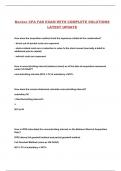
ABSI Study Guide Questions with All Correct Answers.
ABSI Study Guide Questions with All Correct Answers. Eugene Blueler - Answer-coined the term "Autism" in 1911 Hans Asperger - Answer-in 1938 used the word "autistic" to describe people with social isolation but no hallucinations Leo Kanner - Answer-coined the term Early Infantile Austin in 1943 In what year did the DSM-III includes Infantile Autism as a distinct category - Answer-1980 In what year did DSM-IV unwed Autistic Disorder as a separate diagnosis with a more expansive definition? - Answer-1987 What year was Asperger's syndrome added to DSM-IVE to induce milder cases? - Answer-1994 In what year did DSM-V combined several diagnoses into Autism Spectrum Disorder? - Answer-2013 Austin Spectrum Disorder (ASD) - Answer-• Neurological, lifelong developmental disorder • characterized by social deficits and repetitive patterns of behavior • impacts ability to function properly in school, work, and other areas of life Why is Autism a spectrum disorder ? - Answer-• no 2 individuals with ASD are the same • skills may be splintered across domains • different areas may be impacted to varying degrees • some may have more challenging behaviors than others Deficits of ASD - Answer-• communication • play skills • self-help and independent living • social skills • awareness of dangerous situations • no desire to be around others • eye contact Excesses of ASD - Answer-• tantrum behavior • aggression against self, objects or others • restrictive and repetitive patters of behaviors (RRBs) • Echolalia • delayed echolalia-video talk Echoic - Answer-something is spoken then copied Mand - Answer-asking for things that they want (i.e. you hungry so..."Can I have food") Tact - Answer-labeling thins that you, see, hear, small, feel and taste (i.e. sees a bird... "look a bird") intraverbal - Answer-someone say something and you say something different in response such as answering questions and filling in the blanks visual schedules - Answer-tools we can use to help individuals follow. routine, transition between activities, develop new skills, and become more independent what can visual schedules can help prevent or reduce? - Answer-avoidance-maintained behavior & anxiety What can visual schedules increase? - Answer-compliance & predictability Pivotal response treatment (PRT) - Answer-play based, child initiated treatment for individuals with ASD Who developed PRT? - Answer-The koegels from research in 1970s and 1980s In contrast to DTT & NET, PRT targets _______ rather than specific, discrete behaviors - Answer-general skill areas seen as pivotal for learning what are the goals of PRT - Answer-• developing communication and language skills • increasing prosocial behaviors • replacing repetitive or restrictive patterns of behavior What are the 4 pivotal skill areas targets - Answer-• motivation • response to multiple cues • self-management • social initiation Person-Centered Planning - Answer-a planning process that puts the client at the center of the plan to help them meet their furniture goals and dreams P-CP rests on the principle of - Answer-s
Written for
- Institution
- ABSA
- Course
- ABSA
Document information
- Uploaded on
- February 3, 2024
- Number of pages
- 8
- Written in
- 2023/2024
- Type
- Exam (elaborations)
- Contains
- Questions & answers
Subjects
-
absi study guide questions with all correct answer

Also available in package deal