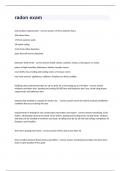
Radon Exam Review 2023/2024 updated to pass
Radon Exam ReviewWhat does the atomic number represent? Mass number? - correct answer Atomic Number: number of protons Mass Number: number of protons and neutrons What isotope of radon is most commonly used when discussing radon testing? - correct answer Radon-222 What is an ion? - correct answer one or more electrically charged atoms where protons and electrons are not equal What is ionizing radiation? - correct answer energetic radiations that impact atoms and produce ions What is the major source of radon? - correct answer Emanation from soil What is radon? - correct answer a radioactive element that is an inert or chemically inactive gas produced by decay of natural uranium in soils. it is odorless and tasteless and moderately soluble in water What is radioactive decay and what are its units? - correct answer the release of radiation (alpha/beta particles and gamma rays) from the decay of the nucleus of an atom. measured in picocuries (pCi/L) What type of radiation is most harmful to humans? - correct answer Alpha particles What is the half life of radon? - correct answer 3.8 days What are radon decay products (RDP)? What are their characteristics? - correct answer elements that are formed from the decay of radon, they are electrically charged, chemically reactive particles that pose a greater health risk to humans than radon itself. they also have a much shorter half life than radon (30 mins or less) What unit are radon decay products (RDPs) measured in? - correct answer Working levels (WL) What is the equilibrium ratio (ER) and what is its formula? - correct answer the ratio of radon decay products to the concentration of radon in the air ER = (WL/(pCi/L)) x 100 What is the maximum equilibrium ratio (ER)? What is the ER assumed to be indoors? - correct answer max = 1, indoors = 0.5 What does a high equilibrium ratio (ER) indicate? A low ER? - correct answer high = little air movement, low outdoor air exchange, or a lot of dust low = a lot of air movement, perhaps filtering, and little dust What is the greatest health risk of radon and its decay products? How was this established? - correct answer lung cancer; established by: 1) accepted scientific models of physical damage from alpha radiation 2) studies of animal exposure 3) comparative studies of underground miner over time (epidemiological studies; case-control studies of residential radon exposure and lung cancer risk are underway); 4) documentation of human exposure What factors change the risk level of radon exposure? - correct answer 1) cumulative length of exposure 2) concentration of radon and RDPs 3) compounding factors, especially smoking (about 85% of lung cancers attributed to smoking also involve radon) What is working level months (WLM) and what is its equation? - correct answer RDP-time-dose-exposure relationship 1 WLM = (WL x hours)/170 hours What is the US average indoor and outdoor radon concentration? - correct answer indoor = 1.25 pCi/L outdoor = 0.4 pCi/L How many deaths per year in the United States are caused by radon exposure according to the EPA? - correct answer 21,000 - 22,000 What is the percentage or fraction of homes in the U.S that the EPA estimates have radon concentrations above 4 pCi/L? - correct answer 1/15 or 6-7% What are the 3 requirements to have elevated indoor radon concentrations? - correct answer 1. radon source 2. pathway from the source to the inside of a building 3. a physical transport mechanism What are the ways that radon can be transported indoors? - correct answer -Emanation from radium bearing materials in products placed indoors (very rare). -Ground water from a private well used indoors (not common in much of the US, but can be significant in some areas). -Diffusion or simply movement from high or low concentration (commonly believed to be minor in importance), and -Pressure-driven air flow from areas of high to low pressure (dominant transport mechanism) What is the most common way that radon is transported into the home? - correct answer Air pressure differentials What are the 3 major causes of negative indoor air pressure? Which is the most common? - correct answer 1) Indoor-outdoor temperature differences creating a thermal stack effect (like a chimney) that increases infiltration low in the building and exfiltration high in the building (with a neutral pressure plane in between). A 40° F indoor-outdoor temperature difference in a typical house produces about 200 cfm of exfiltration/infiltration (most common) 2) Wind, which increases the stack effect; and
Written for
- Institution
- Radon certification
- Course
- Radon certification
Document information
- Uploaded on
- February 2, 2024
- Number of pages
- 9
- Written in
- 2023/2024
- Type
- Exam (elaborations)
- Contains
- Questions & answers
Subjects

Also available in package deal