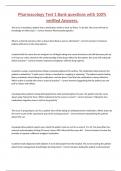
Pharmacology Test 1 Bank questions with 100% verified Answers.
The nurse is teaching a patient how a medication works to treat an illness. To do this, the nurse will rely on knowledge of which topic? - Correct Answers Pharmacotherapeutics What is a desired outcome when a drug is described as easy to administer? - Correct Answers It enhances patient adherence to the drug regimen. A patient tells the nurse that an analgesic he will begin taking may cause drowsiness and will decrease pain up to 4 hours at a time. Based on this understanding of the drug's effects by the patient, the nurse will anticipate which outcome? - Correct Answers Improved compliance with the drug regimen. A patient is using a metered-dose inhaler containing albuterol for asthma. The medication label instructs the patient to administer "2 puffs every 4 hours as needed for coughing or wheezing." The patient reports feeling jittery sometimes when taking the medication, and she doesn't feel that the medication is always effective. Which action is outside the nurse's scope of practice? - Correct Answers Suggesting that the patient use one puff to reduce side effects. A postoperative patient is being discharged home with acetaminophen for pain. the patient asks the nurse about using Tylenol for fever. Which statement by the nurse is correct? - Correct Answers "Taking the two medications together poses a risk for drug toxicity" The nurse is preparing to care for a patient who will be taking an antihypertensive medication. Which action by the nurse is part of the assessment step of the nursing process? - Correct Answers Questioning the patient about OTC use A postoperative patient reports pain, which the patient rates as an 8 on a scale of 1 to 10. The prescriber has ordered acetaminophen 650mg PO every 6 hours PRN. What will the nurse do? - Correct Answers Contact the provider to request a different analgesic medication. A patient newly diagnosed with diabetes is to be discharged from the hospital. The nurse teaching the patient about home management should begin by doing what? - Correct Answers Asking the patient to demonstrate how to measure and administer insulin. The nurse receives an order to give morphine 5 mg IV every 2 hours PRN for pain. Which action is not part of the 6 rights of med adm? - Correct Answers Assessing the patient's pain level 15 to 30 minutes after giving the medication. A patient tells a nurse that a medication prescribed for recurrent migraine headaches is not working. What will the nurse do? - Correct Answers Ask the patient about the number and frequency of tablets taken. A nurse is preparing to administer medications. Which patient would the nurse consider to have the greatest predisposition to an adverse reaction? - Correct Answers A 30 y/o man with kidney disease A nurse consults a drug manual before giving a medication to an 80 y/o patient. The manual states that older-adult patients are at increased risk for hepatic side effects. Which action by the nurse is correct? - Correct Answers Contact the provider to discuss an order for pretreatment laboratory work. A patient has been receiving IV penicillin for pneumonia for several days and begins to complain of generalized itching. The nurse auscultates bilateral wheezing and notes a temperature of 38.5 C (101F). Which action by the nurse is correct? - Correct Answers Hold the next dose and notify the prescriber of the symptoms A postoperative patient has orders for morphine sulfate 1 to 2 mg IV every hour PRN for severe pain and acetaminophen-hydrocodone (Lortab) 7.5 mg PO every 4-6 hours PRN for moderate pain. The patient reports pain at a level of 8. Which action by the nurse is appropriate? - Correct Answers Administer morphine sulfate 2 mg IV and evaluate the patient's pain in 15-30 minutes The nurse is teaching a patient about home administration of insulin to treat DM. As part of the teaching, the patient and nurse identify goals to maintain specific blood glucose ranges. This represents which aspect of the nursing process? - Correct Answers Planning A nurse educator is conducting a continuing education class on pharmacology. To evaluate the learning of the nurses in the class, the nurse educator asks, "Which drug name gives information about the drug's pharmacologic classification? What is the correct response? - Correct Answers Amoxicillin The FDA Amendments Act was passed in 2007 to address which aspect of drug safety? - Correct Answers Evaluating drug safety information that emerges after a drug has been approved and is in use A nursing students asks a nurse about pharmaceutical research and wants to know the purpose of randomization in drug trials. The nurse explains that the randomization is used to do what? - Correct Answers To ensure that differences in outcomes are the result of the treatment and not differences in subjects. Someone asks a nurse about a new drug that is in preclinical testing and wants to know why it cannot be used to treat a friend's illness. Which statement by the nurse is correct? - Correct Answers At this stage of drug development, the safety and usefulness of the medication is unknown. A patient asks a nurse why drugs that have been approved by the FDA still have unknown side effects. What will the nurse tell the patient? - Correct Answers Subjects in drug trials do not always represent the full spectrum of possible patients. A nurse is teaching nursing students about the use of nonproprietary names for drugs. The nurse tells them which fact about nonproprietary names? - Correct Answers They are assigned by the US Adopted Names Council A patient tells the nurse that the oral drug that has been prescribed has caused a lot of stomach discomfort in the past. what will the nurse ask the prescriber? - Correct Answers Whether an enteric-coated form of the drug is available A patient claims to get better effects with a tablet of Brand X of a drug than with a tablet of Brand Y of the same drug. Both brands contain the same amount of the active ingredient. What does the nurse know to be most likely? - Correct Answers Tablets can differ in composition and can have differing rates of disintegration and dissolution, which can alter the drug's effects in the body A patient receives a drug that has a narrow therapeutic range. The nurse administering this medication will expect to do what? - Correct Answers Monitor plasma drug levels. A patient is given a prescription for azithromycin and asks the nurse why the dose on the first day is twice the amount of the dose on the next 4 days. Which reply is correct? - Correct Answers A large initial dose helps to get the drug to optimal levels in the body faster. A nurse is giving an enteral medication. The patient asks why this method is preferable for this drug. How will the nurse reply? - Correct Answers This route is safer, less expensive, and more convenient. The nurse is preparing to administer penicillin G intramuscularly to a child. The child's parents ask why the drug cannot be given in an oral liquid form. What is the nurse's reply? - Correct Answers This drug would be inactivated by the enzymes in the stomach. A provider has written an order for a medication: drug A 100 mg PO every 6 hours. The half-life for the drug is approximately 6 hours. The nurse is preparing to administer the first dose at 8:00 AM on Tuesday. On Wednesday, when will the serum drug level reach plateau? - Correct Answers 8:00 AM An adult male patient is 1 day postoperative from a total hip replacement. On a pain scale of 0 to 10, with 10 being the greatest pain, the patient reports a pain level of 10. Which medication would be most appropriate for the nurse to administer to this patient? - Correct Answers 6 mg morphine sulfate IV A nurse is explaining drug metabolism to a nursing student who asks about glucuronidation. The nurse knows that this is a process that allows drugs to be: - Correct Answers Recycled via the enterohepatic recirculation to remain in the body longer. A patient is receiving IV gentamicin. A serum drug test reveals toxic levels. The dosing is correct, and the medication has been tolerated by this patient in the past. Which could be a probable cause of the test result? - Correct Answers Patient is taking another medication that binds to serum albumin. The nurse is caring for a child who has ingested a toxic amount of aspirin. The provider orders an IV drug that will increase pH in the blood and urine. the nurse understands that this effect is necessary to: - Correct Answers Increase the urinary excretion of aspirin A patient is taking a drug that does not bind to albumin. Which aspect of renal drug excretion is affected by this characteristic? - Correct Answers Glomerular flitration A patient is receiving digoxin twice daily. When assessing the patient before giving a dose, the nurse counts a pulse of 60 bpm and learns that the patient is experiencing nausea. The nurse consults a drug manual and verifies that the ordered dose is correct. What should the nurse do? - Correct Answers Contact the prescriber to report the symptoms A patient reports becoming "immune" to a medication because it no longer works to alleviate symptoms. The nurse recognizes that this decreased effectiveness is likely caused by: - Correct Answers Desensitization of receptor sites by continual exposure to the drug A patient has been receiving an antibiotic with a small therapeutic index for 10 days. Upon assessment, the nurse notes an increase in the drug's side effects. What would be the nurse's priority action? - Correct Answers Ask the prescriber to order a plasma drug level test
Written for
- Institution
- Pharmacology
- Course
- Pharmacology
Document information
- Uploaded on
- February 2, 2024
- Number of pages
- 22
- Written in
- 2023/2024
- Type
- Exam (elaborations)
- Contains
- Questions & answers
Subjects
-
the nurse is teaching a patient how a medication w
-
what is a desired outcome when a drug is described
-
a patient tells the nurse that an analgesic he wil
-
a patient is using a metered dose inhaler conta

Also available in package deal