Uworld NCLEX Exam Questions With 100% Correct Answers 2024
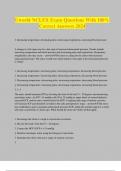
Uworld NCLEX Exam Questions With 100% Correct Answers 2024 2. Increasing temperature, decreasing pulse, decreasing respirations, increasing blood pressure A change in vital signs may be a late sign of increased intracranial pressure. Trends include increasing temperature and blood pressure and decreasing pulse and respirations. Respiratory irregularities also may occur. - answerThe nurse is caring for the client with increased intracranial pressure. The nurse would note which trend in vital signs if the intracranial pressure is rising? 1. Increasing temperature, increasing pulse, increasing respirations, decreasing blood pressure 2. Increasing temperature, decreasing pulse, decreasing respirations, decreasing blood pressure 3. Decreasing temperature, decreasing pulse, increasing respirations, decreasing blood pressure 4. Decreasing temperature, increasing pulse, decreasing respirations, increasing blood pressure 2, 3, 4 The nurse should maintain ICP by elevating the head of the bed 15 - 20 degrees and monitoring neurologic status. An ICP >15 mmHg with 20 to 25 mmHg as upper limits of normal indicates increased ICP, and the nurse should notify the HCP. Coughing and range of motion exercises will increase ICP and should be avoided in the early postoperative stage. - answerThe nurse has established a goal to maintain intracranial pressure (ICP) within the normal range for a client who had a craniotomy 12 hours ago. What should the nurse do? Select all that apply. 1. Encourage the client to cough to expectorate secretions. 2. Elevate the head of the bed 15 - 20 degrees. 3. Contact the HCP if ICP is >15 mmHg. 4. Monitor neurologic status using the Glasgow Coma Scale. 5. Stimulate the client with active range-of-motion exercises. 3 The clear drainage must be analyzed to determine whether it is nasal drainage or CSF. The nurse should not give the client tissues because it is important to know how much leakage of CSF is occurring. Compressing the nares will obstruct the drainage flow. It is inappropriate to tilt the head back, which would allow the fluid to drain down the throat and not be collected for a sample. It is inappropriate to administer an antihistamine because the drainage may not be from postnasal drip. - answerWhat should the nurse do first when a client with a head injury begins to have clear drainage from the nose? 1. Compress the nares 2. Tilt the head back 3. Collect the drainage 4. Administer an antihistamine for postnasal drip 4 Leakage of cerebrospinal fluid from the ears or nose may accompany basilar skull fractures. CSF can be distinguished from other body fluids because the drainage will separate into bloody and yellow concentric rings on dressing material, called a halo sign. The fluid also tests positive for glucose. - answerA client has clear fluid leaking from the nose following a basilar skull fracture. Which finding would alert the nurse that cerebrospinal fluid is present? 1. Fluid is clear and tests negative for
Written for
- Institution
- UWORLD NCLEX
- Course
- UWORLD NCLEX
Document information
- Uploaded on
- February 2, 2024
- Number of pages
- 12
- Written in
- 2023/2024
- Type
- Exam (elaborations)
- Contains
- Questions & answers
Subjects
-
uworld nclex exam questions with 100 correct answ

Also available in package deal