Auerello Matthaeus Pillay History 12 – Mrs Harvey
Independent Africa
Intelligent Jargon
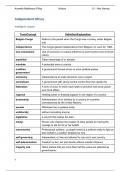
Term/Concept Definition/Explanation
Belgian Congo Refers to the period when the Congo was a colony under Belgian
rule.
independence The Congo gained independence from Belgium on June 30, 1960.
neo-colonialism Use of economic or cultural influence to exert control over a former
colony
exploited Taken advantage of or abused
mandate A protected area or country
coalition A government formed of two or more political parties
government
autonomy Independence to make decisions over a region
centralised A government with strong central control from the capital city
federation A form of union in which each state or province has some power
over local affairs
regional Holding power or drawing support in one region of a country
trusteeship Administration of an territory by a country or countries
commissioned by the United Nations
secede Withdraw from a political entity
unilaterally without consulting anyone
legislative A council that makes the laws
martyr Person who inspires the respect of other people for having the
courage to die for his or her beliefs
mercenaries Professional soldiers, or people hired by a political entity to fight on
their behalf in a conflict. Soldiers for hire.
self-governing Independent, or free and allowed to rule one’s own country
self-determination Freedom to live, act and decide without outside influence
majority rule When parties that win more than half the votes are selected as
governments.
1
, Auerello Matthaeus Pillay History 12 – Mrs Harvey
separatist A person who advocates cultural, ethnic, and or racial separation.
mutiny This is an open rebellion against authority.
insurrection An act of rebellion or resistance against a government
Operation des The United Nations Operation in the Congo, a peacekeeping
Nations Unies au mission established by the UN in 1960.
Congo (ONUC)
Congo Crisis A period of political and social instability in the Congo following
independence, characterised by internal conflicts and external
interventions.
Katanga secession The secessionist movement in the province of Katanga, led by
Moise Tshombe, seeking to break away from the Congo.
United Nations (UN) The UN intervened in the Congo Crisis, deploying peacekeeping
forces to restore order and facilitate independence.
Zaire The new name given to the country by Mobutu in 1971.
Authenticité Mobutu's policy emphasising African cultural identity and
discouraging Western influences.
Africanisation A policy to replace non-Africans in government and to promote
Afrucan customs and traditions
one-party rule Mobutu established a one-party system under his rule, with his
political party, the Popular Movement of the Revolution (MPR), as
the sole legal party.
accountability Responsibility or obligation to answer those who elected you
autocracy A government in which one person holds unlimited authority over
others
authoritarian The powers of a dictator
kleptocracy A term used to describe Mobutu's regime, characterised
by rampant corruption and embezzlement of state
resources.
Rule by a group or individuals who use their political power to steal
their country’s resources. The term is the combination of the word
“kleptomania”
- an obsessive need to steal regardless of need - and the Greek
word
kratos - meaning “power” - and its literal meaning is “rule by
thieves”
nepotism Favouritism shown on the basis of family relationships
2
Independent Africa
Intelligent Jargon
Term/Concept Definition/Explanation
Belgian Congo Refers to the period when the Congo was a colony under Belgian
rule.
independence The Congo gained independence from Belgium on June 30, 1960.
neo-colonialism Use of economic or cultural influence to exert control over a former
colony
exploited Taken advantage of or abused
mandate A protected area or country
coalition A government formed of two or more political parties
government
autonomy Independence to make decisions over a region
centralised A government with strong central control from the capital city
federation A form of union in which each state or province has some power
over local affairs
regional Holding power or drawing support in one region of a country
trusteeship Administration of an territory by a country or countries
commissioned by the United Nations
secede Withdraw from a political entity
unilaterally without consulting anyone
legislative A council that makes the laws
martyr Person who inspires the respect of other people for having the
courage to die for his or her beliefs
mercenaries Professional soldiers, or people hired by a political entity to fight on
their behalf in a conflict. Soldiers for hire.
self-governing Independent, or free and allowed to rule one’s own country
self-determination Freedom to live, act and decide without outside influence
majority rule When parties that win more than half the votes are selected as
governments.
1
, Auerello Matthaeus Pillay History 12 – Mrs Harvey
separatist A person who advocates cultural, ethnic, and or racial separation.
mutiny This is an open rebellion against authority.
insurrection An act of rebellion or resistance against a government
Operation des The United Nations Operation in the Congo, a peacekeeping
Nations Unies au mission established by the UN in 1960.
Congo (ONUC)
Congo Crisis A period of political and social instability in the Congo following
independence, characterised by internal conflicts and external
interventions.
Katanga secession The secessionist movement in the province of Katanga, led by
Moise Tshombe, seeking to break away from the Congo.
United Nations (UN) The UN intervened in the Congo Crisis, deploying peacekeeping
forces to restore order and facilitate independence.
Zaire The new name given to the country by Mobutu in 1971.
Authenticité Mobutu's policy emphasising African cultural identity and
discouraging Western influences.
Africanisation A policy to replace non-Africans in government and to promote
Afrucan customs and traditions
one-party rule Mobutu established a one-party system under his rule, with his
political party, the Popular Movement of the Revolution (MPR), as
the sole legal party.
accountability Responsibility or obligation to answer those who elected you
autocracy A government in which one person holds unlimited authority over
others
authoritarian The powers of a dictator
kleptocracy A term used to describe Mobutu's regime, characterised
by rampant corruption and embezzlement of state
resources.
Rule by a group or individuals who use their political power to steal
their country’s resources. The term is the combination of the word
“kleptomania”
- an obsessive need to steal regardless of need - and the Greek
word
kratos - meaning “power” - and its literal meaning is “rule by
thieves”
nepotism Favouritism shown on the basis of family relationships
2