

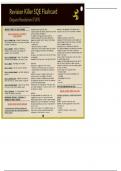
Revision Killer SQE Flashcard
Dispute Resolution (FLK1)
ANALYSIS OF MERITS OF CLAIM OR DEFENCE Alternative Dispute Resolution (ADR): Mediation is not appropriate if the parties need a
Litigation requires that parties consider the use of ADR ruling on a point of law or an injunction is required
INITIAL CASE ANALYSIS OF THE MERITS OF such as Arbitration and Mediation
A_ CLAIM OR DEFENCE ‘All members of the legal profession should now Litigation:
routinely consider with their clients whether their Litigation will apply as a last resort
Step 1 - Claimant’s Case - Establish if evidence shows disputes are suitable for ADR’ (Halsey v Milton Keynes Litigation is the formal process by which disputes are
all the elements required in law and proves the elements NHS Trust), unless: resolved through the courts and involves a trial being
on balance of probabilities ¢ Inappropriate held and a judgment being given
¢ Other party unlikely to co-operate Governed by the Civil Procedure Rules 1998 (CPR)
Step 2 - Defendant - Establish if defendant is * Other party not to be trusted to comply with an award Civil claims are commenced in the County Court or High Court
traceable, solvent and has assets available for An offer to engage in ADR should not be unreasonably Litigation is subject to the rules of disclosure
judgement, costs and enforcement refused requiring parties to produce all available evidence that
The burden is on the other party to show that the refusal relates to the claim
Step 3 - Limitation Period - Assess if the limitation is unreasonable Failure to adhere to the disclosure rules may result in
period has expired depending on the cause of action Unreasonable refusal may result in an adverse costs order the evidence being excluded
Judgments are binding though parties have the right to
Step 4 - Damages - What damages are available? Arbitration: apply for leave or permission to appeal a decision
Arbitration is triggered in one of two ways: Litigation is adversarial, more time consuming, complex
Step 5 - Interest - Does the claim carry interest? * Pursuant to an arbitration clause in a contract; or and costly to conduct
¢ The parties agree to arbitration once a dispute has Five main stages of the litigation process:
Step 6 - Alternative Remedies - What other remedies are arisen ¢ Pre-Action Conduct
possible? Arbitrator’s decision is binding on parties with no ¢ Commencement of the Action and Defending of the
recourse to seek a court judgment on the matter Proceedings
Step 7 - Funding the Case - Establish how client will Disclosure is limited so information may be withheld Case Management by the Court
finance the action e.g. private resources or Legal Aid The winning party can apply to the court for permission Trial
.
to enforce the arbitration award Post-Trial
St = Pre-Action Protocol - Comply with any relevant Arbitration may not be appropriate if the parties need
pre-action protocol before proceedings issued an in-depth investigation, a ruling on a point of law or PRE-ACTION CONSIDERATION AND STEPS
an injunction is required
Step 9 - Jurisdiction - If a foreign element to claim, RESOLVING A DISPUTE THROUGH A CIVIL CLAIM
consider the appropriate jurisdiction Mediation:
The agreed appointment of a mediator (who is an Preliminary Considerations - Limitation And Pre-Action
ARBITRATION, MEDIATION, LITIGATION AS A independent third party) to facilitate discussion Protocols:
MECHANISM TO RESOLVE DISPUTES between disputing parties to reach an agreed settlement Parties:
Mediation may or may not be binding but if not binding, Claimant: The person who makes the claim
DIFFERENT OPTIONS FOR DISPUTE RESOLUTION the party may withdraw at any time, to allow parties to Defendant: The person against whom a claim is made
return to court Check they are:
The Characteristics Of Arbitration, Mediation And There is no set format, it’s a confidential process, no * Traceable
Litigation Which Make Them An Appropriate Mechanism To formal rules to disclose information/documentation/ * Identify the Individual or Body Corporate
Resolve A Dispute: requirement to follow statutes or case law ¢ Solvent
, ra
CausesOfAction: Applicable Law - Mechanisms To Determine Which Country’s Jurisdiction Where Defendant Served Outside The
Common causes of action include: Laws Apply To A Contractual Or Tortious Claim Issued In Jurisdiction:
¢ Breach of Contract The Courts Of England & Wales: If the defendant is outside the jurisdiction, and the claim
Misrepresentation (Contract) English courts will also generally respect a choice of does not fall within the specific cases where permission is not
Negligence and Negligence Misstatement (Tort) English law required, the claimant must seek the permission of the court
Nuisance (Tort) However, there are certain limitations on choice of law/ to serve the defendant outside the jurisdiction
governing law: The court will exercise jurisdiction over foreign
Calculating Limitation Periods For Claims In Contract * Mandatory rules of the law of the forum where the defendants where the subject matter of the dispute has a
And Tort: dispute will be heard override the governing law of the sufficient connection with England
Contract - 6 years from date of breach of contract parties To obtain such permission, must show that all of the
Tort (other than PI and Latent Damage) - 6 years from Statutory protections enacted for the benefit of following are satisfied:
date damage occurs presumptively weak parties will override the parties’ ¢ The claim falls within one the Key Common Law Gateways
Tort (PI) - 3 years from later of i) date cause of action choice of law ¢ The claim has a reasonable prospect of success
occurs or; ii) date of knowledge of person injured Choice of law may be refused if its incompatible with * England is the proper place to bring the claim
Tort (Latent Damage) - 6 years from date of damage; or 3 the public policy of the jurisdiction
years from date of knowledge. In any event, claim must be The parties’ choice of law is not considered as bona fide The Hague Convention on Choice of Court Agreements:
brought within 15 years from date of negligence Hague Convention gives effect to an exclusive choice of a
Jurisdiction - Mechanisms To Determine Jurisdiction Over court in a contracting state (which includes the EU, the
Principles And Purpose Of Pre-Action Protocols Governing An International Contractual Or Tortious Claim: UK, Mexico, Singapore and Montenegro) where:
Particular Of Claim And Consequences For Failure To Jurisdiction Where Defendant Served Within The * The chosen court is obliged to hear the case
Follow Their Terms: Jurisdiction: Common Law Rules (apply from 1 January 2021) * Any other court must refuse to hear the case
Pre-Action Protocols: Prior to issuing of proceedings, If a defendant is within the jurisdiction of the English * The judgment of the chosen court will be recognised and
parties must comply with pre-action protocols Court and is validly served process, the English court enforced in other states
Practice Direction on Pre-Action Conduct and Protocols has jurisdiction over the defendant It has no application to agreements choosing a court in a
(PDPACP): This protocol applies where no relevant Pre- non-contracting state, such as the USA
Action Protocol exists (i.e. it is a catch all protocol) The Key Common Law Gateways:
Pre-Action Protocols and PDPACP encourage the quick Defendant domiciled in England COMMENCING A CLAIM, RESPONDING TO A CLAIM,
resolution of cases without litigation by the early and Branch in England PROGRESSING A CLAIM
fair exchange of information by the following prior to Injunction to do (or not do) an act in England
issuing of proceedings: Another party is being sued in England WHERE TO START PROCEEDINGS
* Parties should consider ADR Contract made in England, governed by English law or
Claimant should write to defendant with concise details subject to English jurisdiction Allocation Of Business Between The High Court And The
of the claim Breach of contract in England County Court:
Defendant should respond within a reasonable time if Assisting a breach of contract County Court:
claim is accepted and/or if there is a counterclaim Tort claims where damage in England or resulting from Claims worth £100,000 or less (except claims relating to
The parties should disclose key documents relevant to act in England media and communications work)
dispute Property in England Personal injury claims worth £50,000 or less
¢ Parties should take steps to narrow issues in dispute Trust governed by English law or subject to English Claims falling within the County Court jurisdiction may
Consequences for failure to follow Pre-Action Protocols jurisdiction be started in the High Court if there is reason to believe
and PDPACP include a court order to: Breach of fiduciary duty with English connection and that they should be heard by a High Court judge such as:
* Pay the other party’s costs (in full or part) assisting in a breach of fiduciary duty ¢ Financial value of the claim and the amount in dispute
* Pay the other party’s costs on an indemnity basis Declaration of non-liability Complexity of the facts, legal issues, remedies or
* Deprive the claimant who has been awarded a sum of Contempt applications procedures
money, interest on that sum of money Information orders against third parties Importance of the outcome of the claim to the public in
Require the defendant to pay interest on any damages general
awarded defendant’s right to contest jurisdiction may be waived In the absence of special reasons, claims less than £100,000
or lost by taking a step in the proceedings that is that have been commenced in the High Court will generally
inconsistent with that right and which may be seen as be transferred to the County Court unless there is another
constituting a submission to the court’s jurisdiction specific requirement for them to be tried in the High Court
Dispute Resolution (FLK1)
ANALYSIS OF MERITS OF CLAIM OR DEFENCE Alternative Dispute Resolution (ADR): Mediation is not appropriate if the parties need a
Litigation requires that parties consider the use of ADR ruling on a point of law or an injunction is required
INITIAL CASE ANALYSIS OF THE MERITS OF such as Arbitration and Mediation
A_ CLAIM OR DEFENCE ‘All members of the legal profession should now Litigation:
routinely consider with their clients whether their Litigation will apply as a last resort
Step 1 - Claimant’s Case - Establish if evidence shows disputes are suitable for ADR’ (Halsey v Milton Keynes Litigation is the formal process by which disputes are
all the elements required in law and proves the elements NHS Trust), unless: resolved through the courts and involves a trial being
on balance of probabilities ¢ Inappropriate held and a judgment being given
¢ Other party unlikely to co-operate Governed by the Civil Procedure Rules 1998 (CPR)
Step 2 - Defendant - Establish if defendant is * Other party not to be trusted to comply with an award Civil claims are commenced in the County Court or High Court
traceable, solvent and has assets available for An offer to engage in ADR should not be unreasonably Litigation is subject to the rules of disclosure
judgement, costs and enforcement refused requiring parties to produce all available evidence that
The burden is on the other party to show that the refusal relates to the claim
Step 3 - Limitation Period - Assess if the limitation is unreasonable Failure to adhere to the disclosure rules may result in
period has expired depending on the cause of action Unreasonable refusal may result in an adverse costs order the evidence being excluded
Judgments are binding though parties have the right to
Step 4 - Damages - What damages are available? Arbitration: apply for leave or permission to appeal a decision
Arbitration is triggered in one of two ways: Litigation is adversarial, more time consuming, complex
Step 5 - Interest - Does the claim carry interest? * Pursuant to an arbitration clause in a contract; or and costly to conduct
¢ The parties agree to arbitration once a dispute has Five main stages of the litigation process:
Step 6 - Alternative Remedies - What other remedies are arisen ¢ Pre-Action Conduct
possible? Arbitrator’s decision is binding on parties with no ¢ Commencement of the Action and Defending of the
recourse to seek a court judgment on the matter Proceedings
Step 7 - Funding the Case - Establish how client will Disclosure is limited so information may be withheld Case Management by the Court
finance the action e.g. private resources or Legal Aid The winning party can apply to the court for permission Trial
.
to enforce the arbitration award Post-Trial
St = Pre-Action Protocol - Comply with any relevant Arbitration may not be appropriate if the parties need
pre-action protocol before proceedings issued an in-depth investigation, a ruling on a point of law or PRE-ACTION CONSIDERATION AND STEPS
an injunction is required
Step 9 - Jurisdiction - If a foreign element to claim, RESOLVING A DISPUTE THROUGH A CIVIL CLAIM
consider the appropriate jurisdiction Mediation:
The agreed appointment of a mediator (who is an Preliminary Considerations - Limitation And Pre-Action
ARBITRATION, MEDIATION, LITIGATION AS A independent third party) to facilitate discussion Protocols:
MECHANISM TO RESOLVE DISPUTES between disputing parties to reach an agreed settlement Parties:
Mediation may or may not be binding but if not binding, Claimant: The person who makes the claim
DIFFERENT OPTIONS FOR DISPUTE RESOLUTION the party may withdraw at any time, to allow parties to Defendant: The person against whom a claim is made
return to court Check they are:
The Characteristics Of Arbitration, Mediation And There is no set format, it’s a confidential process, no * Traceable
Litigation Which Make Them An Appropriate Mechanism To formal rules to disclose information/documentation/ * Identify the Individual or Body Corporate
Resolve A Dispute: requirement to follow statutes or case law ¢ Solvent
, ra
CausesOfAction: Applicable Law - Mechanisms To Determine Which Country’s Jurisdiction Where Defendant Served Outside The
Common causes of action include: Laws Apply To A Contractual Or Tortious Claim Issued In Jurisdiction:
¢ Breach of Contract The Courts Of England & Wales: If the defendant is outside the jurisdiction, and the claim
Misrepresentation (Contract) English courts will also generally respect a choice of does not fall within the specific cases where permission is not
Negligence and Negligence Misstatement (Tort) English law required, the claimant must seek the permission of the court
Nuisance (Tort) However, there are certain limitations on choice of law/ to serve the defendant outside the jurisdiction
governing law: The court will exercise jurisdiction over foreign
Calculating Limitation Periods For Claims In Contract * Mandatory rules of the law of the forum where the defendants where the subject matter of the dispute has a
And Tort: dispute will be heard override the governing law of the sufficient connection with England
Contract - 6 years from date of breach of contract parties To obtain such permission, must show that all of the
Tort (other than PI and Latent Damage) - 6 years from Statutory protections enacted for the benefit of following are satisfied:
date damage occurs presumptively weak parties will override the parties’ ¢ The claim falls within one the Key Common Law Gateways
Tort (PI) - 3 years from later of i) date cause of action choice of law ¢ The claim has a reasonable prospect of success
occurs or; ii) date of knowledge of person injured Choice of law may be refused if its incompatible with * England is the proper place to bring the claim
Tort (Latent Damage) - 6 years from date of damage; or 3 the public policy of the jurisdiction
years from date of knowledge. In any event, claim must be The parties’ choice of law is not considered as bona fide The Hague Convention on Choice of Court Agreements:
brought within 15 years from date of negligence Hague Convention gives effect to an exclusive choice of a
Jurisdiction - Mechanisms To Determine Jurisdiction Over court in a contracting state (which includes the EU, the
Principles And Purpose Of Pre-Action Protocols Governing An International Contractual Or Tortious Claim: UK, Mexico, Singapore and Montenegro) where:
Particular Of Claim And Consequences For Failure To Jurisdiction Where Defendant Served Within The * The chosen court is obliged to hear the case
Follow Their Terms: Jurisdiction: Common Law Rules (apply from 1 January 2021) * Any other court must refuse to hear the case
Pre-Action Protocols: Prior to issuing of proceedings, If a defendant is within the jurisdiction of the English * The judgment of the chosen court will be recognised and
parties must comply with pre-action protocols Court and is validly served process, the English court enforced in other states
Practice Direction on Pre-Action Conduct and Protocols has jurisdiction over the defendant It has no application to agreements choosing a court in a
(PDPACP): This protocol applies where no relevant Pre- non-contracting state, such as the USA
Action Protocol exists (i.e. it is a catch all protocol) The Key Common Law Gateways:
Pre-Action Protocols and PDPACP encourage the quick Defendant domiciled in England COMMENCING A CLAIM, RESPONDING TO A CLAIM,
resolution of cases without litigation by the early and Branch in England PROGRESSING A CLAIM
fair exchange of information by the following prior to Injunction to do (or not do) an act in England
issuing of proceedings: Another party is being sued in England WHERE TO START PROCEEDINGS
* Parties should consider ADR Contract made in England, governed by English law or
Claimant should write to defendant with concise details subject to English jurisdiction Allocation Of Business Between The High Court And The
of the claim Breach of contract in England County Court:
Defendant should respond within a reasonable time if Assisting a breach of contract County Court:
claim is accepted and/or if there is a counterclaim Tort claims where damage in England or resulting from Claims worth £100,000 or less (except claims relating to
The parties should disclose key documents relevant to act in England media and communications work)
dispute Property in England Personal injury claims worth £50,000 or less
¢ Parties should take steps to narrow issues in dispute Trust governed by English law or subject to English Claims falling within the County Court jurisdiction may
Consequences for failure to follow Pre-Action Protocols jurisdiction be started in the High Court if there is reason to believe
and PDPACP include a court order to: Breach of fiduciary duty with English connection and that they should be heard by a High Court judge such as:
* Pay the other party’s costs (in full or part) assisting in a breach of fiduciary duty ¢ Financial value of the claim and the amount in dispute
* Pay the other party’s costs on an indemnity basis Declaration of non-liability Complexity of the facts, legal issues, remedies or
* Deprive the claimant who has been awarded a sum of Contempt applications procedures
money, interest on that sum of money Information orders against third parties Importance of the outcome of the claim to the public in
Require the defendant to pay interest on any damages general
awarded defendant’s right to contest jurisdiction may be waived In the absence of special reasons, claims less than £100,000
or lost by taking a step in the proceedings that is that have been commenced in the High Court will generally
inconsistent with that right and which may be seen as be transferred to the County Court unless there is another
constituting a submission to the court’s jurisdiction specific requirement for them to be tried in the High Court


