Week 1 - Introduction to Loss and Psychotrauma
LOSS &
PSYCHOTRAUMA
UTRECHT UNIVERSITY, MASTER
CLINICAL PSYCHOLOGY 2023/24
, Week 1 - Introduction to Loss and Psychotrauma
Content
- All lectures and Workshops
- All articles corresponding the lectures and workshops, i.e.
Lecture 1 Mirjam van Zuiden
• Boelen, P. A., & Smid, G. E. (2017). Disturbed grief: Prolonged Grief Disorder (PGD) and Persistent
Complex Bereavement Disorder (PCBD). British Medical Journal, 357. doi:10.1136/bmj.j2016. See
this link.
• Stroebe, M.S., Schut, H.A.W. & Stroebe, W. (2007). The health consequences of bereavement: A
review. The Lancet, 370, 1960-1973. 10.1016/S0140-6736(07)61816-9. See this link.
• Burback, L., Brémault-Philps S, Nijdam, M.J. , McFarlane A. & Vermetten, E. (2023) Treatment of
Posttraumatic Stress Disorder: A state-of-the-art Review. See this link. Article sections 1; 2; 5.1; 5.2;
6; 7 (NB: you do not need to learn the exact names of all mentioned brain structures, hormones,
pharmacological interventions etc but instead the goal is that you gain a more overall overview of
involved neurocognitive mechanisms in PTSD and thereby understand PTSD’s complexity and the
challenges in improving treatment efficacy).
Lecture 2: Maggie Stroebe
• Stroebe, M.S., Schut, H.A.W. & Boerner, K. (2017). Models of coping with bereavement: An
updated overview. Studies in Psychology, 1-26. 10.1080/02109395.2017.1340055. See this link.
Lecture 3: Trudy Mooren
• Mogil, C., Hayal, N., Aralis, H., Paley, B., Milburn, N.G., Barrera, W., Kiff, C., Beardslee, W., & Lester,
P. (2022). A trauma-informed, family-centered, virtual home visiting program for young children:
One-year outcomes. Child Psychiatry & Human Development, 53, 964-979. See this link.
• Yohannan, J., Carlson, J.S., & Volker, M.A. (2021). Cognitive behavioral treatments for children and
adolescents exposed to traumatic events: A meta-analysis examining variables moderating
treatment outcomes. Journal of Traumatic Stress, https://doi.org/10.1002/jts.22755. See this link.
Lecture 4: Iva Bicanic
• Covers, Karst & Bicanic (2022) Development of multidisciplinary sexual assault centers in the
Netherlands, European journal of psychotraumatology, 13:2, 2127475. See this link.
• Also highly recommended, yet not required: viewing the Centrum voor Seksueel geweld vlogs for
healthcare providers (in Dutch unfortunately). See this link.
Lecture 5: Henk Schut
• Johannsen, M., Damholdt, M. F., Zachariae, R., Lundorff, M., Farver-Vestergaard, I., & O'Connor, M.
(2019). Psychological interventions for grief in adults: A systematic review and meta-analysis of
randomized controlled trials. Journal of Affective Disorders, 253, 69–86.
https://doi.org/10.1016/j.jad.2019.04.065. See this link.
Lecture 6: Paul Boelen
• Boelen, P. A., Hout, M. v. d., & Bout, J. v. d. (2013). Prolonged grief disorder: Cognitive-behavioral
theory and therapy. In M. Stroebe, H. Schut, & J. van den Bout (Eds.), Complicated grief: Scientific
foundations for health care professionals (p. 221–234). Routledge/Taylor & Francis Group. Chapter
will be made available on Blackboard (see course content - literature).
• Spuij, M., van Londen-Huiberts, A., & Boelen, P. A. (2013). Cognitive-Behavioral Therapy for
prolonged grief in children: Feasibility and multiple baseline study. Cognitive and Behavioral
Practice, 20, 349-361. See this link.
Lecture 7: Sjef Berendsen
• Burback, L., Brémault-Philps S, Nijdam, M.J. , McFarlane A. & Vermetten, E. (2023) Treatment of
Posttraumatic Stress Disorder: A state-of-the-art Review. See this link. Article sections: 3; 4; 5.4.
Lecture 8: Jeroen Knipscheer & Franziska Lechner- Meichsner
• Patanè, M., Ghane, S., Karyotaki, E., Cuijpers, P., Schoonmade, L., Tarsitani, L., & Sijbrandij, M.
(2022). Prevalence of mental disorders in refugees and asylum seekers: A systematic review and
meta-analysis. Global Mental Health, 1-14. doi:10.1017/gmh.2022.29. See this link.
• Turrini, G., Tedeschi, F., Cuijpers, P., Del Giovane, C., Kip, A., Morina, N., Nosè, M., Ostuzzi, G.,
Purgato, M., Ricciardi, C., Sijbrandij, M., Tol, W., & Barbui, C. (2021). A network meta-analysis of
psychosocial interventions for refugees and asylum seekers with PTSD. BMJ Global Health, 6(6),
e005029. See this link.
1
, Week 1 - Introduction to Loss and Psychotrauma
• Killikelly, C., Bauer, S., & Maercker, A. (2018). The assessment of grief in refugees and postconflict
survivors: a narrative review of etic and emic research. Frontiers in Psychology, 9. doi:
10.3389/fpsyg.2018.01957. See this link.
Workshop Josita Versteeg: Narrative Exposure Therapy (NET)
• Neuner, F., Elbert, T., & Schauer, M. (2020). Narrative exposure therapy for PTSD. In L. F. Bufka, C.
V. Wright, & R. W. Halfond (Eds.), Casebook to the APA Clinical Practice Guideline for the treatment
of PTSD (pp. 187–205). American Psychological Association. https://doi.org/10.1037/0000196-009.
Chapter will be made available on Blackboard (see course content – workshops - workshop
preparations – workshop Josita Versteeg)
Workshop Jeroen Knipscheer: Treatment of prolonged grief following traumatic loss
Same literature as for Lecture 6 by Paul Boelen
• Boelen, P. A., Hout, M. v. d., & Bout, J. v. d. (2013). Prolonged grief disorder: Cognitive-behavioral
theory and therapy. In M. Stroebe, H. Schut, & J. van den Bout (Eds.), Complicated grief: Scientific
foundations for health care professionals (p. 221–234). Routledge/Taylor & Francis Group. Chapter
will be made available on Blackboard (see course content - literature).
• Spuij, M., van Londen-Huiberts, A., & Boelen, P. A. (2013). Cognitive-Behavioral Therapy for
prolonged grief in children: Feasibility and multiple baseline study. Cognitive and Behavioral
Practice, 20, 349-361. See this link.
Workshop Franziska Lechner-Meichsner
• Lechner-Meichsner, F., Ehring, T., Krüger-Gottschalk, A., Morina, N., Plankl, C., & Steil, R. (2022).
Using imagery rescripting to treat posttraumatic stress disorder in refugees: A Case Study.
Cognitive and Behavioral Practice. doi: 10.1016/j.cbpra.2022.06.002. See this link.
• Boterhoven de Haan, K. L., Lee, C. W., Fassbinder, E., van Es, S. M., Menninga, S., Meewisse, M.-L.,
Rijkeboer, M., Kousemaker, M., & Arntz, A. (2020). Imagery rescripting and eye movement
desensitisation and reprocessing as treatment for adults with post-traumatic stress disorder from
childhood trauma: Randomised clinical trial. The British Journal of Psychiatry, 217 (5), 609–615.
https://doi.org/10.1192/bjp.2020.158. See this link.
Workshop Simone Belt: Sexual trauma
• Dworkin, E. R., Ojalehto, H. J., Brill, C. D., Fitzpatrick, S., Bedard-Gilligan, M. A., & Kaysen, D. (2019).
Understanding PTSD and sexual assault. In Handbook of Sexual Assault and Sexual Assault
Prevention (pp. 293-307). Cham: Springer International Publishing. See this link.
Workshop Anneke Vedder: Mourner’s social space
• Maciejewski, P. K., Falzarano, F. B., She, W. J., Lichtenthal, W. G., & Prigerson, H. G. (2022). A
micro-sociological theory of adjustment to loss. Current Opinion in Psychology, 43, 96–101.
https://doi.org/10.1016/j.copsyc.2021.06.016. See this link.
2
, Week 1 - Introduction to Loss and Psychotrauma
INTRODUCTION TO LOSS AND PSYCHOTRAUMA AND ITS MOST COMMON PSYCHOLOGICAL
LECTURE
CONSEQUENCES
PART 1: LOSS
Definitions
• Bereavement = Situation of having lost a loved one/relative
• Grief = The emotional/psychological responses to this loss
• Mourning = Behavioural and social expressions of grief, which are shaped by the practices of a given
society or cultural group (e.g. mourning rituals).
• Unhealthy, disordered, complicated grief = General terms for stagnated grief – possibly developing
into a full-blown grief disorder.
• Prolonged Grief Disorder = Term for formal classification of grieving disorder in DSM-5-TR(section 2)
and ICD-11
Misconceptions about Grief
• Normal grieving is a process occurring in stages or phases Denial; Anger; Bargaining; Depression;
Acceptance.
• The same reactions (anger, depression, sadness) are always part of the grieving process.
• Intense emotions in the initial period of mourning predict healthy adjustment, absence of reactions
indicate unhealthy, abnormal grief
• Losing a child is always worse than losing a partner – which are both worse than losing a parent
• A grieving process ends after 1 years (partners) or 2 years (children)
What Is Grief?
• Primarily: 'separation distress’
o All (automatic) responses occurring after being separated from an attachment figure
o Attachment figure = person providing a safe haven for you (parent, partner)
o Attachment figure = person you are responsible for as caretaker (your children)
• Feelings = yearning, longing
, Week 1 - Introduction to Loss and Psychotrauma
• Behaviour = proximity seeking (searching)
• Thoughts = preoccupation with thoughts about deceased and death event
• Perceptions = sensation of seeing/hearing the person; feeling that separation is “unreal”
• Adjusting to loss is all about TASKS not about STAGES/PHASES:
o (1) accepting the loss
o (2) experiencing pain of grief
o (3) adjusting
o (4) relocating and moving on
DISTURBED, UNHEALTHY GRIEF
• Normal, healthy grief: DUAL PROSCESSING MODEL = Oscillation between Loss and Restoration
Oriented Coping
Disturbed Grief
• No Oscillation
• Many terms in the literature:
o Too much grief -> chronic grief
o Too little grief -> suppressed grief, delayed grief
o Grief after disturbed relationship -> ambivalent grief
• DSM vs. ICD:
o Typological (ICD) vs detailed description of criteria (DSM)
o Number of symptoms and severity specification for diagnosis (more specific in DSM)
o Timing after loss when diagnosis can be made (6-months ICD vs. 12 months DSM)
1
, Week 1 - Introduction to Loss and Psychotrauma
ASSESSING DISTURBED, UNHEALTHY GRIEF AND PROLONGED GRIEF DISORDER
Diagnosing Prolonged Grief Disorder in Clinical Practice?
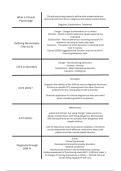
• Phenomenological distinction between “healthy grief” and PGD:
2
LOSS &
PSYCHOTRAUMA
UTRECHT UNIVERSITY, MASTER
CLINICAL PSYCHOLOGY 2023/24
, Week 1 - Introduction to Loss and Psychotrauma
Content
- All lectures and Workshops
- All articles corresponding the lectures and workshops, i.e.
Lecture 1 Mirjam van Zuiden
• Boelen, P. A., & Smid, G. E. (2017). Disturbed grief: Prolonged Grief Disorder (PGD) and Persistent
Complex Bereavement Disorder (PCBD). British Medical Journal, 357. doi:10.1136/bmj.j2016. See
this link.
• Stroebe, M.S., Schut, H.A.W. & Stroebe, W. (2007). The health consequences of bereavement: A
review. The Lancet, 370, 1960-1973. 10.1016/S0140-6736(07)61816-9. See this link.
• Burback, L., Brémault-Philps S, Nijdam, M.J. , McFarlane A. & Vermetten, E. (2023) Treatment of
Posttraumatic Stress Disorder: A state-of-the-art Review. See this link. Article sections 1; 2; 5.1; 5.2;
6; 7 (NB: you do not need to learn the exact names of all mentioned brain structures, hormones,
pharmacological interventions etc but instead the goal is that you gain a more overall overview of
involved neurocognitive mechanisms in PTSD and thereby understand PTSD’s complexity and the
challenges in improving treatment efficacy).
Lecture 2: Maggie Stroebe
• Stroebe, M.S., Schut, H.A.W. & Boerner, K. (2017). Models of coping with bereavement: An
updated overview. Studies in Psychology, 1-26. 10.1080/02109395.2017.1340055. See this link.
Lecture 3: Trudy Mooren
• Mogil, C., Hayal, N., Aralis, H., Paley, B., Milburn, N.G., Barrera, W., Kiff, C., Beardslee, W., & Lester,
P. (2022). A trauma-informed, family-centered, virtual home visiting program for young children:
One-year outcomes. Child Psychiatry & Human Development, 53, 964-979. See this link.
• Yohannan, J., Carlson, J.S., & Volker, M.A. (2021). Cognitive behavioral treatments for children and
adolescents exposed to traumatic events: A meta-analysis examining variables moderating
treatment outcomes. Journal of Traumatic Stress, https://doi.org/10.1002/jts.22755. See this link.
Lecture 4: Iva Bicanic
• Covers, Karst & Bicanic (2022) Development of multidisciplinary sexual assault centers in the
Netherlands, European journal of psychotraumatology, 13:2, 2127475. See this link.
• Also highly recommended, yet not required: viewing the Centrum voor Seksueel geweld vlogs for
healthcare providers (in Dutch unfortunately). See this link.
Lecture 5: Henk Schut
• Johannsen, M., Damholdt, M. F., Zachariae, R., Lundorff, M., Farver-Vestergaard, I., & O'Connor, M.
(2019). Psychological interventions for grief in adults: A systematic review and meta-analysis of
randomized controlled trials. Journal of Affective Disorders, 253, 69–86.
https://doi.org/10.1016/j.jad.2019.04.065. See this link.
Lecture 6: Paul Boelen
• Boelen, P. A., Hout, M. v. d., & Bout, J. v. d. (2013). Prolonged grief disorder: Cognitive-behavioral
theory and therapy. In M. Stroebe, H. Schut, & J. van den Bout (Eds.), Complicated grief: Scientific
foundations for health care professionals (p. 221–234). Routledge/Taylor & Francis Group. Chapter
will be made available on Blackboard (see course content - literature).
• Spuij, M., van Londen-Huiberts, A., & Boelen, P. A. (2013). Cognitive-Behavioral Therapy for
prolonged grief in children: Feasibility and multiple baseline study. Cognitive and Behavioral
Practice, 20, 349-361. See this link.
Lecture 7: Sjef Berendsen
• Burback, L., Brémault-Philps S, Nijdam, M.J. , McFarlane A. & Vermetten, E. (2023) Treatment of
Posttraumatic Stress Disorder: A state-of-the-art Review. See this link. Article sections: 3; 4; 5.4.
Lecture 8: Jeroen Knipscheer & Franziska Lechner- Meichsner
• Patanè, M., Ghane, S., Karyotaki, E., Cuijpers, P., Schoonmade, L., Tarsitani, L., & Sijbrandij, M.
(2022). Prevalence of mental disorders in refugees and asylum seekers: A systematic review and
meta-analysis. Global Mental Health, 1-14. doi:10.1017/gmh.2022.29. See this link.
• Turrini, G., Tedeschi, F., Cuijpers, P., Del Giovane, C., Kip, A., Morina, N., Nosè, M., Ostuzzi, G.,
Purgato, M., Ricciardi, C., Sijbrandij, M., Tol, W., & Barbui, C. (2021). A network meta-analysis of
psychosocial interventions for refugees and asylum seekers with PTSD. BMJ Global Health, 6(6),
e005029. See this link.
1
, Week 1 - Introduction to Loss and Psychotrauma
• Killikelly, C., Bauer, S., & Maercker, A. (2018). The assessment of grief in refugees and postconflict
survivors: a narrative review of etic and emic research. Frontiers in Psychology, 9. doi:
10.3389/fpsyg.2018.01957. See this link.
Workshop Josita Versteeg: Narrative Exposure Therapy (NET)
• Neuner, F., Elbert, T., & Schauer, M. (2020). Narrative exposure therapy for PTSD. In L. F. Bufka, C.
V. Wright, & R. W. Halfond (Eds.), Casebook to the APA Clinical Practice Guideline for the treatment
of PTSD (pp. 187–205). American Psychological Association. https://doi.org/10.1037/0000196-009.
Chapter will be made available on Blackboard (see course content – workshops - workshop
preparations – workshop Josita Versteeg)
Workshop Jeroen Knipscheer: Treatment of prolonged grief following traumatic loss
Same literature as for Lecture 6 by Paul Boelen
• Boelen, P. A., Hout, M. v. d., & Bout, J. v. d. (2013). Prolonged grief disorder: Cognitive-behavioral
theory and therapy. In M. Stroebe, H. Schut, & J. van den Bout (Eds.), Complicated grief: Scientific
foundations for health care professionals (p. 221–234). Routledge/Taylor & Francis Group. Chapter
will be made available on Blackboard (see course content - literature).
• Spuij, M., van Londen-Huiberts, A., & Boelen, P. A. (2013). Cognitive-Behavioral Therapy for
prolonged grief in children: Feasibility and multiple baseline study. Cognitive and Behavioral
Practice, 20, 349-361. See this link.
Workshop Franziska Lechner-Meichsner
• Lechner-Meichsner, F., Ehring, T., Krüger-Gottschalk, A., Morina, N., Plankl, C., & Steil, R. (2022).
Using imagery rescripting to treat posttraumatic stress disorder in refugees: A Case Study.
Cognitive and Behavioral Practice. doi: 10.1016/j.cbpra.2022.06.002. See this link.
• Boterhoven de Haan, K. L., Lee, C. W., Fassbinder, E., van Es, S. M., Menninga, S., Meewisse, M.-L.,
Rijkeboer, M., Kousemaker, M., & Arntz, A. (2020). Imagery rescripting and eye movement
desensitisation and reprocessing as treatment for adults with post-traumatic stress disorder from
childhood trauma: Randomised clinical trial. The British Journal of Psychiatry, 217 (5), 609–615.
https://doi.org/10.1192/bjp.2020.158. See this link.
Workshop Simone Belt: Sexual trauma
• Dworkin, E. R., Ojalehto, H. J., Brill, C. D., Fitzpatrick, S., Bedard-Gilligan, M. A., & Kaysen, D. (2019).
Understanding PTSD and sexual assault. In Handbook of Sexual Assault and Sexual Assault
Prevention (pp. 293-307). Cham: Springer International Publishing. See this link.
Workshop Anneke Vedder: Mourner’s social space
• Maciejewski, P. K., Falzarano, F. B., She, W. J., Lichtenthal, W. G., & Prigerson, H. G. (2022). A
micro-sociological theory of adjustment to loss. Current Opinion in Psychology, 43, 96–101.
https://doi.org/10.1016/j.copsyc.2021.06.016. See this link.
2
, Week 1 - Introduction to Loss and Psychotrauma
INTRODUCTION TO LOSS AND PSYCHOTRAUMA AND ITS MOST COMMON PSYCHOLOGICAL
LECTURE
CONSEQUENCES
PART 1: LOSS
Definitions
• Bereavement = Situation of having lost a loved one/relative
• Grief = The emotional/psychological responses to this loss
• Mourning = Behavioural and social expressions of grief, which are shaped by the practices of a given
society or cultural group (e.g. mourning rituals).
• Unhealthy, disordered, complicated grief = General terms for stagnated grief – possibly developing
into a full-blown grief disorder.
• Prolonged Grief Disorder = Term for formal classification of grieving disorder in DSM-5-TR(section 2)
and ICD-11
Misconceptions about Grief
• Normal grieving is a process occurring in stages or phases Denial; Anger; Bargaining; Depression;
Acceptance.
• The same reactions (anger, depression, sadness) are always part of the grieving process.
• Intense emotions in the initial period of mourning predict healthy adjustment, absence of reactions
indicate unhealthy, abnormal grief
• Losing a child is always worse than losing a partner – which are both worse than losing a parent
• A grieving process ends after 1 years (partners) or 2 years (children)
What Is Grief?
• Primarily: 'separation distress’
o All (automatic) responses occurring after being separated from an attachment figure
o Attachment figure = person providing a safe haven for you (parent, partner)
o Attachment figure = person you are responsible for as caretaker (your children)
• Feelings = yearning, longing
, Week 1 - Introduction to Loss and Psychotrauma
• Behaviour = proximity seeking (searching)
• Thoughts = preoccupation with thoughts about deceased and death event
• Perceptions = sensation of seeing/hearing the person; feeling that separation is “unreal”
• Adjusting to loss is all about TASKS not about STAGES/PHASES:
o (1) accepting the loss
o (2) experiencing pain of grief
o (3) adjusting
o (4) relocating and moving on
DISTURBED, UNHEALTHY GRIEF
• Normal, healthy grief: DUAL PROSCESSING MODEL = Oscillation between Loss and Restoration
Oriented Coping
Disturbed Grief
• No Oscillation
• Many terms in the literature:
o Too much grief -> chronic grief
o Too little grief -> suppressed grief, delayed grief
o Grief after disturbed relationship -> ambivalent grief
• DSM vs. ICD:
o Typological (ICD) vs detailed description of criteria (DSM)
o Number of symptoms and severity specification for diagnosis (more specific in DSM)
o Timing after loss when diagnosis can be made (6-months ICD vs. 12 months DSM)
1
, Week 1 - Introduction to Loss and Psychotrauma
ASSESSING DISTURBED, UNHEALTHY GRIEF AND PROLONGED GRIEF DISORDER
Diagnosing Prolonged Grief Disorder in Clinical Practice?
• Phenomenological distinction between “healthy grief” and PGD:
2