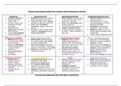
Describe and evaluate research into caregiver-infant interactions in humans.
Reciprocity Reciprocity (cont) Interactional Synchrony Interactional Synchrony (cont)
● Caregiver responds to ● Brazelton describes it as a ‘dance’, ● When caregiver and infant react ● Meltzoff + Moore looked at IS in
baby’s actions with partner responds to each other. ‘in time’ with each other, mirror 2 week old infants.
similar action. ● Traditionally baby seen as passive, facial/body movements. ● Adult displayed 1 of 3 facial
● Moving in rhythm when although now baby has active role. ● Babies have alert phases which expressions/gestures, & child’s
interacting with adult, ● Mother and child initiated mothers respond to. response was filmed.
turn-taking. interactions, appear to take turns ● ‘Coordination of micro behaviour’ ● Association found between
● Reciprocity more doing so. ● Actions + emotions mirror. expression + action of child.
frequent after 3 months, ● Regularity of infant’s signals allows ● Provides necessary foundation ● Isabella found high IS w/ more
elicits response. caregiver to anticipate behaviour + for mother + infant connection for strongly attached caregiver-infant
● Involves close attention respond appropriately. later years. relationships.
to facial expressions. ● Children respond differently via IS
Difficult to test reliability Well controlled, high validity Socially Sensitive Research Murray + Trevarthen, Research
● Mouths always moving, ● Mother-infant interactions filmed, ● Suggests children could be ● Study with 2 month old infants.
expressions like smiling from multiple angles. Fine details disadvantaged because of ● Infants first reacted via video in
occur frequently. recorded + analysed later. particular child-rearing practices. real time to mother.
● Different to distinguish ● Babies don’t know they are being ● Mothers who return to work short ● Recording of mother replayed to
between general activity observed, no change in behaviour in after child is born restricts infants, image on screen did not
+ specific imitated response to observation, mainly SDB interactional synchrony. respond to infant’s facial/body
behaviours. ● Studies have good validity, well ● Suggests mother should not gestures. Infants became
● Are they conscious or controlled procedures. return to work so soon - has distressed, tried to attract
deliberate? social sensitive implications and mother’s attention.
● No certainty. can affect economy. ● Shows infants actively interacting
Findings not replicated Real World Application Holistic Behaviourist Approach
● Koepke failed to ● Interactional synchrony used as ● Holistic, considers both mother ● Belief children and caregiver are
replicate findings of foundation of high-quality and child interaction as active taught and reinforced behaviour,
Meltzoff + Moore. attachments to benefit society. objects in childhood particularly in reciprocity.
● Counter: M&M argue ● 10 min parent-child therapy development. ● Considers behaviour of both
their research was less improved IS in 20 low-income ● Qualitative methods to individuals as active objects.
controlled. mothers, compared to control. investigate all aspects of the
● Findings may lack ● Valuable in developing mother-infant individual, as well as the
reliability. attachments, particularly in groups at interactions between people.
risk.
Describe and evaluate the role of the father in attachment.
Reciprocity Reciprocity (cont) Interactional Synchrony Interactional Synchrony (cont)
● Caregiver responds to ● Brazelton describes it as a ‘dance’, ● When caregiver and infant react ● Meltzoff + Moore looked at IS in
baby’s actions with partner responds to each other. ‘in time’ with each other, mirror 2 week old infants.
similar action. ● Traditionally baby seen as passive, facial/body movements. ● Adult displayed 1 of 3 facial
● Moving in rhythm when although now baby has active role. ● Babies have alert phases which expressions/gestures, & child’s
interacting with adult, ● Mother and child initiated mothers respond to. response was filmed.
turn-taking. interactions, appear to take turns ● ‘Coordination of micro behaviour’ ● Association found between
● Reciprocity more doing so. ● Actions + emotions mirror. expression + action of child.
frequent after 3 months, ● Regularity of infant’s signals allows ● Provides necessary foundation ● Isabella found high IS w/ more
elicits response. caregiver to anticipate behaviour + for mother + infant connection for strongly attached caregiver-infant
● Involves close attention respond appropriately. later years. relationships.
to facial expressions. ● Children respond differently via IS
Difficult to test reliability Well controlled, high validity Socially Sensitive Research Murray + Trevarthen, Research
● Mouths always moving, ● Mother-infant interactions filmed, ● Suggests children could be ● Study with 2 month old infants.
expressions like smiling from multiple angles. Fine details disadvantaged because of ● Infants first reacted via video in
occur frequently. recorded + analysed later. particular child-rearing practices. real time to mother.
● Different to distinguish ● Babies don’t know they are being ● Mothers who return to work short ● Recording of mother replayed to
between general activity observed, no change in behaviour in after child is born restricts infants, image on screen did not
+ specific imitated response to observation, mainly SDB interactional synchrony. respond to infant’s facial/body
behaviours. ● Studies have good validity, well ● Suggests mother should not gestures. Infants became
● Are they conscious or controlled procedures. return to work so soon - has distressed, tried to attract
deliberate? social sensitive implications and mother’s attention.
● No certainty. can affect economy. ● Shows infants actively interacting
Findings not replicated Real World Application Holistic Behaviourist Approach
● Koepke failed to ● Interactional synchrony used as ● Holistic, considers both mother ● Belief children and caregiver are
replicate findings of foundation of high-quality and child interaction as active taught and reinforced behaviour,
Meltzoff + Moore. attachments to benefit society. objects in childhood particularly in reciprocity.
● Counter: M&M argue ● 10 min parent-child therapy development. ● Considers behaviour of both
their research was less improved IS in 20 low-income ● Qualitative methods to individuals as active objects.
controlled. mothers, compared to control. investigate all aspects of the
● Findings may lack ● Valuable in developing mother-infant individual, as well as the
reliability. attachments, particularly in groups at interactions between people.
risk.
Describe and evaluate the role of the father in attachment.