FORT Test Questions and Answers Already Passed
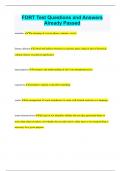
FORT Test Questions and Answers Already Passed semantics The meaning of a word, phrase, sentence, or text. literary allusion a brief and indirect reference to a person, place, thing or idea of historical, cultural, literary or political significance metacognition awareness and understanding of one's own thought processes expository intended to explain or describe something syntax the arrangement of words and phrases to create well-formed sentences in a language. norm-referenced test this type of test identifies whether the test taker performed better or worse than other test takers, not whether the test taker knows either more or less material than is necessary for a given purpose. phonemes any of the perceptually distinct units of sound in a specified language that distinguish one word from another. (smallest unit of sound) Phonological Awareness A conscious sensitivity to the structure of language by sound. It includes the ability to distinguish between parts of speech such as syllables and phonemes. Rhyming A pair of lines which end in the same sound (phonological awareness) Syllables Beats in a word (phonological awareness) onset and rime Parts of spoken language that are smaller than syllables but larger than phoneme (phonoligical awareness) Phonemic Awareness The ability to hear, identify,and manipulate the individual sounds, phonemes, in oral language. Phonics Ability to make the correct association between the phonemes and graphemes (sounds and the symbols) of a language (lights on, visual) explicit clearly stated or shown; forthright in expression implicit Implied or understood though unexpressed literal comprehension students ability to state sequence of events, characters, setting, etc. stated directly in text. (who, what, when) inferential comprehension students ability to use clues from passage to infer (wonder, ponder, predict) what is happening. (read between the lines) engagement of schema reader shows evidence of activating background knowledge. self-monitoring reader shows evidence of metacognition (visualization, summarizing, making connections, etc.) sight words Words that a student recognizes on sight, rather than first having to sound them out. grapheme smalles unit of written language (letters) Morpheme smalles unit of meaning in word blending combinin sounds, typically into words segmenting dividing a spoken word into the smalles units of sound within that word deleting removing on or more sounds from a word substituting replacing one sound with another rcontrolled words r colors the way the preceding vowel is pronounced schwa The vowel sound sometimes heard in an unstressed syllable and is most often sounded as 'uh' or as the short 'u' sound as in 'cup.' semantic mapping A strategy that visually displays the relationship among words and helps to categorize them. Emergent Literacy Students that have not yet begun formal reading instruction. Book Handling Skills a child's knowledge of how books "work" Alphabetic Principle The concept that letters and letter combinations represent individual phonemes in written words. Automaticity Reading without conscious effort or attention to decoding. Chunking A decoding strategy for breaking words into manageable parts Consonant Digraph Two consecutive consonants that represent one phoneme, or sound (e.g., ch, sh). Decoding The ability to translate a word from print to speech, usually by employing knowledge of sound-symbol correspondences; also the act of deciphering a new word by sounding it out. Digraphs A group of two consecutive letters whose phonetic value is a single sound (e.g., ea in bread; ch in chart; ng in sing). Dipthong A vowel produced by the tongue shifting position during articulation; a vowel that feels as if it has two parts, especially the vowels spelled ow, oy, ou, and oi. Fluency Ability to read text quickly, accurately, and with proper expression; provides a bridge between word recognition and comprehension. Homograph Words that are spelled the same but have different origins and meanings. They may or may not be pronounced the same
Written for
- Institution
- FORT
- Course
- FORT
Document information
- Uploaded on
- January 30, 2024
- Number of pages
- 6
- Written in
- 2023/2024
- Type
- Exam (elaborations)
- Contains
- Questions & answers
Subjects
-
fort test questions and answers already passed

Also available in package deal