Mental Health FINAL EXAM Study Guide 3 (NUR 2488) Questions and Answers.
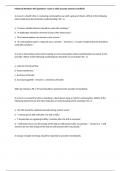
Mental Health FINAL EXAM Study Guide 3 (NUR 2488) Questions and Answers. Mental Health FINAL EXAM Study Guide – A 1 EBP (evidence based practice) Using the best available research evidence, clinical expertise, & patient preferences to make clinical decisions The 5 A’s of integrating best evidence into clinical practices includes: Asking Acquiring Appraising Applying Assessing The mental health recovery model is one of helping people with psychiatric disabilities effectively manage their symptoms, reduce psychosocial disability, and find a meaningful life in a community of their choosing. 3 specific areas are inherent within the art of nursing: caring, attending & patient advocacy. Basic Brain Anatomy- what do the different part of brain control? o Frontal Lobe: Thought Processes & Voluntary Movement (decision making) o Temporal Lobe: Auditory Processes (language, speech, connects to Limbic system) o Occipital Lobe: Vision (interprets visual images) o Parietal Lobe: Sensory & Motor (L/R orientation, reading, math, proprioception) o Hypothalamus: maintains homeostasis, regulates BP, Temp, libido, hunger, thirst, and sleep/wake cycles. o Cerebellum: Balance, Skeletal Muscle Coordination o Neurons: Nerves that translate electrical impulses into chemical signals released at the synapse Synapse- The space between neurons in which neurotransmitters are released and either inhibit/excite the adjacent neuron. The 4 NT’s are dopamine, norepinephrine, serotonin and acetylcholine. Milieu Therapy: Creating a SAFE, structured inpatient/outpatient setting where the mentally ill can test new behaviors and coping mechanisms with others. o Climate is essential to healing: paint color, relaxed environments are conducive to the healing process. o Florence Nightingale believed that the environment helps heal Maslow’s Hierarchy of needs o Basic Needs: food, oxygen, water, sleep, sex, and a constant body temperature. If all the needs were deprived, this level would take priority. o Safety Needs: Security, protection, freedom from fear/anxiety/chaos, and the need for law, order, and limits. o Belonging and Love Needs: intimate relationship, love, affection, and belonging, having a family and a home and being part of identifiable groups. o Esteem Needs: If self-esteem needs are met, we feel confident, valued, and valuable. When self-esteem is compromised, we feel inferior, worthless, and helpless. o Self-actualization: Reaching our full potential to feel inner peace and fulfillment. Peplau’s Theory of Interpersonal Relations o Created the Nurse-Patient Partnership increasing individual and family roles in recovery. (Based off of Sullivan’s Interpersonal Theory). Relationships greatly influence recovery Freud- contributed to psychiatric setting -Unconscious thoughts o Id – unconscious mind, instincts (this is dominant) o Ego – sense of self, use of defense mechanisms o Superego – our conscious and is greatly influenced by our parents morals and ethical stances Mental Health FINAL EXAM Study Guide – A 2 Erickson’s o Trust vs. Mistrust (infant 0- 1 ½) trust developed if caregivers give affection, love, care, attention, and reliability. (Feeding) o Autonomy vs. Shame (toddlers 1 ½ - 3) kids need to develop a sense of personal control. (Toilet Training) o Initiative vs. Guilt (children 3-6) children need to have power to explore their environment and not receive disapproval from parents. (Exploration) o Industry vs. Inferiority: (school aged kids 6-12) Kids dealing with new social and academic demands. Success leads to a sense of competence. (School) o Identity vs. Role Confusion (teens 12-20) Teens need to develop self-identity and personal identity to stay true to themselves. (Social Relationships) o Intimacy & Solidarity vs. Isolation (young adults 20-30) Young Adults need to form intimate, loving relationships. (Relationships) o Generativity vs. Self-Absorption: (adults 30-65) Need to create/nurture things by having children. (Work & Parenthood) o Integrity vs. Despair (elderly 65+) Need to look back and feel fulfilled by accomplishments; have wisdom and no regrets (Reflection on Life) Sullivan Personalities are influenced during childhood and mostly by the MOTHER. Therapeutic Communication: goal directed, professional, scientifically based. The goal is to get information so that you can plan care for the patient. o Active Listening Clarifying: promotes understanding of the patient’s statement Restating: repeating the same key words the patient has just spoken to echo their feelings. (Ex: If a patient remarks, “My life is empty…it has no meaning,” additional information may be gained by restating, “Your life has no meaning?”) Reflecting: helps people understand their own thoughts better; summarizes (Ex: For example, to reflect a patient's feelings about his or her life, a good beginning might be, “You sound as if you have had many disappointments.”) Exploring: use of open-ended questions or statements to allow the patient to express thoughts/feelings. (Ex: “Tell me more…”, “Give me an example of…”) Communication Technique Examples in Different Scenarios o For Suicidal Patients: “These thoughts are very serious Mr. Adams. I do not want any harm to come to you. Can you tell me what you were feeling and if there were any circumstances that led you to this decision?” o For Patients who start Crying: Stay with your patient and reinforce that it is all right to cry & offer tissues. “You seem upset, what are you thinking right now?” o For Patients who say they “don’t want to talk”: “Its alright. I would like to spend time with you. We don’t have to talk.” Or reapproach at a later time, “Our 5 minutes is up. I will be back at 10am and spend another 5 minutes with you.” o For Patients who ask the nurse to keep a secret: Nurses cannot make such promises, as it may be important to share that information with other staff for safety reasons. “I cannot make that promise Mr. Adams as it might be important for me to share it with the other staff”. o Non-Verbal: Tone of voice (tone, pitch, intensity, stuttering, silence, pausing) Facial expressions (frown, smile, grimaces, raises eyebrows, licks lips) Posture (slumps over, puts face in hands, taps feet, fidgets with fingers) Amount of eye contact (angry, suspicious or accusatory looks, wandering) Sighs/Hand gestures (fidgeting, snapping fingers) Yawning.
Written for
- Institution
- NUR 2488
- Course
- NUR 2488
Document information
- Uploaded on
- January 30, 2024
- Number of pages
- 18
- Written in
- 2023/2024
- Type
- Exam (elaborations)
- Contains
- Questions & answers
Subjects
-
mental health final exam study guide 3 nur 2488
-
mental health final exam study guide 3
-
mental health final exam nur 2488
-
mental health final exam questions and answers
-
mental health questions and answ