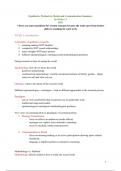
Qualitative Methods in Media and Communication Summary
by Elvan <3
2023
* there are some repetitions for certain concepts because the order goes from lecture
slides to readings for each week
WEEK 1: Introduction
4 principles of qualitative research;
1. meaning-making NOT numbers
2. complexity NOT causal relationships
3. micro insights NOTmacro picture
4. different epistemological, ontological and methodological positions
Doing research=a form of seeing the world
Epistemology: how do we know the world
- positivist epistemology
- constructivist epistemology: socially constructed notions of family, gender…shape
what you ask and what you see
Ontology: what is the nature of the (social) world
Different epistemologies + ontologies = lead to different approaches to the research process
Paradigms:
- sets of views and beliefs that researchers use to guide their work
- intellectual maps and models
- epistemological+ontological+methodological positions
Two views of communication (2 paradigms of communication):
1. Message Transmission
- focus on effects on audiences (media effects)
- messages are explicit, have denotative meanings
- receiver, medium, sender (transmission)
2. Communication as Ritual
- focus on meaning-making as an active participation drawing upon cultural
familiarity
- language is implicit and have connotative meanings
Methodology vs. Methods
Methodology: beliefs related to how to study the social world
1
,Methods: concrete ways of studying the social world, method of data collection and data
analysis
Methodological section in papers/thesis;
- methodological literature
- justify what you have done to collect and analyze the data
Dominant Media and Communication Paradigms
1. Predictive
- Positivism: “consider reality to exist and scientific truth to be knowable and
findable through rigorous testing that is free to human bias, focus on
explanation, prediction and control while knowledge accumulates as factual
building blocks in the form of generalizations or cause-effect linkages”
- Post-positivism: “similar to positivism yet responds to its criticism, reality is
thought to exist but because people are flawed they may not be able to actually
understand it, findings that can be replicated are considered as true, use of a
variety of experimental methods, including qualitative methods in an effort to
falsify their hypotheses”
2. Descriptive
- constructivism/-ionism: “represent a theoretical shift regarding the concept of
reality from realism to relativism, lean towards an anti-foundational
understanding of truth, rejecting any permanent standards by which truth can
be universally known”
- critical theories: “consider reality and truth to be shaped by specific historical,
cultural, racial, gender, political and economic conditions, values, and
structures, they critique racism, sexism, oppression, and inequality”
- participatory/cooperative inquiry: “transformative perspective that emphasizes
the subjectivity of practical knowledge and the collaborative nature of
research, focus on a human rights agenda, pursuing social justice by
challenging poverty, inequality, injustice and oppression”
NOTE: “Positivist and Post-positivist perspectives maintain a belief in a singular “big-T”
understanding of truth as well as a notion of a unified reality, in contrast, Critical Theories,
Constructivism and Participatory/Cooperative Inquiry perspectives all believe in multiple
interpretations of a “little-t” understanding of truth and envision many constructed and
competing notions of reality”
A shift in perspective-> towards new vocabulary
Quantitative Language Qualitative Language
2
, Hypothesis Research Question
Variables Concepts
Correlations Relationships
Objectivity Reflexivity/Context
Researcher Bias Situatedness and Intersubjectivity
Core features of qualitative research:
1. insightful
2. complex
3. emancipatory
(this is why qualitative research findings are significant)
The qualitative research process:
1. intentionality
theoretically informed
2. methodological process
choices explained and justified
transparency
qualitative research=iterative
6 Steps of Qualitative Research Projects
1. Idea
personal experiences, related experiences and circumstances, societal problems,
theory and literature, funding priorities
2. Perspective
anchoring idea in theoretical perspectives, choosing a focus/angle for the idea
3. RQ
answerable and open ended, usually “how” question, incorporates theoretical concept
4. Design
what type of evidence is needed to answer RQ, methodology and methods
5. Research
gather data, analyze data, interpret findings
6. Write
3
, writing it all up, follow norms of academic writing, transparency and argumentation
Ethics Purpose and Principles
- protection, for yourself, research subjects, and research data
- basic principles;
● required part of research
● people should:
- participate on volunteer basis
- understand the study and participation
- understand risks and benefits
- able to give consent
● avoid deception
● privacy and confidentiality
● data accuracy
● respect
● well-being
● justice
How do we engage in ethical research?
Awareness of:
- potential confrontations
- potential harm
- vulnerable people
- disturbance of research site
- own interaction (pushiness)
- own ignorance
Maintain:
- accuracy
- fairness
- confidentiality
- respect
- sensitiveness
- anonymity
Stories are produced with respondents rather than solely by us or by them.
- Reflexivity
- “full disclosure is always appropriate in the realm of qualitative research”
(got it from ChatGPT sorry lol)-> Triangulation: the use of multiple methods, data sources,
investigators, or theories to enhance the credibility and validity of research findings. The
underlying idea is that by using multiple approaches, researchers can gain a more
comprehensive and nuanced understanding of the phenomenon under investigation.
4
by Elvan <3
2023
* there are some repetitions for certain concepts because the order goes from lecture
slides to readings for each week
WEEK 1: Introduction
4 principles of qualitative research;
1. meaning-making NOT numbers
2. complexity NOT causal relationships
3. micro insights NOTmacro picture
4. different epistemological, ontological and methodological positions
Doing research=a form of seeing the world
Epistemology: how do we know the world
- positivist epistemology
- constructivist epistemology: socially constructed notions of family, gender…shape
what you ask and what you see
Ontology: what is the nature of the (social) world
Different epistemologies + ontologies = lead to different approaches to the research process
Paradigms:
- sets of views and beliefs that researchers use to guide their work
- intellectual maps and models
- epistemological+ontological+methodological positions
Two views of communication (2 paradigms of communication):
1. Message Transmission
- focus on effects on audiences (media effects)
- messages are explicit, have denotative meanings
- receiver, medium, sender (transmission)
2. Communication as Ritual
- focus on meaning-making as an active participation drawing upon cultural
familiarity
- language is implicit and have connotative meanings
Methodology vs. Methods
Methodology: beliefs related to how to study the social world
1
,Methods: concrete ways of studying the social world, method of data collection and data
analysis
Methodological section in papers/thesis;
- methodological literature
- justify what you have done to collect and analyze the data
Dominant Media and Communication Paradigms
1. Predictive
- Positivism: “consider reality to exist and scientific truth to be knowable and
findable through rigorous testing that is free to human bias, focus on
explanation, prediction and control while knowledge accumulates as factual
building blocks in the form of generalizations or cause-effect linkages”
- Post-positivism: “similar to positivism yet responds to its criticism, reality is
thought to exist but because people are flawed they may not be able to actually
understand it, findings that can be replicated are considered as true, use of a
variety of experimental methods, including qualitative methods in an effort to
falsify their hypotheses”
2. Descriptive
- constructivism/-ionism: “represent a theoretical shift regarding the concept of
reality from realism to relativism, lean towards an anti-foundational
understanding of truth, rejecting any permanent standards by which truth can
be universally known”
- critical theories: “consider reality and truth to be shaped by specific historical,
cultural, racial, gender, political and economic conditions, values, and
structures, they critique racism, sexism, oppression, and inequality”
- participatory/cooperative inquiry: “transformative perspective that emphasizes
the subjectivity of practical knowledge and the collaborative nature of
research, focus on a human rights agenda, pursuing social justice by
challenging poverty, inequality, injustice and oppression”
NOTE: “Positivist and Post-positivist perspectives maintain a belief in a singular “big-T”
understanding of truth as well as a notion of a unified reality, in contrast, Critical Theories,
Constructivism and Participatory/Cooperative Inquiry perspectives all believe in multiple
interpretations of a “little-t” understanding of truth and envision many constructed and
competing notions of reality”
A shift in perspective-> towards new vocabulary
Quantitative Language Qualitative Language
2
, Hypothesis Research Question
Variables Concepts
Correlations Relationships
Objectivity Reflexivity/Context
Researcher Bias Situatedness and Intersubjectivity
Core features of qualitative research:
1. insightful
2. complex
3. emancipatory
(this is why qualitative research findings are significant)
The qualitative research process:
1. intentionality
theoretically informed
2. methodological process
choices explained and justified
transparency
qualitative research=iterative
6 Steps of Qualitative Research Projects
1. Idea
personal experiences, related experiences and circumstances, societal problems,
theory and literature, funding priorities
2. Perspective
anchoring idea in theoretical perspectives, choosing a focus/angle for the idea
3. RQ
answerable and open ended, usually “how” question, incorporates theoretical concept
4. Design
what type of evidence is needed to answer RQ, methodology and methods
5. Research
gather data, analyze data, interpret findings
6. Write
3
, writing it all up, follow norms of academic writing, transparency and argumentation
Ethics Purpose and Principles
- protection, for yourself, research subjects, and research data
- basic principles;
● required part of research
● people should:
- participate on volunteer basis
- understand the study and participation
- understand risks and benefits
- able to give consent
● avoid deception
● privacy and confidentiality
● data accuracy
● respect
● well-being
● justice
How do we engage in ethical research?
Awareness of:
- potential confrontations
- potential harm
- vulnerable people
- disturbance of research site
- own interaction (pushiness)
- own ignorance
Maintain:
- accuracy
- fairness
- confidentiality
- respect
- sensitiveness
- anonymity
Stories are produced with respondents rather than solely by us or by them.
- Reflexivity
- “full disclosure is always appropriate in the realm of qualitative research”
(got it from ChatGPT sorry lol)-> Triangulation: the use of multiple methods, data sources,
investigators, or theories to enhance the credibility and validity of research findings. The
underlying idea is that by using multiple approaches, researchers can gain a more
comprehensive and nuanced understanding of the phenomenon under investigation.
4