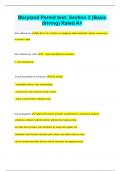
Maryland Permit test: Section 3 (Basic driving) Rated A+
Maryland Permit test: Section 3 (Basic driving) Rated A+ drive defensively the driver of a vehicle on a highway shall control the vehicle as necessary to avoid a crash drive defensively (info) 1. visual search/driver awareness 2. risk management Visual Search/Driver Awareness You should: - constantly observe your surroundings - watch front, sides, and rear of the vehicle - allow yourself time to identify risks risk management -adjust your speed, position, and direction to respond to roadway conditions, enhance vehicle control, and increase response time -let other drivers know your intentions by using turn signals, etc. -maintain a safe distance between your vehicle and other roadway users -do not assume that other drivers will do what they are supposed to do -use caution at all times Right-of-way Privilege of the immediate use of the highway right of way rules you should yield the right of way to -the driver who is at or arrives before you at the intersection -drivers in the opposing traffic lane, when you are making a left turn -the driver on your right, if both of you arrive at the intersection at the same time -drivers on a public highway, if you are entering the highway from a driveway or a private road -drivers already on a limited access or interstate highway, if you are on the entrance or acceleration ramp -the driver on your right at a four-way intersection controlled by stop signs -pedestrians, bicyclists, and other drivers who are still in the intersection -drivers on the through highway, if you are at a "T" intersection and you are entering the through highway by either making a right or left turn -other drivers, if you are approaching an intersection with a Yield sign facing you understanding vehicle speed -the posted speed limit is the maximum legal speed you can travel on a road under ideal conditions -It is safest to drive at the same speed that most traffic is moving, up to the maximum speed limit. -traveling at a speed lower than other traffic encourages other vehicles to constantly pass you and increases the chances of a crash. Speeding -one of the most prevalent factors contributing to traffic crashes -does not save time and often leads to high-risk decision-making disastrous effects of speeding -reduces the ability to negotiate curves or maneuver around obstacles in the roadway -extends the distance necessary for a vehicle to stop -decreases the driver's ability to realize and react to a hazard or dangerous situation -increases the risk of crashes because other roadway users and pedestrians may not be able to judge distance accurately -increases the force and impact in a crash, which more likely results in serious bodily injuries and deaths death is 8 times more probable in a crash at ____ than at ____ 60 mph, 20 mph appropriate speed for conditions You may drive slower than the posted speed limit, based on road conditions, but it is illegal to drive any faster than the posted speed limit Some conditions, which require reduced speed for safety, include: -sharp curves or hills - where visibility is limited -slippery roads -roads where there may be pedestrians or animals present -shopping centers, parking lots and downtown areas -traffic congestion -narrow bridges and tunnels -toll plazas schools, playgrounds and residential streets -railroad grade crossings following distance a minimum following distance of 3 to 4 seconds to get to the same reference point as the car ahead of you if you are following vehicles which stop often (bus, delivery vans) you should increase the distance between your vehicle and the one ahead of you to _____, and possible more as needed. 4 to 5 seconds stopping distance The sum of the thinking distance and the braking distance your actual stopping distance will depend upon many factors, including: -the length of time it takes a driver to see and recognize that there is a dangerous situation -the type and condition of the roadway -the condition of the tire treads -the condition of the brakes lane driving Your vehicle should be driven in a single lane. Do not switch lanes until you determine it is safe to do so. You should avoid drifting across lane lines and making lane changes within an intersection. You should keep your vehicle to the right of the center roadway, unless you are passing another vehicle going in the same directions turning When turning, you should: - look for signs and signals that give direction on when you can turn; - plan your turn before reaching the turning point; -activate your turn signal in advance to alert other drivers; -look behind and to both sides to ensure it is safe to proceed before making a turn; -adjust your speed for the turn. U-turn If you must make a U-turn, first check to see if U-turns are allowed, and then turn on your left turn signal, stop and yield for approaching traffic. When the way is clear, proceed into the outside or right-hand lane traveling in the opposite direction. When passing is permitted, you must: estimate the time and space necessary to pass, be sure you can pass w/o interfering with any other vehicle -use your turn signal before passing -leave plenty of space and go around the other vehicle at a safe distance -see both headlights of the passed vehicle in your rear view mirror before returning to the original lane Generally, you should pass to the left of the other vehicle. However, it is acceptable to pass on the right if it is safe to do so, you stay on the roadway, and: -the other vehicle is about to make a left turn -you are on an obstructed highway with two or more lanes moving in the same direction -you are on unobstructed one-way roadway wide enough for two lanes or more You may not pass: -where there is no passing zone -where the solid yellow is on your side of the center of the roadway -where there are double solid yellow lines -when passing will interfere with the safe operation of oncoming vehicles -when approaching the top of the hill or on a curve and you do not have a sufficiently clear view ahead -when crossing or within 100 feet of an intersection or railroad grade crossing -when the view is obstructed upon approaching within 100 feet of any bridge, elevated roadway, or tunnel -on the shoulder of the highway either to the right or to the left General Parking Rules You are responsible for making sure you vehicle is not hazard when its parked -park in designated area -parking along roadway park far from traffic as possible - set brakes when you park -check mirrors -take keys out of ignition
Written for
- Institution
- Maryland Permit
- Course
- Maryland Permit
Document information
- Uploaded on
- January 28, 2024
- Number of pages
- 8
- Written in
- 2023/2024
- Type
- Exam (elaborations)
- Contains
- Questions & answers
Subjects
-
maryland permit test section 3 basic driving ra

Also available in package deal