Chapter 14 Essentials of Leadership
Takeaway 1: The Nature of Leadership
Leadership and power
Leadership – The process of inspiring others to work hard to accomplish important tasks
Contemporary leadership challenges
Shorter time frames for accomplishing things
High performance expectations
Complex, ambiguous, and multidimensional problems
Scarce resources
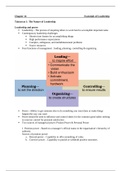
Four functions of management : leading, planning, controlling & organizing
Power –Ability to get someone else to do something you want done or make things
happen the way you want
Power should be used to influence and control others for the common good rather seeking
to exercise control for personal satisfaction
Two sources of managerial power: Postion Power & Personal Power
1. Position power - Based on a manager’s official status in the organization’s hierarchy of
authority
Sources of position power:
a. Reward power – Capability to offer something of value
b. Coercive power – Capability to punish or withhold positive outcomes
, c. Legitimate power – Organizational position or status confers the right to control
those in subordinate positions
2. Personal power – Based on the unique personal qualities that a person brings to the
leadership situation
Sources of personal power:
a. Expert power – Capacity to influence others because of one’s knowledge and
skills
b. Referent power – Capacity to influence others because they admire you and want
to identify positively with you
Leadership and Vision
Vision – A future that one hopes to create or achieve in order to improve upon the present
state of affairs
Visionary leadership – A leader who brings to the situation a clear and compelling sense
of the future as well as an understanding of the actions needed to get there successfully
Have a clear vision, communicate the vision and get people motivated and inspired
Visionary leadership gives meaning to peoples work
Leadership as a service
Service is central to integrity, leaders who have integrity act as “servants to the
organization”
Servant leadership – Commitment to serving others, your followers more important than
leader, “Other centered” not “self-centered”, power is not a “zero-sum” quantity &
focuses on empowerment, not power
Empowerment
The process through which managers enable and help others to gain power and achieve
influence
Effective leaders empower others by providing them with:
Informaton Responsibility Authority Trust
Takeaway 2 : Leadership Traits and Behaviors
Leadership traits
Leadership behavior
Leadership behavior theories focus on how leaders behave when working with
followers
Leadership styles are recurring patterns of behaviors exhibited by leaders
Basic dimensions of leadership behaviors:
Takeaway 1: The Nature of Leadership
Leadership and power
Leadership – The process of inspiring others to work hard to accomplish important tasks
Contemporary leadership challenges
Shorter time frames for accomplishing things
High performance expectations
Complex, ambiguous, and multidimensional problems
Scarce resources
Four functions of management : leading, planning, controlling & organizing
Power –Ability to get someone else to do something you want done or make things
happen the way you want
Power should be used to influence and control others for the common good rather seeking
to exercise control for personal satisfaction
Two sources of managerial power: Postion Power & Personal Power
1. Position power - Based on a manager’s official status in the organization’s hierarchy of
authority
Sources of position power:
a. Reward power – Capability to offer something of value
b. Coercive power – Capability to punish or withhold positive outcomes
, c. Legitimate power – Organizational position or status confers the right to control
those in subordinate positions
2. Personal power – Based on the unique personal qualities that a person brings to the
leadership situation
Sources of personal power:
a. Expert power – Capacity to influence others because of one’s knowledge and
skills
b. Referent power – Capacity to influence others because they admire you and want
to identify positively with you
Leadership and Vision
Vision – A future that one hopes to create or achieve in order to improve upon the present
state of affairs
Visionary leadership – A leader who brings to the situation a clear and compelling sense
of the future as well as an understanding of the actions needed to get there successfully
Have a clear vision, communicate the vision and get people motivated and inspired
Visionary leadership gives meaning to peoples work
Leadership as a service
Service is central to integrity, leaders who have integrity act as “servants to the
organization”
Servant leadership – Commitment to serving others, your followers more important than
leader, “Other centered” not “self-centered”, power is not a “zero-sum” quantity &
focuses on empowerment, not power
Empowerment
The process through which managers enable and help others to gain power and achieve
influence
Effective leaders empower others by providing them with:
Informaton Responsibility Authority Trust
Takeaway 2 : Leadership Traits and Behaviors
Leadership traits
Leadership behavior
Leadership behavior theories focus on how leaders behave when working with
followers
Leadership styles are recurring patterns of behaviors exhibited by leaders
Basic dimensions of leadership behaviors: