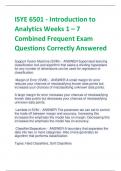
SYE 6501 - Introduction to Analytics Weeks 1 – 7 Combined Frequent Exam Questions Correctly Answered
ISYE 6501 - Introduction to Analytics Weeks 1 – 7 Combined Frequent Exam Questions Correctly Answered Support Vector Machine (SVM) - ANSWER Supervised learning classification tool and algorithm that seeks a dividing hyperplane for any number of dimensions can be used for regression or classification. Margin of Error (SVM) - ANSWER A small margin for error reduces your chances of misclassifying known data points but increases your chances of misclassifying unknown data points. A large margin for error increases your chances of misclassifying known data points but decreases your chances of misclassifying unknown data points. Lambda in SVM - ANSWER The parameter we can set to control the trade off between margin and accuracy. Increasing this increases the emphasis the model has on margin. Decreasing this increases the emphasis the model has on accuracy. Classifier/Separators - ANSWER A boundary that separates the data into two or more categories. Also (more generally) an algorithm that performs classification. Types: Hard Classifiers, Soft Classifiers Classification - ANSWER The separation of data into two or more categories, or the category a data point is put into. Models: SVM, K-Nearest Neighbor (KNN), Decision Tree, Logistic Regression Tree, Random Forest, K-Means Clustering, Logistic Regression Soft Classifier/Seperator - ANSWER Gives as good a separation as possible, generally trying to minimize errors, though it's impossible to be 100% accurate. Data Point - ANSWER A single entry in a data set with all the attributes (generally a row in a table) Attributes/Features/Covariates/Predictors - ANSWER An independent variable in a data point that is a measurement and can influence the outcome of a given statistical trial, but which is not of direct interest. (generally a column in a data table) Structured Data - ANSWER Easily classified data that can be stored, sorted, and analyzed easily. Includes: Quantitative Data, Categorical Data, and Binary Data Unstructured Data - ANSWER Data that is not very well organized for analysis - for example, a list of free responses to the question "What do you like about analytics?" Time Series Data - ANSWER Data that records the same attribute/response at multiple points in time (often at equal time intervals). Models that use it: Autoregression, Differencing, CUSUM, GARCH, ARIMA (Box-Jenkins), Exponential Smoothing Binary Data - ANSWER Data with 2 values, generally simplified for modeling into 0 & 1 Categorical Data - ANSWER Numbers, Words, or Letters that denote different categories. Example: Zipcode, Eye Color, Marital Status Quantitative Data - ANSWER Numbers that have meaning, a measurement of some
Written for
- Institution
- ISYE
- Course
- ISYE
Document information
- Uploaded on
- January 26, 2024
- Number of pages
- 17
- Written in
- 2023/2024
- Type
- Exam (elaborations)
- Contains
- Questions & answers
Subjects
-
sye 6501 introduction to analytics weeks 1
-
sye 6501 introduction to analytics weeks 1 7

Also available in package deal