SAEM Trauma Exam 2024 with complete solutions
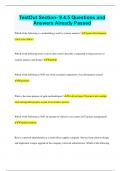
SAEM Trauma Exam 2024 with complete solutions An 18 year old hockey player is hit in the mouth with a puck, fracturing a maxillary canine tooth. He brings the severed piece of tooth with him. On physical exam, the tooth is fractured halfway between the tip and the gumline. The root of the tooth is still firmly intact. The exposed fracture site has a yellowish tinge without blood. Of the following choices, which is the most appropriate management for this patient? A. Application of calcium hydroxide, placement of aluminum foil, and dental follow-up B. Placement of tooth fragment in saline gauze, outpatient dental follow-up C. No specific treatment required D. Immediate dental consult to avoid abscess formation E. Replace fractured piece and place acrylic splint - Answer ️️ -The answer is D. Ellis II dental fracture involves enamel and dentin. The fracture site typically has a yellowish tinge. Ellis III dental fractures are characterized by exposure of pinkish pulp and often blood. These fractures require immediate dental consultation to prevent abscess formation. A 22 year old man is punched in the nose during a fight. He presents to the emergency department with obvious nasal bone deformity. Pressure controls the bleeding. Physical exam reveals no maxillary bone or orbital rim tenderness, intact vision and extraocular movement. The oropharynx and mandible are unremarkable. Nasal inspection reveals a swollen, ecchymotic, tender nasal septum. Which of the following is the most appropriate initial step? A. Incision and drainage of the septal hematoma followed by nasal packing B. Needle aspiration of the septal hematoma C. Plastic surgery consult for immediate reduction of nasal fracture D. Facial CT scan to rule out more serious facial fractures E. Outpatient follow-up with an ENT specialist to surgically correct a deviated septum - Answer ️️ -A. Incision and drainage of the septal hematoma followed by nasal packing A 24 year old woman is playing racquetball and sustains a direct blow from the ball to the right eye. She presents to the emergency department complaining of eye pain and double vision. On exam, her right eye does not track properly with upward gaze. This finding suggests which of the following injuries? A. Zygomatic arch fracture B. Ethmoid fracture C. Inferior orbital wall fracture D. Inferior orbital rim fracture E. Superior orbital rim fracture - Answer ️️ -C. The patient most likely has an orbital floor fracture with entrapment. A 32 year old man is struck several times in the head with a baseball bat. Upon emergency medical service arrival, he is mildly confused, vomits once, and complains of a severe headache. The emergency medical technicians establish two large-bore IVs. Prior to arrival at the emergency department, he loses consciousness and begins to seize. He is actively seizing when he is brought into the trauma bay. What should be the first step in the management of this patient? A. Administration of mannitol 50 g IV B. Emergency craniotomy C. Rapid sequence intubation using paralytic agent D. Administration of 2 liters NS bolus - Answer ️️ -C. Rapid sequence intubation using paralytic agent The airway should be managed as the first priority in this patient. The other maneuvers may be helpful but are secondary to securing an airway and providing oxygenation/ventilation. Airway comes first! A 46 year old man is brought in by EMS after a motor vehicle collision in which he was an unrestrained driver. Although he has no obvious injury to his head or neck, he complains of chest pain and appears very short of breath. His vital signs are: T 99.2 F, BP 85/57, HR 123, RR 36, SpO2 95% on non-rebreather. The CXR demonstrates a tension pneumothorax. Of the following, which is the most appropriate next step in this man's care? A. Performance of a chest CT scan to further delineate the pathology B. Transfusion of 2 units of O-negative packed red blood cells C. Placement of a needle decompression device, followed by repeat CXR D. Placement of a chest tube followed by a chest xray to determine proper placement - Answer ️️ -C. Placement of a needle decompression device, followed by repeat CXR This patient needs emergent chest decompression and this is rapidly done by needle thoracostomy. A chest CT may be performed, but only once he is stabilized. A formal chest tube will be placed, but placement may not be rapid enough and he may decompensate in the meantime. Transfusion of blood does nothing to correct the physiology of a tension pneumothorax The most sensitive bedside test for nerve injury in a finger after trauma is: A. light touch B. O'Riain wrinkle test C. pain D. temperature sensation E. two-point discrimination - Answer ️️ -E. two-point discrimination Light touch is a good screening test, but two-point discrimination is more sensitive and should be used routinely in evaluating injuries to digits. The O'Riain wrinkle test involves placing the digit in warm water and looking for wrinkling of the digital pulps. Presence of wrinkling indicates the nerve is intact. Which is not part of the Ottawa ankle rules? A. inability to walk 4 steps at the time of the injury B. inability to walk 4 steps in the emergency department C. tenderness over the lateral malleolus D. tenderness over the medial malleolus E. tenderness over the talus - Answer ️️ -E. tenderness over th
Written for
- Institution
- SAEM
- Course
- SAEM
Document information
- Uploaded on
- January 25, 2024
- Number of pages
- 15
- Written in
- 2023/2024
- Type
- Exam (elaborations)
- Contains
- Questions & answers
Subjects
-
saem trauma exam 2024 with complete solutions

Also available in package deal