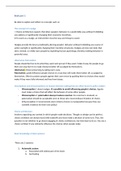
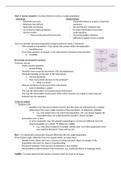
Pricing options
Class 1: Recall + introduction: what are derivatives:
A derivative is a financial agreement with a future consequence (a payoff) that depends on what is
happening (derived from) with something else (underlying asset).
Example: A call option on stock IBM that matures in one year, with strike price K = 150.
= > If you buy this option, you get the right (not the obligation) to buy one IBM stock in one
year for 150.
= > When you buy the option, you pay the premium right now.
= > You will exercise the option if the price of the stock is higher than 150 and then you can
immediately sell the stock at the current market price.
= > Payoff = Max [ S(1) – 150 , 0 ] **S(1) = price of IBM stock after 1 year.
Pricing of derivatives:
1. Replicating portfolio approach
2. Risk-Neutral pricing (RNP)
= > These two pricing approaches are valid if and only if the underlying asset is a market
instrument!!
Example 1: Call option on IBM stock = > Two approaches are valid
Example 2: Payoff = 500 000 if house burns down
0 otherwise
= > Two approaches are not possible (because the underlying asset is not a market
instrument). To price this, you would use expected value approach.
Model we will use: Cox-Ross-Rubenstein Model.
Black-Sholz made the assumption that returns were normally distributed. Mathematically, this was very
complicated. The CRR model is much simpler in the way it describes the randomness of returns. There are only 2
states (the value of an asset can go up or down) => Not really realistic, but very valuable!
S(h) = C(h) =
p S(0) * u p C*u
S(0) C(0)
1-p 1-p
S(0) * d C*d
There’s also a risk-free instrument (bank account) => 1 euro a t = 0 is worth 1 + i at t = 1
=> At time t=h, it becomes worth (1+i)h.
We rewrite (1=i)h as: e ln [(1+i)^h] = e h * ln (1+i) = e h * r , with r = ln(1+i) = the continuous risk-free rate
, Pricing with an example (Slide 6-9):
S(0) = 41.
S(1) is either 60 or 30.
r = 8%.
K = 40
If the stock goes to 60, the call option payoff = 20.
If the stock goes down to 30, the call option payoff = 0.
What is C(0)?
o We are going to create 2 portfolios. The first portfolio is just the call option. The
second portfolio contains an amount of stocks and a loan. The payoff of both
portfolios has to be exactly the same (replicate). And since the payoffs are the same,
the prices should be also the same. We can calculate the price of the second
portfolio, so then we can mirror this price to the first portfolio and you find the value
of the option.
▪ Portfolio 1: Contains the call option
▪ Portfolio 2: Contains 2/3 (Delta) of stock and a cash amount of -18,462 (B)
** Delta and B are given for now, but later you have to compute this yourself.
o Compare both payoffs
▪ Portfolio 1: C(1)= 20 if stock rises
0 if stock goes down
▪ Portfolio 2: 2/3 * 60 – 18,462*e8% = 20 if stock rises
2/3 * 30 – 18,462*e8% = 0 if stock goes down
▪ Payoff 1 = Payoff 2. Hence, C(0) = price of payoff 1 = price of payoff 2.
• Price of payoff 2 = 2/3 * 41 – 18,462 = 8,871
• => The price does not depend on the probabilities p!!!!!!!!!!!!!!!
An optimistic person and a pessimistic person will still be willing to
pay the same price for the derivative.
S(1) = C(1) =
p 60 p 20
S(0) = 41 C(0)
1-p 1-p
30 0
Class 1: Recall + introduction: what are derivatives:
A derivative is a financial agreement with a future consequence (a payoff) that depends on what is
happening (derived from) with something else (underlying asset).
Example: A call option on stock IBM that matures in one year, with strike price K = 150.
= > If you buy this option, you get the right (not the obligation) to buy one IBM stock in one
year for 150.
= > When you buy the option, you pay the premium right now.
= > You will exercise the option if the price of the stock is higher than 150 and then you can
immediately sell the stock at the current market price.
= > Payoff = Max [ S(1) – 150 , 0 ] **S(1) = price of IBM stock after 1 year.
Pricing of derivatives:
1. Replicating portfolio approach
2. Risk-Neutral pricing (RNP)
= > These two pricing approaches are valid if and only if the underlying asset is a market
instrument!!
Example 1: Call option on IBM stock = > Two approaches are valid
Example 2: Payoff = 500 000 if house burns down
0 otherwise
= > Two approaches are not possible (because the underlying asset is not a market
instrument). To price this, you would use expected value approach.
Model we will use: Cox-Ross-Rubenstein Model.
Black-Sholz made the assumption that returns were normally distributed. Mathematically, this was very
complicated. The CRR model is much simpler in the way it describes the randomness of returns. There are only 2
states (the value of an asset can go up or down) => Not really realistic, but very valuable!
S(h) = C(h) =
p S(0) * u p C*u
S(0) C(0)
1-p 1-p
S(0) * d C*d
There’s also a risk-free instrument (bank account) => 1 euro a t = 0 is worth 1 + i at t = 1
=> At time t=h, it becomes worth (1+i)h.
We rewrite (1=i)h as: e ln [(1+i)^h] = e h * ln (1+i) = e h * r , with r = ln(1+i) = the continuous risk-free rate
, Pricing with an example (Slide 6-9):
S(0) = 41.
S(1) is either 60 or 30.
r = 8%.
K = 40
If the stock goes to 60, the call option payoff = 20.
If the stock goes down to 30, the call option payoff = 0.
What is C(0)?
o We are going to create 2 portfolios. The first portfolio is just the call option. The
second portfolio contains an amount of stocks and a loan. The payoff of both
portfolios has to be exactly the same (replicate). And since the payoffs are the same,
the prices should be also the same. We can calculate the price of the second
portfolio, so then we can mirror this price to the first portfolio and you find the value
of the option.
▪ Portfolio 1: Contains the call option
▪ Portfolio 2: Contains 2/3 (Delta) of stock and a cash amount of -18,462 (B)
** Delta and B are given for now, but later you have to compute this yourself.
o Compare both payoffs
▪ Portfolio 1: C(1)= 20 if stock rises
0 if stock goes down
▪ Portfolio 2: 2/3 * 60 – 18,462*e8% = 20 if stock rises
2/3 * 30 – 18,462*e8% = 0 if stock goes down
▪ Payoff 1 = Payoff 2. Hence, C(0) = price of payoff 1 = price of payoff 2.
• Price of payoff 2 = 2/3 * 41 – 18,462 = 8,871
• => The price does not depend on the probabilities p!!!!!!!!!!!!!!!
An optimistic person and a pessimistic person will still be willing to
pay the same price for the derivative.
S(1) = C(1) =
p 60 p 20
S(0) = 41 C(0)
1-p 1-p
30 0