CPPB Exam Prep Questions Answers
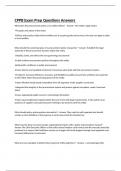
What does the procurement policy of an entity reflects? - Answer -The entity's legal system -The goals and values of the entity -Policies and practices federal-level entities use to acquire goods and services; this may not apply to state or local entities What should the overall purpose of a procurement policy manual be? - Answer -Establish the legal authority of the procurement function within the entity. -Simplify, clarify, and reflect the laws governing procurement -Enable uniform procurement policies throughout the entity -Build public confidence in public procurement -Ensure the fair and equitable treatment of everyone who deals with the procurement system -Provide for increased efficiency, economy, and flexibility in public procurement activities and maximize to the fullest extent the purchasing power of the entity -Foster effective broad-based competition from all segments of the supplier community -Safeguard the integrity of the procurement system and protect against corruption, waste, fraud and abuse -Ensure appropriate public access to contracting information -Foster equal employment opportunities that are in line with legal requirements, in the policies and practices of suppliers and subcontractors wishing to do business with the entity What should policy and procedure manuals be? - Answer They must be well organized and should contain a clear definition of the purpose of each manual and its intended use. What must be done to ensure proper organizational impact with a policy and procedure manual? - Answer The Chief Executive Officer of the entity should endorse each manual and the manuals should be produced in a manner that facilitates revision as changes will surely happen through new legislation and increased efficiencies in processes. What are two examples of policies that represent entity objectives? - Answer -a set-aside/goal that allows an established percentage of the business conducted with an entity to be excluded from the general competitive pool and purchased from a specialized class of business -a policy that encourages and promotes a recycling program which includes procuring recycled goods What must Procurement professionals involved in the establishment of policy manuals be? - Answer -be responsive and adaptive to their environments -act in the best interest of the entity -be well-informed about the information associated with regulations -provide the support to perform functions within established procurement policies and procedures How are procedure manuals written? - Answer They are written at a finer level of detail that sets out processes, forms and steps. Who primarily uses procedure manuals? - Answer They are primarily used by the end user and procurement staff, the procedures manual provides guidelines and steps for preparing purchasing requisitions, developing specifications, receiving and inspection, and reporting and documenting supplier performance. What do procedure manuals detail? - Answer They detail the business processes of Procurement and describe the entity, duties of staff, signing authorities, procedures to be followed, and forms and filing systems to be used. What is a supplier manual? - Answer A supplier manual provides formal and extensive information for suppliers seeking to do business with the entity. What should a supplier manual include? - Answer -general information about the entity -key contacts and telephone numbers -how the solicitation process is conducted -how to receive an opportunity to participate in entity solicitations -a description of the need to be both a responsive and responsible supplier -how are are to be submitted, public openings of offers, and the policy regarding late submissions What are the characteristics of a supplier manual? - Answer -well organized, clear and easy to understand -clear definition of the purpose and a consistent approach to decision making -framework for training -flexible -endorsed by the entity's Chief Executive Officer -supplier outreach information -transparent -facilitate revision Is Governmental power inherent? - Answer Yes, they are inherent powers that are granted by a constitution, charter or act. Does a government official have inherent power? - Answer No, for purposes of public procurement, there must be a specific authorization from officials in the executive branch of government to enter into contracts. Without that authority, the officials may not do so. The existence of such authority is the foundation of any public procurement system. Who passes laws and/or ordinances to generally define the scope of authority and identifies who may exercise that authority? - Answer Legislative bodies. What are the most effective procurement statutes and ordinances? - Answer Those that establish the general parameters of an official's contracting or procurement authority and authorize that official to promulgate rules, regulations or policies to implement it. Is Government procurement restricted to activities that are authorized by law? - Answer Yes, the authority of the central procurement department is limited by what has been included in the enabling legislation. How is the private sector restricted in procurement? - Answer They may do whatever the law does not prohibit. What does enabling legislation include? - Answer -constitutions -statutes -ordinances and charters -rules and regulations -policy -procurement procedures What are the three primary sources of procurement laws in any entity? - Answer -Statutory Laws -Administrative Laws -Common Law What are Statutory Laws? - Answer These include constitutions, statutes, ordinances and charters. Statutory Laws are based on statutes or laws passed by governments. State or provincial statutes provide state/provincial-directed legislative law. Ordinances and charters provide for local and municipal governments. What are Administrative Laws? - Answer These are written rules and regulations and entity policy (developed and promulgated by administrative and regulatory governmental agencies). Administrative Law, provided by the applicable regulatory entity, has equal force and effect as legislative law as long as it does not supersede the context of legislative law. What is Common Law? - Answer These are based on customs and traditions and codified through the legal system. Common Law is based on custom and usage or confirmed by court decisions, i.e., a collection of court decisions. Access to published judicial decisions is available through volumes called "reporters" in major law libraries. What social and economic problems have policy makers enacted because of the magnitude of state and local government spending which require contractors to do what? - Answer -maintain fair employee practices -provide safe and healthy working conditions -pay fair wages -refrain from polluting the air and waters -give preference to contractors from the same state/province or locality -award to small or women owned businesses -promote the rehabilitation of prisoners and the disabled What other laws are applicable to public procurement? - Answer -Criminal Law -Tort Law -Budget/Finance Laws Define Criminal Law - Answer Imposes punishment such as imprisonment or fines for an act deemed to be criminal Define tort law - Answer Permits parties to sue each other for damage to a person or property. Define Budget/Finance Laws - Answer These laws prohibit an entity from spending funds beyond those that the legislative body appropriates. What is authority? - Answer The right to perform certain acts or prescribe rules governing the conduct of others. What is Law of Agency? - Answer The law of agency states that an agent is someone who acts on behalf of a principal. A product of common law that focuses not only on the creation of agent relationships but also the liability for losses suffered by others who deal with agents. What are the two ways an agency relationship by created? - Answer -by agreement between principal and agent or -by law What is a principal? - Answer A principal is one who employs an agent. A person who authorized another to act for him/her. What is an agent? - Answer An agent is a person authorized by a superior, i.e., principal, to act for him or her. Individuals who act on behalf of an entity, such as a corporation, partnership, or any level of government as that entity conducts business. In public procurement, this designation is usually incorporated into statute and ordinance. What is express authority? - Answer Express authority is the authority that is explicitly given in direct language rather than inferred from conduct. It can be in writing or oral. Express authority can be very specific; for example, "the chief procurement officer is authorized to enter into a contract for less than $25,000." Express authority may also be generalized; for example, "the chief procurement officer has the authority to enter into all contracts according to the procurement needs of his/her government entity." What is implied authority? - Answer Implied authority is not defined expressly, but is only determined by inferences and reasonable deductions that are necessary to perform the expressly authorized acts. Can consider the conduct of the principal regarding the historical actions of the agent. What is apparent authority? - Answer Apparent authority is the reasonable impression that an agent is permitted to act on their principal's authority even though that authority has not been granted. What is inherent authority? - Answer Inherent authority is based on an entity's sovereignty, to enter into contracts, although not explicitly authorized. What are some of the technologies that are currently available to procurement? - Answer -E-Commerce; more specifically-e-sourcing, e-procurement, e-purchasing, e-auctions, e-tender -Electronic payment solutions -Marketplaces/Business exchanges -Contract registers/databases -Knowledge portals/supplier databases -Business intelligence -E-invoicing/e-payables -ERP (Enterprise Resource Planning) systems -MRP (Materials Resource Planning) inventory systems -EPOS (Electronic Point of Sales) -Barcoding/RFID (Radio Frequency Identification) -Intranets -Extranets What should be included on a checklist of best practices to implement the use of technology in procurement? - Answer -Integration of financial system with procurement system to allow for verification of funds prior to the release of the order -Automated process flows for approvals -Enable the entity to receive electronic requisitions -Preparation of solicitations from requisition information -Utilization of "push technology" to notify potential offerors of available opportunities -Preparation of bid tabulations and bid analysis reports -Preparation of proposal evaluation reports -Preparation and distribution of notices of award -Use of a commodity/service code structure to group and track purchases -Automated production of purchase orders for standard inventory items -Accumulation of usage data for contract items -Track order released against contracts -Implementation of supplier performance reports that reflect Client satisfaction -Client satisfaction/dissatisfaction, etc. -Automate recording and updates to the purchase history -Track the status of requisitions and purchase orders -Production of essential management reports and summaries -Inclusion of contract administration functionality within the technology -Use of e-commerce to source and order goods and services online -Acceptance of electronic informal quotes -Provide electronic catalogues to the user departments/divisions -Use of reverse auction processes for high-volume, standardized commodities -Use of online surplus auction services -Use of solicitation development software with process flow, templates, library of clauses, approval process, etc. -Online posting of purchasing , award, and contract information for transparency purposes. What does the concept of competition presume? - Answer It presumes the existence of a marketplace in which there is more than one supplier providing similar goods or services. Define competition. - Answer Competition can be defined as the process by which two or more suppliers attempt to secure the business of a third party by offering the most favorable price, quality, delivery terms, or service. What does competition promote? - Answer It promotes free access to the marketplace, induces new businesses to enter, promotes better market performance, and encourages new technology and higher productivity. The extent to which procurement professionals foster competition depends on what? - Answer -requirements in law or regulation to use specific suppliers -requirements for "maximum practicable" and "full and open" competition -the validity and suitability of an unsolicited proposal -requirements to set aside procurements for small business -availability of suppliers under the small business programs What is another term for fair and open competition? - Answer Full and open competition. What are suspicious practices suggesting collusion? - Answer -identical bids -alternating bid patterns, where bidders rotate providing the lowest bid -rotating territorial or product bidding -"no-bid" responses from expected bidders -simultaneous price increases List circumstances in which the procurement cannot be conducted in full and open competition (FAOC) - Answer -Only one responsible source and no other supplies or services will satisfy entity requirements: -no other source is available -the contract is a "follow-on" for the continued development or production of a major system or highly specialized services; therefore, if switching contractors would result in unacceptable delays or a substantially higher cost -the contract is in response to an unsolicited research proposal -There exists unusual and compelling urgency (e.g., delay in award would result in serious financial or other injury -In the case of industrial mobilization; or engineering, developmental, or research capability, if there is a need for: -maintaining a facility, producer or manufacturer, or supplier in case of a natural emergency or wartime industrial mobilization -essential engineering or research and development capability to be provided by educational or nonprofit institutions or federally funded research and development centers -The head of the contracting activity prepares a document that describes the terms of an agreement or treaty or the written directions, such as a Letter of Offer and Acceptance, that has the effect of requiring the use of other than competitive procedures for the procurement. -Other than Full and Open Competition is authorized or required by statute, as is the case when procuring from: -specified prison industries -qualified nonprofit agencies for the disabled -In the case of National Security, when it would be compromised by broad disclosure of needs. -In the case of public interest, when the entity head determines that FAOC would be contrary to it. What is an audit? - Answer An audit is a formal examination or verification of financial accounts or other business operations by internal staff or independent experts, concluding with a a detailed report that may also include a management letter of findings. What are the four types of audits? - Answer -Financial and compliance audits -Economy and efficiency audits -Program audits or evaluations -Performance audits What is a Financial and compliance audit? - Answer These are normally performed by an independent accounting firm to determine whether financial transactions are recorded and verify their accuracy. What is an economy and efficiency audit? - Answer These audits are management or operational audits which examine an entity's managerial and administrative practices for economy and cost efficiency and strive to identify the cause of any cost inefficiencies. What are program audits or evaluations? - Answer These monitor results to determine the extent to which an entity has achieved program objectives. They also evaluate the cost effectiveness of the alternatives that were employed. What are performance audits? - Answer These review all of the operations of an entity and encompass the following types of audits: financial, economy, efficiency and program results. Performance audits are an increasingly common means of ensuring that those entrusted with management of public services and programs are held accountable. What are the three phases to any evaluation/audit process? - Answer 1. planning 2. data collecting ion making based on findings and recommendations Define an intradepartmental audit report. - Answer Intradepartmental reports are designed to inform the management concerning departmental matters. Define an interdepartmental audit report - Answer Interdepartmental reports are for distribution to other departments on a need-to-know basis. Define a higher level management audit report. - Answer Higher level management reports are issued to senior management and other key personnel. What should be the end result of an audit? - Answer The improvement of the decentralized unit and ensured compliance with statutory requirements, policy and procurement procedures for the entity. The purpose of an audit to to ensure what? - Answer -procurement policies and procedures are clearly defined, and end-users are in compliance regarding the solicitation process for the clients utilizing Procurement -purchase order are required and used for purchases -the proper use of the procurement card (pCard). the pCard purchases are always an area for audits and departmental/division reviews. - The department/division has the means to make purchases (emergency) after hours -Procurement maintains that the suppliers list and goods and services are properly coded for commodity and service selections -Procurement determines the performance measures of the department/division and suppliers -Impress funds (petty cash) if applicable, are replaced frequently, balanced and have authorized transactions (note: the use of the pCard may have replaced impress funds) -that the procurement staff is trained and is aware of policies and procedures affecting procurement (e.g., competitive process, supplier selection, supplier relations, direct purchases, methods of procurement, security of solicitation documents and purchase numbers, etc.) -files and folders are set up properly, in order and are easily accessible -verification of solicitation documents with requisition and supporting material -a tracking and reporting system that documents solicitation activity -the integrity, fairness, and ethical application of the procurement process in procuring goods and services from suppliers What is preference? - Answer an advantage given to bidders/proposers in a competition for contract award, which may be granted based on pre-established criteria such as ethnicity, residence, business location, origination of the good or service, business classification (e.g., small business), or other reasons. A governmental bias. Do preferences typically restrain trade? - Answer Preferences, set asides, or goals may open opportunities for selected suppliers, but overall they do restrain competition. Preferences always restrain trade because the suppliers gender does not guarantee that the good will offer the highest market quality at the best price. Whenever a procurement will be affected by preferences, does the factor have to be included in the solicitation? - Answer Yes. List special preference programs. - Answer -Minority and women-owned business (as permitted by the entity or law) -Local or disadvantaged business enterprises -Sustainable procurement program -Joint or cooperative procurement -Surplus disposition -Materials management -Low value spend (e.g. purchasing card program) Governments have the ability to change the specifics of their preference programs to meet the needs of the community they serve. Procurement professionals must continually monitor impending changes and assess the fiscal impact of changes on their community. Assessing the financial impact may include: - Answer -the time and resources expended by the entity to conduct background checks on potential Minority-Owned Business Enterprise (MBEs) or Historically Underutilized Businesses (HUBs) to ensure that they meet all entity qualifications to be considered a MBE or HUB supplier -The cost of the entity's outreach program and training programs to encourage MBE participation in their solicitations -conducting a comprehensive disparity study to determine which supplier groups have been historically underutilized by the entity Whose responsibility is it to determine the best value of sustainable goods, services and construction? - Answer It is procurements responsibility. What are some environmentally safe goods and services? - Answer -reuse and recycle of goods and resources -disposal of organic and other solid waste -conservation efforts in regard to transportation, energy and water -disposal of hazardous waste -maintenance -pollution reduction or avoidance -construction of buildings and infrastructure, using development practices and accepted performance criteria that focus on the environment A procurement professional with an environmental mandate should understand what terms? - Answer -Reduce -Reuse -Recycle -Substitute Explain reduce in regards to environmental practices. - Answer Reduction in the amount of waste by requiring certain commodities to be made with recycled content and reducing the amount of packaging. Explain reuse in regards to environmental practices. - Answer The reuse of the items that can be repurposed (for example, wooden pallets, shipping containers, etc.) Explain recycle in regards to environmental practices. - Answer The recycling of items that cannot be reused in their present form (paper, cans, toner cartridges) Explain substitute in regards to environmental practices. - Answer To substitute is the use of less hazardous, more environmentally preferable goods whenever possible. When specifying and procuring recycle commodities, the procurement professional should be familiar with what terms? - Answer -Post-consumer -Pre-Consumer What is the definition of post-consumer? - Answer Post-consumer materials are those materials that are from commodities that have been used by consumers, recycled, and reprocessed back into a consumer product. What is the definition of pre-consumer? - Answer Pre-consumer materials are those that are left over in manufacturing processes and then reused in a consumer product. Relationships with other entities and organizations. - Answer -A procurement professional shall not use his/her position to exert leverage on individuals or firms for the purpose of creating a benefit for the entity or entities that he/she may represent -All involvement and transaction shall be handled in a professional manner with the interest of the procurement professional's employer taking precedent. Relationships with professional procurement organizations and associations. - Answer -It is the obligation and the responsibility of the procurement professional, through affiliation with professional organizations, to represent that entity in a professional and ethical manner. -A procurement professional shall not use his/her position to persuade an individual or supplier to provide a benefit to an entity. What are the basic factors to consider regarding procurement records retention? - Answer -legal or statutory requirements -administrative requirements -historical requirements What does procurement involve? - Answer The effective and efficient management of resources to determine the right good delivered at the right time, and at the right price to entity clients. What is strategic procurement planning? - Answer It is the transformation of the entity's mission, goals and objectives into measurable activities to be used to plan, budget, and manage the procurement function within the entity. What is the ultimate goal of strategic procurement planning? - Answer The ultimate goal of strategic procurement planning is to effectuate positive change in entity culture, systems and operational processes. What is the goal of strategic procurement planning? - Answer The goal of strategic procurement planning is to establish a set of agreed-upon tactical goals and objectives within the operational context of the entity, thus linking resource allocation decisions in a priority-setting model. What will a thorough and well-crafted strategic procurement plan generate? - Answer A thorough and well-crafted strategic procurement plan will generate an effective and efficient procurement system. What are some of the benefits associated with strategic procurement planning? - Answer -focuses attention on the entity's mission and links tactical procurement decisions to entity strategy. -assists in designing future procurement strategies -assists in designing or redesigning the structure of the procurement functions and processes. -allows procurement professionals to verify the legitimacy of procurement strategy consistent with the entity's strategy -creates a framework for communicating with suppliers and cross-functional team members -allows procurement resources to be assigned according to opportunities and risks -gives a framework to review strategy implementation and control -facilitates a better understanding of the implications of cross-functional problems and projects arising out of procurement decisions -facilitates the identification of opportunities and threats for future procurement decisions. What is the strategic sourcing plan? - Answer The strategic sourcing plan is a subset of the entity's strategic procurement plan. Strategic sourcing is a methodology and process that enables procurement professionals to analyze what and how they acquire goods and services. What is the objective of the strategic sourcing plan? - Answer The objective of the strategic sourcing plan is to lower costs to the entity and improvements in supply fulfillment from the producer level to the end user (supply chain).
Written for
- Institution
- CPPB
- Course
- CPPB
Document information
- Uploaded on
- January 24, 2024
- Number of pages
- 58
- Written in
- 2023/2024
- Type
- Exam (elaborations)
- Contains
- Questions & answers
Subjects
- cppb exam prep stuvia
-
cppb exam prep questions answers
-
what does the procurement policy of an entity refl
-
what should the overall purpose of a procurement p

Also available in package deal